Through no fault of mine, my house is filled with strife.
To be sure, it is one-sided strife. We are all together on the side of Union. But the strife goes on, long and ardent, from the time the morning paper is snatched from the doorstep and the latest infamy of the Antis read aloud, until bedtime is deferred for another final, emphatic and further elaborated recapitulation of the Union case, in all its justice, righteousness and light.
And now, the small son of the house has taken sides. He has just had his curls cut off, and in the pride of his new tonsure, which he confirms with frequent visits to his mother’s long mirror, he feels he must assume a more intelligent interest in the larger affairs of the world about him.
With grave eyes, he has listened to the arguments at the breakfast, luncheon and dinner tables. An extraordinary increase in the telephone calls, both in and out, have arrested his attention, being filled, as they are, with the mysterious words and phrases, the fervor and scorn, of the interminable table conversations.
He finally got me alone on the chesterfield after dinner, and in a low voice which his grandmother could not hear, he asked me:
“Is Auntie Beth bad?”
“Bad! I should say not.”
“Is Auntie Madl bad?”
“Certainly not!”
“or Aunt Margi?”
“No. What’s the idea?”
“Well, grandmother says-” and he looked the picture of woe – “that they are bad.”
“No!”
“Yes. They are all bad.”
“Well, well! What does she say?”
“She says they are fighting. Little boys mustn’t fight. Well, then, aunties mustn’t fight.”
“Dear me!” I said.
“And they are holding meetings. They mustn’t hold meetings. They must let them go. Is a meeting a kitty?”
“Look here, sonny,” I asked. “Which of your aunties has fallen foul of grandmother? Which auntie does grandmother talk about?”
“All aunties,” said the boy.
“Does she say Auntie Beth?”
“No,” replied the boy. “Auntie Oonun.”
“Auntie who?”
“Auntie Oonun.”
I racked my brains.
“Who?” I repeated.
“Auntie Oo-nun!” cried the boy, louder than he should.
His grandmother, hearing and recognizing the battle-cry, swept into the room.
“What about the Anti-Unionists, laddie?” she asked.
He looked guiltily at me.
“The boy thinks you are attacking his aunties,” I explained.
“Auntie Beth isn’t bad!” he added.
“No, Auntie Beth is for Union,” acceded his logical grandmother.
“Auntie Madl kisses me, and Auntie Margl gives me fire reels and comes up to see me in bed.”
Following the ancient procedure for removing misapprehensions from the minds of little children, grandmother and I took turns in smothering him in our arms, tousling his hair and hugging him.
“Why, you silly boy,” cried grandmother, “it is another kind of Anti I am talking about.”
“What kind?” he demanded with firmness.
“Another kind altogether.”
“Are they ladies?”
“Whish! Tut-tut!” I burst in. “You mustn’t ask your grandmother leading questions, in her present state of mind.”
“Well,” said the boy. “I like my aunties and they are all good.”
“And every one of them,” said grandmother triumphantly, “for Union.”
At the point of the sword, I drove grandmother back to the telephone and her messages to follow Unionists no less ardent. The boy and I resorted to a discussion of Indians and cow punchers, the boy assuring me, with fitting gestures, that next summer, when we go to Muskoka, he is going to punch a cow, himself.
But at bedtime, during the tucking-in exercises, he said to me:
“I never saw Auntie Oonun.”
“No.”
“Did she ever kiss me?”
“Never.”
“Does she smell nice?” (referring to his Auntie Madl’s delicate and elusive sachet.)
“I couldn’t say.”
He usually tells himself a story to put himself to sleep. He commences it the moment the light goes out.
“She has a long nose,” he began. “She doesn’t kiss little boys. She pinches them. The better to smell you wif, said she. A big, long nose. And she is fat. Could eat no lean. And she fights and holds meetings and pulls their tails. Who pulled her out? Little Johnny Stout. Who put her in? Auntie Oonun. And she had a big, long nose. And a . . .”
But the rest was lost in murmurs, which is the junction for Dreamland and all points south.
Editor’s Note: The Union they are discussing, is the creation of the United Church of Canada, from the Methodist Church of Canada, the Congregational Union of Canada and about 70 percent of the Presbyterian churches in Canada. As you can likely tell from the argument, not all Presbyterians supported the Union. Government legislation was required to deal with the property rights, and was passed on June 27, 1924, and the church was formally created on June 10, 1925.
Ontario conducted it’s 5th plebiscite on Prohibition on October 23, 1924. (following ones in 1894, 1902, 1919, and 1921). Prohibition was not successful in 1894 and 1902. It was instituted nationally in 1916 during World War 1, but removed (nationally) in 1919. The 1919 referendum voted to keep it in Ontario, and the 1921 one voted to ban the import of alcohol. The 1924 referendum was whether to keep prohibition. It was approved by only 51.5%, a result that did not sit well with many and urban centers voted against it, while rural areas voted in favour of it.
This comic is inspired by Mary Pickford, the biggest and most popular actress of the silent movie era. In the comic, little “Mary Toothpick” dreams of being a big star and returning to her hometown in Birdseye Center. She holds a newspaper with the headline “Mary Pickford Revisits Her Childhood Home”, which really happened. Mary Pickford was born in Toronto and grew up at 211 University Avenue. The actress visited Toronto with her husband, Douglas Fairbanks Sr., in March 1924, returning to her childhood home and posing in front of the house with her mother.
The scanned copy of this was poor, as the top right-hand corner of the comic was badly ripped in the microfilm. The text bubble in that corner is hard to read, but it says “What a tomboy she was – and so homely!”
This illustration by Jim accompanied an article by Fred Griffin about hazing rituals at the University of Toronto’s University College. Apparently, in the 1880s and 1890s, there was a “secret society” in the “old residence” called the K.K.K. (It seemed to have no affiliation with the Ku Klux Klan).
These illustrations by Jim accompanied an article by Fred Griffin on female baseball players. One of the unexpected delights of reading pre-World War Two newspapers is the emphasis on amateur sports in the Sports section, often giving near-equal time to women’s sports. From the article:
Consequent upon witnessing the game of baseball described below, the Canadian National Exhibition authorities made arrangements to have the leading teams of the Toronto Major Girls’ League and other crack teams from other parts of Canada play off for the dominion championship in the Coliseum. The games will be played on the evenings of Sept. 1, 3 and 5. Three games will be played each evening. This will give Exhibition visitors an opportunity of witnessing the newest and most interesting sporting development of recent years.
It Pays to Marry. But It Doesn’t Pay to Spend Money. Build a House or Have a Stake in the Community – The Floater Keeps Himself Liquid and Escapes Heavy Taxation.
When old John Doe died his estate amounted to only ten thousand five hundred dollars, and as he left it to his two sons in equal shares, no succession duty tax had to be paid on the estate to the Ontario government.
After the funeral’ expenses, debts and probate changes had been paid, there were exactly five thousand dollars left to each of the sons, John H. and Harry J. Doe.
Harry was the cute member of the family, always had been. He was married, but had no children. He was a traveler for a textile concern and lived in a fashionable apartment and had a good car.
Harry took his five thousand and put it at once into Ontario six per cent bonds, which he got at par on issue.
John Junior, was married and had five children, three of them over sixteen, but going to college.
John was bothered what to do with his five thousand. Should he pay off a bunch of debts, or should he get the new big touring car the boys wanted, or should he invest it?
He finally decided to build a house.
So he selected a good lot on a north end street, and went ahead with a house that cost him, in the end, twelve thousand dollars, house and land.
The five thousand cash went into materials for the house. He gave a mortgage for the remaining seven, which covered land and labor.
At the end of the year this is what had happened to the five thousand dollars of the two men.
Harry, that foxy lad, received from his $5,000 bond interest at 6 per cent., or $300.
John Junior first paid a transfer tax to the Ontario government on his $4,000 lot of $8.
He paid the workmen’s compensation tax of the minimum of $4 when the contractor put it in the bill.
On his materials, which cost $5,000, he paid the 6 per cent sales tax which, though paid at the point of production by the manufacturer, was nevertheless included in the cost of the material. So right there, John paid the dominion government a tax of $300.
The city assessment department assessed his new property at $9,000, and John was presented in due time with a tax bill of $300.
So, while Harry’s $5,000 brings him in $300 interest from the government, poor John’s five thousand gets him into a position where the various authorities tax him a total of $612.
Now, both Harry and John earn salaries of $5,000 per annum.
Harry, with this bonds, thus earns $5,300 a year. Being married, he is exempt $2,000.
John earns $5,000 and is exempt $2,000 as being married, and the dominion exempts him $300 for each child under sixteen. This only exempts him $2,600, as three of his children are over sixteen and going to college. But the city exempts him for the whole five children.
Foxy Harry’s Plan
But of his salary Harry saves $2,000 cold cash a year. He does it this way: With his five thousand bond from his father’s legacy as security, he goes to the bank and has the bank buy him $2,000 six per cent industrial bond at par. Then he pays $166.66 a month to the bank, purchasing one bond in one year. The bank charges him interest on the loan, but Harry gets interest on the bond. It works out very nicely at six months’ interest exactly. So Harry pays the bank $60 for the transaction, and gets $120 interest from the new purchase of bonds.
Now, the dominion income tax allows Harry to deduct the $60 he paid in bank interest for the purchase of the bond amongst his exemptions. The city assessor does not.
Harry, who is a traveler, uses his fine new big car in his business. The dominion income fax allows him 25 per cent, depreciation the first year plus his upkeep and repairs. This comes in Harry’s case to no less than $1,200. He keeps an itemized account of the cost of gas, oil and repairs.
So Harry pays income tax as follows: To the dominion, $5,000; salary, plus $300 bond interest, plus $120 new bond interest, less $2,000 married exemption, less $1,200 car expenses, less $60 carrying charges on the new industrial bond, or $2,160 taxable income, which at 4 per cent. makes a tax bill of $86.40. To the city income tax he is not exempt the $60 interest, and he is allowed only 20 per cent. depreciation on his car, plus upkeep and repairs. So Harry pays the city on taxable income of $2,330 at 33 1-3 mills, which renders bill of $69.60.
Now we come to poor old John.
John’s $5,000 salary is exempt $2,000 for being married plus $300 per child under sixteen by the dominion. He is therefore exempt $2,600. He pays the Dominion government # tax bill of $96. For while John has a car, he cannot, by any stretch of the imagination, describe it as an essential to the carrying on of his business. It is a family car. It is for the pleasure of his family of five children.
To the city, John pays a bill of $60. He gets no deduction for the money he has soaked into the building of his house, to the benefit and improvement of the city. He cannot deduct the $300 taxes on his new property.
“Why should he?” asks Harry.
On that cursed mortgage of $7,000, at 7 ½ per cent., poor John pays Interest of $525 per annum, not to mention reduction of principal.
Does he get exemption on that interest? Certainly NOT!
So while Harry, with an income of $5,420, on which to support a wife, a car and pays rent, expends a total in taxes of $156, John Junior, on total income of $5,000, on which to support a family of seven, a car, but owning his own house, a stake in the community, pays taxes totaling no less than $456.
Poor Old House-Owner
It is a wonder poor John hasn’t committed suicide on me before this. I will be glad to get this story written. It is positively pitiful the pickle we are getting John into.
For we are not through with him yet.
What is left of John’s income after he has paid all these taxes and charges on his new property and mortgage, he uses to the last nickel in keeping his family clothed and fed.
And on everything he buys for the use of his family, save only such food as is a direct product of the farm (not all food, remember), on such items as clothing, boots, tobacco, pies, cakes, hair nets, books, furniture, utensils, gas, oil, every mortal thing a family of seven buys from day to day, he is taxed another six per cent, by the Dominion government.
Of course, the tax law says this tax shall be paid at the point of production, but of course again, the people at the point of production are only the collectors of the tax for the dominion.
The tax is paid by the consumer of the goods. It is passed on. It isn’t the famous “turnover” tax they are talking about, but it is turned over, just the same. It is turned over and over until It reaches John.
“I wish,” says John, “they would invent a non turnover tax.”
So suppose John spends $3,000 of his salary (for he spends every cent of it) on manufactured goods which are taxed six per cent: then John pays the dominion another lump of cash – to wit, $180.
We have said nothing whatever about the biggest tax burglar of all, that lays for both John and Harry, but which gets to them only insofar as they are spenders of money. And that is the tariff.
The tariff, ranging from 15 to 35 per cent., is a tax not merely on what comes over the border – in which case the government gets the money again – but also on all things that don’t come over the border, for clothes made right in town, for example, cost what they cost plus what they would cost if they came over the border. That is, lest the American clothes which have to pay 35 per cent. duty on crossing the line, be put at an unfair disadvantage in the stern world of business competition, the Canadian manufacturers of clothing add on thirty-five per cent. too, to do the sporting thing. This Is one way of looking at it, as John says.
The Tariff Burglar
How much out of his $5,000 salary John pays the government through the tariff, through the extra money he has to pay resulting from the tariff, cannot be arrived at. But it is a hefty amount. For it involves not any piker 4 per cent or six per cent., like sales and income taxes, but 35 per cent…
It is so vague and veiled a thing, this tariff burglar, that John can’t visualize him, can’t feel personal about him. So John vents most of his feelings on the two or three taxes he can visualize.
This one year, in which that five thousand dollar legacy came like a blight into his life, John pays out: $300 sales tax on the building of the house, $300 property tax to the city. $156 income taxes, $180 sales tax on the things he buys to keep house. In addition he pays $525 interest on his mortgage. John is so hard up. he tries to borrow a few hundred from Harry. But Harry quite justifiably takes the view that John is in such circumstances it would not be safe to lend money to him.
So John borrows a little from a bank, at 7 ½ per cent.
What about Harry? He saves $2,000 out of his salary, so there is no sales tax on that. It isn’t spent. Having only his wife and himself to keep he doesn’t spend much on food and raiment. He spends some on golf fees and other club fees, which aren’t sales. He spends other sums, having a good time. Say he spends $2,000 on living the year.
Harry slips the government only $120 via the sales tax.
What is the moral of this sad story?
It is pretty clear.
Marry by all means: it exempts you $2,000. But don’t have any children, and don’t spend money, don’t build a house, don’t go and do that most foolish of all things, from a financial standpoint – don’t go and get yourself stake in the community.
Keep liquid. Buy bonds. Rent your flat. Then when times are hard, you can move to the States.
And when times are good, you can move back home.
Keep yourself liquid. Taxes say so.
Editor’s Note: I think the point of this article is that the taxes are too high, or at least not distributed in an appropriate manner, but the examples used do not make the point very well. Of course if John has five kids with 3 in college, he is going to have it tougher that Harry with no kids. Plus John is working towards home ownership which has value, compared to a renter.
This illustration by Jim accompanied an article on how Prohibition made some unscrupulous doctors money as they could give “prescriptions” for alcohol for “medicinal purposes”. The text indicated that one doctor issued 2005 prescriptions in one month. This abuse resulted in limits on how many prescriptions doctors could issue.
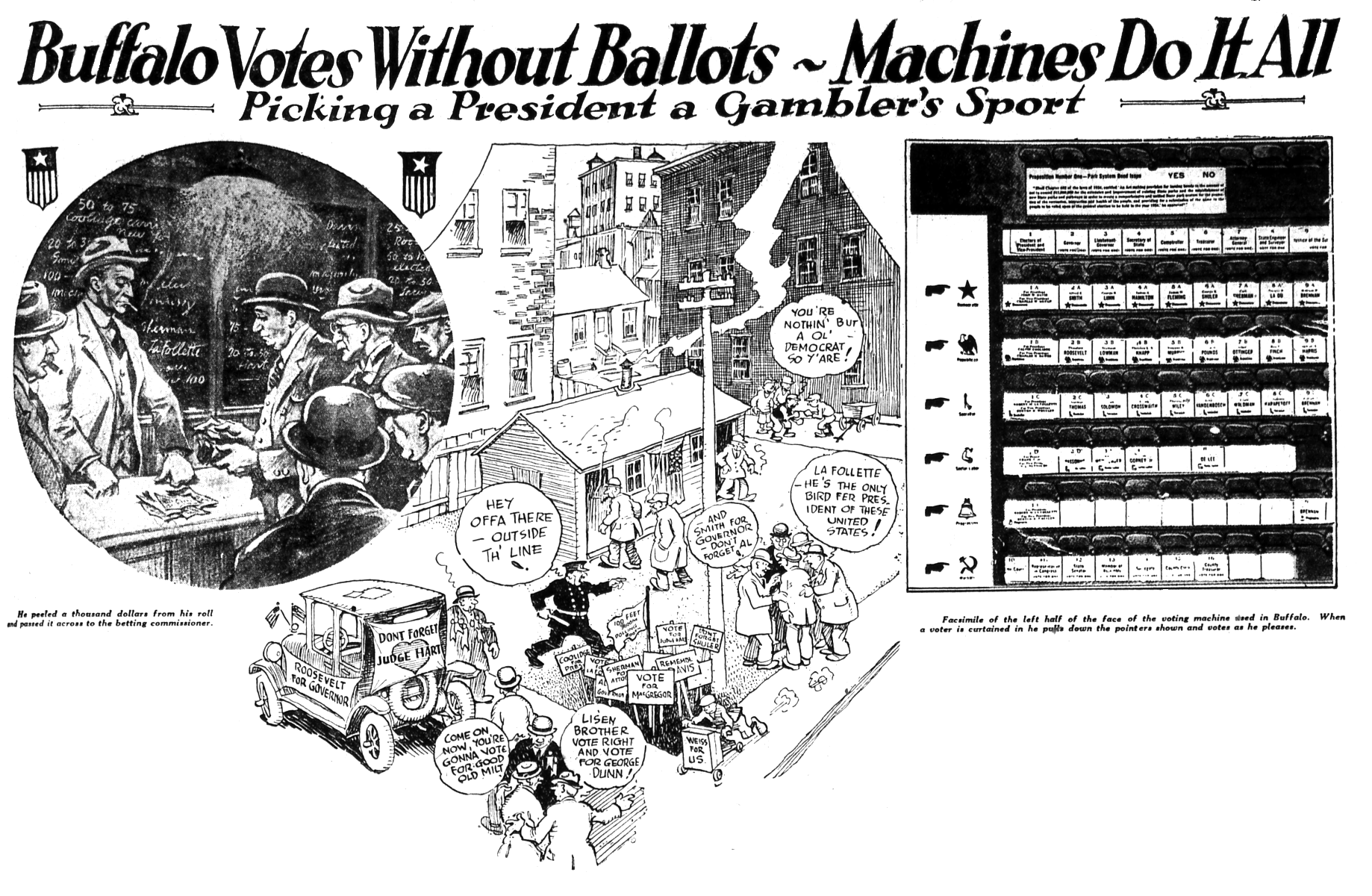
This story (by Fred Griffin) was illustrated by Jim, which was about new voting machines in the United States Presidential Election of 1924. The article noted differences between Canadian and American elections, including American special polling booths, no canvassers allowed within 100 feet, automatic vote counting with machines, and open betting on the results. The illustration mentions some of the candidates running, including Robert La Follette for the Progressive Party, and New York State Governor candidates Al Smith and Theodore Roosevelt Jr.
Unrelated to the article, but on the same page, was a notice that this particular issue of the Toronto Star Weekly would be delivered to subscribers of the Toronto Sunday World, which had just shut down.