The Work of Gregory Clark and Jimmie Frise

Tag: Hunting Page 1 of 3

Cow Country

With a tremendous soaring, joyous sail, the buck leaped into the open, trailing from its neck the wide bright scarlet ribbons of a bow.

By Gregory Clark, Illustrated by James Frise, November 10, 1945.

I’m a realist,” asserted Jimmie Frise tartly.

“With a gun,” I sneered.

“There is enough meat on a deer,” declared Jim, “if properly butchered and stored in one of these cold storage lockers, to last an average family for three months.”

“Yah,” I said, “but how many families would eat venison every day for three months?”

“Our pioneer ancestors,” stated Jim, “lived on it every winter, year after year.”

“One of the reasons our pioneer ancestors worked so hard,” I explained, “was to get away from venison. When you travel around these older provinces and see the work those pioneers did – the fences made of gigantic tree stumps or of massive boulders weighing hundreds of pounds – you often wonder what incentive there was in those days for men to work the way they did. Uprooting colossal pines and dragging the roots over rough ground to make a fence. Patiently digging out boulders and transporting them on stoneboats1 hauled by slow oxen to erect a barrier around their poor fields.”

“They wanted land,” said Jim.

“On which,” I cried, “to pasture cows and sheep and hogs in order to escape from the terrible venison, venison, venison.”

“And porcupines,” added Jim, “and partridge and groundhogs, et cetera.”

“They cleared their fields,” I pursued, “to grow hay to feed the cows to eat the beef to get enough strength to uproot another 10 acres of pine stumps to enclose another field to grow hay to feed the cows…”

“Since when,” interrupted Jim, “have you turned against venison?”

“I haven’t turned against it, Jim,” “I assured him. “All I am pointing out is that venison is a novelty, something you like once or twice in the fall. But as a steady diet it would never do. The average hunter, when he comes home from the hunt, takes his deer to the family butcher, who cuts it up into 20 or 30 parcels, filling two big butcher baskets. The hunter then puts the baskets in his car and drives around in the evening, calling on all his friends and giving them each a present – maybe a roast, a steak, a few chops. To try to justify deer hunting on the ground that it is a big important factor in the meat situation is ridiculous.”

“But all that meat introduced into the domestic economy of the country,” protested Jim, “must have some effect.”

“Unless,” I suggested, “half the people who receive that nice little gift of venison throw it in the garbage or bury it under a rambler rose bush.”

Jim was scandalized.

“A roast of venison, properly cooked,” he declaimed, “is the most heavenly feed a man can eat.”

“How can you properly cook,” I demanded, “a roast of venison that has been abused and kicked around the way the average hunter treats his deer? Amateur butchers, to begin with. They kill their deer and then bleed it, take out its entrails and hang it up in the woods. They are too busy hunting to take proper care of it. The gang they are with are all jealous of the guy who got the deer, so they don’t want to quit hunting and help carry it safe back to camp. No. Hurry up and gut it and hang it in a tree, and come on, let’s get another.”

“That’s true,” recollected Jim.

“So, the deer is left hanging in a tree,” I pursued, “for several days. You get some very mild days in November. Most hunters don’t open their deer up enough to let it cool quickly. So, between body heat held in and a mild spell of weather, the meat sours.”

“You have to hang meat,” protested Jim.”

“But cold,” I insisted. “Then, on the journey home, where do most hunters carry their deer? On the front bumper or the side mud guards! Right up against the hot engine. Or else, on the back bumper, against the exhaust.”

Bird Watchers Increasing

“Where else can you carry a deer?” inquired Jim indignantly.

“The chief function of a deceased buck,” I asserted, “is to decorate a hunter’s car on the trip home, so he can brag and show off before all the citizenry. The fact that he is ruining the meat makes no difference to a sportsman who wants to tie his buck up on the hood of his car.”

“Aw, it isn’t that!” cried Jim.

“What,” I questioned, “after all, is the chief function of the dead buck? Its horns to decorate the sportsman’s den. Its meat to be distributed around among the neighbors as a testimony to the sportsmanship and woodcraft of the hunter.”

“You forget,” said Jim bitterly, “the sport itself. Any man with enough gumption to go into the woods in the late fall of the year and pit his strength and wits against the native wit and strength of a wild denizen of the woods deserves some credit when he gets a fine big buck. Or are you changing?”

“Changing?” I queried.

“Maybe you are turning into one of those sentimental people,” suggested Jimmie, “who can’t understand how men can still be so brutal, in this enlightened age, as to go out and slaughter innocent wild animals.”

“The world,” I warned, “is getting more and more people like that.”

“And nobody,” insinuated Jim, “is likely to be more sentimental than an old hunter who reforms.”

“The day is coming, Jim,” I presented, “when the number of nature lovers is going to exceed the hunters by so much that they are going to put the law on us.”

“There have never been so many gun licenses in history,” countered Jim, “as there are now. In the United States over 11,000,000 gun licenses sold this year.”

“And naturally.” I submitted, “the game is getting scarcer all the time. In the central and southern states, where all the larger game has already been killed off, they make a great sport out of squirrel shooting! Imagine guys by the hundred in some of those central states making a big sporting hobby out of going out squirrel shooting!”

“The great out-of-doors,” propounded Jim, “is something that I sincerely trust will never lose its appeal to the common man. There is nothing so good for the public health as outdoor sport. Instead of making it less attractive for men to go out into the woods and fields whenever possible, the government should make it more attractive by every known means. And a rod or a gun is the most persuasive means of all.”

“Mister,” I said, “maybe you don’t know it, but the number of bird watchers in this country alone has increased 1,000 per cent. in the past 10 years.”

“Bird watchers!” exclaimed Jim disgustedly.

“Yes sir,” I asserted. “People dedicated to going out into the woods and fields with nothing but a pair of field-glasses.”

“Puh,” said Jim.

“They join field naturalist clubs,” I explained. “And they go out, mostly in pairs or small gangs of friends, and tramp the woods and fields at all seasons of the year. They make a game of listing the birds they see. Each member keeps a score. In the spring they have a marvellous time, welcoming back the migrants. In the summer nesting season, they satisfy every craving a man or woman feels for the open air by going out with their check lists and seeing how many birds they can add to their score for the year. In the dead of winter they still go out, on skis, on snow-shoes, on foot; and perhaps the highest peak of their hobby is in the winter. Because the birds that remain are few and very hard to see. But bird watching is one of the most fascinating outdoor sports of all.”

“When I get too old to aim a gun,” growled Jim, “I might take up field-glasses.”

“You miss the point,” I insisted. “All over America the number of people who love the out-of-doors only for the wild things they can see in it is increasing by leaps and bounds. Don’t you see? One of these fine days they are going to resent people killing the wild things they wish merely to look at!”

“I tell you hunting,” cried Jim, “was never more popular.”

“All the more reason,” I assured him, “for an early showdown. As soon as the number of hunters grows big enough to be a menace to the already vanishing wild life, the nature lovers are going to rise up in their might.”

Jim brooded out the window.

“Then,” he said explosively, “what are we waiting for? Maybe we’ve only got a couple more deer seasons left. Maybe this sentimental uprising is already under way. The way the world is now anything can happen. A great religious revival… anything.”

“Jim,” I submitted slowly, “I’m not sure I care about any more deer hunts. Not with a gang, anyway. It’s too troublesome. A big gang. All the cooking and dish-washing. All the bickering over where we’ll hunt today.

“Just let’s you and me go,” wheedled Jim. “I’m not much inclined towards those old hunting gangs myself.”

“It’s a long, weary trip, Jim,” I complained. “A lot of hard work for just the two of us. Suppose we get a deer away back by Crooked lake, for instance? Three miles in from the river, over rocks and muskegs. Imagine us two, at our age, wrastling with a 200-pound buck…”

“I’ve had an idea simmering in the back of my head,” cut in Jim, “for the past couple of years. How about us hunting down here the settled part of the province? I’m told there are more deer in the farming country than there are in the bush north of it. The deer have invaded, the settled areas, living in the bush lots and the odd swamp. They’ve become a positive nuisance to the farmers.”

“They open the season,” I admitted, “in at lot of these southern counties, just to keep the deer population in check.”

“I know any number of people,” cried Jim, “who get their buck every year. And they don’t have to go into the bush at all. They don’t have to travel long distances and live in uncomfortable camps. They don’t have to tramp miles over rock and through tag alders2.”

Farmland Hunters

“How about the risk of getting plinked in a country full of people shooting at their ease?” I questioned.

“Not as risky,” said Jim, “as being plinked by some guy who shoots at anything he sees moving, up in the wilds.”

“Aw, it’s the feel of being in the wilds that attracts me,” I complained. “This deer hunting over farm lands doesn’t appeal to me.”

“But think,” pleaded Jim. “Driving in your car to a farmhouse. Walking over a field to the corner of a woodlot. Sitting down, in full sight of comfortable human habitations, and waiting for a deer to come out!”

“No carrying,” I agreed.

“Heck, cried Jim, “we could simply drive over the field and load the deer into the car.”

“But the tameness of it, Jim,” I muttered. “Like shooting a sheep.”

“I tell you what we could do,” said Jim eagerly. “We don’t have to hunt in the actually settled counties. We could go up to the edge of the farm country. Right on the edge of the woods belt. Lots of farms. Lots of good roads. Plenty of conveniences and comfort. We could sort of compromise between the wilderness and the civilized farming country.”

“Do you know of such a place?” I inquired. “Dozens of them,” assured Jim, “in Muskoka. All over Haliburton. The summer resort country is full of roads and farms. We don’t have to go into the unexplored wilderness to find deer.”

“But,” I sighed, “I’m not sure if it is deer I want. Maybe that’s just the excuse for getting into the wilderness.”

“Aw, try it,” urged Jim. “Let’s try it this once. Let’s agree that if we can get good, fresh meat to add to the national food supply this year, we’ll get it where we can immediately take care of it, with good roads handy to it straight to cold storage…”

“Jim,” I protested, “nothing good ever comes of framing up a lot of false motives. Let’s face the facts. Are we going deer hunting for the sake of the national meat shortage? Or because we’re just a couple of tough old sports who want to shoot off guns at running targets?”

“Both,” declared Jim.

So we pooled ideas over a road map of Ontario and decided on a country not 100 miles from Toronto, but which is still in the northern area open during the normal deer season.

It was, in fact, one of the most settled districts in all that northern fringe of farming country. But we could tell, by the bare spots on the road map, without paved highways and with sparse villages, that there were plenty of swamps, woodlots and wilderness areas close to the farming districts. And plenty of streams.

“I never heard of anybody ever doing any deer hunting there,” said Jim. “And obviously it’s a good deer country.”

There is something about arming for a deer hunt that must waken deep, subconscious memories in all men. Even though he is taking a modern high-power rifle into the woods to shoot at a perfectly innocent and beautiful animal, a man always feels more manly when he loads up his car with supplies and equipment for a journey into the woods.

If the morals of it are to be debated, I can always quote the innocent lambs and calves that we raise up in all tenderness, only to knock them on the head with a mallet or cut their throats. Some people can detect a clear distinction between a lamb deliberately raised for slaughter and a deer that comes to its death by a bullet. But I can’t. In fact, my sympathy goes to the lamb. Because the deer is a pretty clever, gifted and resourceful animal who at least has a run for his money. Whereas a lamb is taught to come when called.

With a fairly large percentage of the old familiar feelings of going on the annual November warpath, Jim and I set forth on our three-day deer hunt. We made it that short because we were pretty sure of our deer. We dressed in the old familiar wilderness clothes, though we were going to sleep in a good town hotel each night. We wore our hunting boots, though oxfords would have done for walking over stubble fields. We donned our heavy woollen underwear, because sitting on a rail fence in the corner of a farm pasture was likely to be just as chilly as sitting on a runway in some far northern wilderness.

We drove on good concrete highways through factory towns and prosperous villages, gazing fondly on them as we passed, with that sweet hunters’ feeling of leaving all this behind, and joy before.

We came almost imperceptibly into the country where cultivation starts to decline and the wilderness to linger. The woodlots to grow wilder and larger. We reached the town which was to be our base, and there spent the night. It was the kind of hotel where they still give you pie for breakfast.

Before daybreak we were disturbing the frosty silence of the town by taking our car out of the barn at the back. Before the first streak of day we were speaking to a farmer with a lantern at his pump, asking permission to walk across his fields and take up our stand at the corner of his woodlot. Our map had shown this to be a corner of a swampy tract of forest that stretched for several miles north into the real woods. At crack of day were hidden behind a snake fence and heard far off the first race of hounds. And the first shots.

There were many other hunters out. Far to the north, a pack of hounds, larger than the law allows, gave tongue for half an hour before their voices grew so faint they vanished into silence.

More than three hounds there,” whispered Jim, as we watched across the dawning meadows and along the frost-wet, colored brushwood of the forest.

“You can’t prevent,” I explained, “two or three different parties of hounds ganging up when one of them raises a deer.”

To the west, a lone hound gave tongue and brought something down through our woodlot to within a few hundred yards of us, and Jim and I sat with rifles ready and safety catches off. But it

was a fox that broke cover and went, with lazy waving brush, out over the pastures, while 200 yards behind him, never looking up from the earth, but yodelling mournfully with his nose enjoying the hot tracks of the fox, came an old fat hound.

Before day was fully broken we heard many shots, far and near. And we knew fellow hunters were trying for something, whether deer or otherwise could not be said: because a man with a gun is tempted.

Then, about 8 o’clock, from the misty north, came faintly back that lovely music of the pack of hounds. There is no music like it, unless it is the first wild geese coming from the south in spring, or that passage in Sir Edward Elgar’s “Enigma Variations,” which he portrays the running of hounds3.

“They’re coming this way,” hissed Jim.

“They’re miles away,” I retorted.”

“They’re in this very woods,” insisted Jim through his teeth. “At the far end of it. About two miles.”

“The bush is full of hunters,” I assured softly. “It’ll never come this far.”

Music of the Hounds

But as we harked, the melody of the hounds was increasing in volume every instant. You could make out the high bugles of some of them and the deep, belling sounds of others with fuller voice.

They would fade away, as the pack ran behind a hill or into a swamp. Then the music would rise, as the hounds came round the hill or got on to higher ground.

“Just in case, Jim,” I suggested, “let’s stand there in the open where we can get a fair shot, if it should come this way. It might break out across any of the fields…”

We took our stand facing both sides of this tag end of the long belt of woods.

“It’ll be a buck,” shivered Jim, who always gets the shakes when this moment comes.

“The way it twists,” I agreed, hoarsely. I always get choked up at this moment.

Faded went the tumult. Up it rose again, very near, as the hounds breasted a ridge in the woods. We prayed that no other shot would interrupt this dream. You could hear the yammer of hounds squealing with the heat of the scent and, tangled in the clamor, the deep tolling sound of glorious old hounds of the joyous type that date their ancestry back to the time of Richard the Lion Heart.

We both began to shake. It is buck fever, the best fever there is. Our hands were numb. Our hearts thudding in our ears.

But even so, we heard the crack and crash of some mighty animal going high and wide in the woods to our left. We raised our rifles. We extended our trigger fingers ready to close. The hounds were babbling so near and so frantic we knew now that this was our hour.

Amid the colored mystery of the brush something swift, gray, fawn and with a fleeting sparkle of white flashed. It was coming straight out to us. Our trigger fingers began to close.

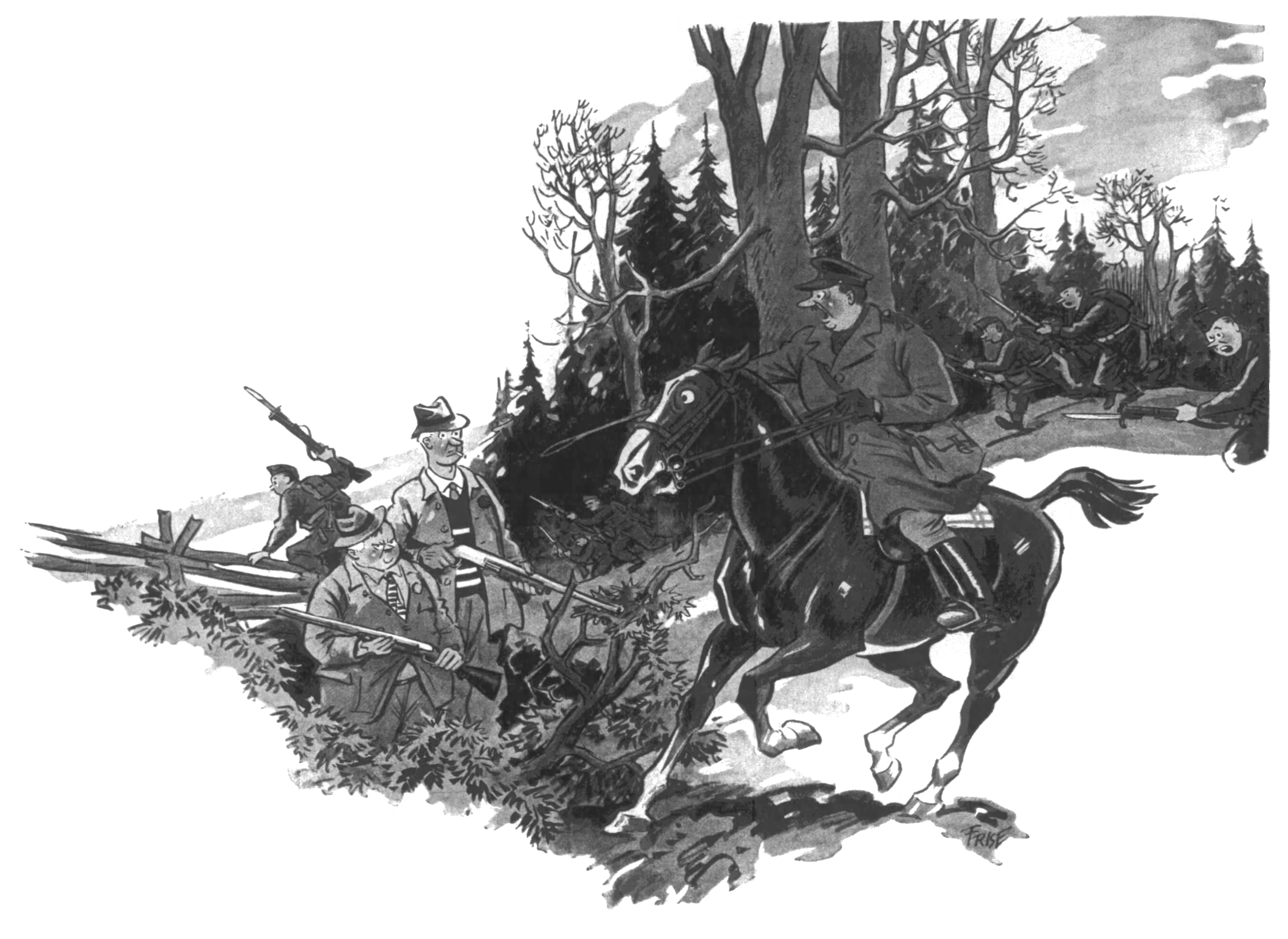
With a tremendous, soaring, joyous sail, the buck leaped into the open, trailing from its neck the wide bright scarlet ribbons of a bow, 10 inches wide, tied fetchingly under its chin.

As it passed it flashed us a wide, genial glance; its mouth seemed parted in a grin – the friendliest expression imaginable.

After a short loop out into the pasture, where it paused an instant and listened, with pricked ears, to the oncoming hounds, with all the airs of somebody playing a game – it bounded silently, in those indescribable floating movements of a deer, back into the woods.

The hounds came boiling out on the scent, frantic, heedless of us, their tongues flapping, their voices strident.

Before we could catch our breath they were already fading away back up the way they had come.

“One of those sentimentalists,” said Jim, unloading his rifle. “Probably the pet of some joker…”

So we sat and listened for the rest of the morning to the distant, mysterious sounds of others.


Editor’s Notes:

  1. A stone boat a type of sled for moving heavy objects such as stones or hay bales. ↩︎
  2. A tag alder is a shrubby tree that can be a common sight in swamps and wetlands ↩︎
  3. Which variation? He probably means variation XI “G.R.S.” ↩︎

Blind Date

“Now that’s too much,” said Jimmie rising to his feet in the stern… “I’m going to tell the warden they threatened us.”

By Gregory Clark, Illustrated by James Frise, October 28, 1939.

“Though the heavens fall,” declared Jimmie Frise, “we ought to get one day’s good duck shooting.”

“We should fiddle,” I muttered, “while Rome burns.1

“No good purpose,” stated Jim, “will be served if everybody in the Empire goes gloomy. The secret of morale is a high heart.”

“Mister,” I warned, “we are fighting a totalitarian state. Every atom of energy, men, women, boys, girls, the weak, the strong, all the energy of the enemy is being directed against us.”

“So we should waste our energy,” retorted Jimmie, “by sulking at our desks. By sitting and brooding.”

“We can cut out all idle waste.” I submitted. “Waste of gas and oil in going some idle place. Waste of powder and shot shooting at ducks. Waste of time that we might better employ in some war work.”

“Name it,” suggested Jim. “Name some war work we can do this week-end. Will we knit socks? Will we go and walk the streets, tapping young men on the chests saying, ‘How about it, young man?’ Your know as well as I do that more men are ready to enlist than they can accommodate right now. You know that war work is going on in a thousand places, high and low, that factories are being geared, that women are organizing into knitting clubs. War work has to grow, like something strong, like an oak tree, like a lion, slowly, atom by atom, stage by stage. There is no greater waste, no more dangerous waste, than the frenzied and excited effort of undirected enthusiasm – the desire to be doing something for the sake of doing.”

“I feel,” I stated unhappily, “that we ought to be doing something. I’ve had a feeling for weeks that we are letting priceless time slip by.”

“Look,” said Jim. “War is like an industry. Let us say the war is like a new factory opening up in a town. Does the manager of the factory, on the day it opens, blow a whistle and call all the townsfolk in and say to them, ‘Get busy, start work, let everybody sail in now with all he’s got?’ Does he say that? No, sir. When that new factory opens up, first comes a skeleton staff to set up the machinery and to assemble the raw materials. Then a small crew of workers is taken on to start the machinery and test out the materials. It takes weeks, months, for a factory to get going at full production. It’s the same with a war. That is, in a peaceful country that hasn’t been gearing for war all along.”

“Ah, but we’re fighting a country that has been gearing up all along,” I reminded him.

“All the more reason,” claimed Jim, “that we should organize with the utmost caution, the utmost clarity of mind and purpose. Suppose we did jump in like madmen and start enlisting men by the hundreds of thousands, and ordering all the factories to begin one hundred per cent. production of clothing and arms and equipment, where would we be in six months?”

“We’d probably have a good big army,” I stated. “And plenty of material.”

“And,” said Jim, “according to all past experience, such as Russia in the last war, and countless other examples that are on file in the offices of every intelligent ruler on earth, we would have a big, ill-equipped army, the factories of the nations would be packed with hastily made goods, and the country would be broke.”

Building a Hide

“Still, we ought to be doing something,” I sighed.

“Let’s go duck shooting,” repeated Jim.

“It seems wicked,” I protested.

“If it did nothing else,” stated Jim, “it would revive our spirits. What is the chief difference between the Germans and the British? We are both energetic. We are both capable of a tremendous patriotism. We both love leisure and a good time. The Germans love to sit in beer gardens and sing songs and talk philosophy. But the British like to play games. Why should we turn German now, and sit around, gassing and brooding and talking dummy politics? Why not stay British, and go and play games and shoot ducks and be natural? We’ll win this war because we are British, not because we have turned German.”

“One of the first maxims of warfare,” I informed Jimmie, “is to study your enemy, his nature, his character, his weaknesses of temperament and disposition.”

“Correct,” agreed Jim. “Why aren’t the Germans flying over Britain dropping leaflets?2 Because they know that all the British people are too busy playing football or hunting foxes or digging badgers or poaching salmon, in between drilling and working in factories, to bother picking up leaflets. Whereas, it is good policy for the British to drop leaflets to give the Germans something to gas about while sitting in the beer gardens after hours.”

“I would prefer,” I insisted, “to spend the week-end out at the rifle ranges, practising rifle shooting to amusing myself shooting at ducks.”

“Okay, then,” said Jim. “I was merely making the suggestion.””

“Now that I come to think of it,” I proffered, “rifle shooting is pretty old-fashioned. Modern warfare, with its flying machines and its fast tanks and so forth, calls for a different sort of shooting than aiming with a rifle at a perfectly still bull’s-eye.”

“Army rifles,” agreed Jim, “were designed for one soldier to use, lying down, shooting at another soldier lying down.”

“Wing shooting,” I continued, “bring with a shotgun at flying ducks, for example, is the most modern training a man could undertake. In fact, all soldiers ought to be trained at shooting at either wild ducks or partridge, or at clay pigeons, so as to teach them the art of timing, of swing, of leading a moving target. In modern war, all targets are moving.”

“You’re quite right,” said Jim expectantly.

“What a wonderful training,” I cried, “if all our boys were taught to shoot ducks on the wing! What chance would airplanes and fast tanks have against men schooled to wing shooting!”

So we went duck shooting last week-end, as you can surmise. We went to our old familiar haunts, arriving at the farmhouse which is our lodging on duck hunts, and it being a very soft, still, fine evening, and no ducks flying at all, we spent the first night building a hide. The trouble with most duck shooting excursions is that you are too eager. You dash out into the marsh the minute you arrive, and place yourself in some hastily constructed hide, a few bulrushes, a few wisps of grass, and no self-respecting duck would come within a mile of you. What a duck hunter needs is a real blind, a hide built of cedar boughs, rushes, grass, so skilfully woven and pieced together that it looks like a natural little island in the bog, and the body of the hunter is wholly concealed.

Their Favorite Point

A good hide should also be comfortable. It should have a good footing or floor, a good seat for the sportsman to sit on, well down out of sight; and it should be so woven that it is a shield against the cold, windy weather that is the best for ducks.

“And,” I said to Jimmie as we worked at our splendid new hide, “here is another point that should make duck hunting part of the training of the modern soldier. It teaches the art of concealment, of camouflage. Duck hunters knew all about camouflage a hundred years ago, while the armies of the world were still marching into battle over open fields in bright scarlet and blue uniforms.”

So we felt our consciences easy as we toiled in the fading sunlight of a soft and lovely day, far too nice for the ducks. We laid planks for a footing. We drove boughs of cedar and balsam deep into the mud of the boggy point which was one of our favorite shooting spots. We wove rushes and grass in amongst the boughs, and Jimmie, being an artist, fastened tufts of marsh grass in the camouflage most artistically, so that our beautiful new hide was a wonder to behold.

“The probs,” said Jim, “are cold and north-west breezes for tomorrow. I can feel the change of weather coming, can’t you?”

“I bet the wind will spring up in the night,” I replied, “and tomorrow will be a classic duck shooter’s day.”

Back at the farmhouse, we spent the traditional duck shooters’ evening, sitting around the kitchen stove with the farmer and his wife talking about everything but duck shooting, Jimmie and I explaining all about the war and how it came about and how it will end. And we went upstairs to bed in the slope ceilinged room at 9.30, so as to be up before the break of day to set out our decoys by our beautiful new duck blind.

And it was before the break of day we were waked by the farmer and went down in our rubber boots and oilskins to a lamplit breakfast of country bacon, fried potatoes and pie, and so out under frosty stars to find the night waning with a sting in it, and a light breeze blowing fog wraiths, and a smell of ducks in the air.

Into the punt we crept, stumbling amid the decoys, and across the bay we rowed to the shadowy outline of our favorite point and our lovely new hide.

Furtive sounds came to our ears, as other hunters took their stands in the darkness. We knew the moment well. For a half hour, these faint sounds would come, faint knocks and thuds, as decoys are tossed out, as oars are shipped, as punts are rammed into the reeds. Then would follow a little time of deathly and breathless stillness until the first faint pallor of day began to creep. Then would come the whistling wings, the swift, rushing flight, the wheeling of half-seen objects in the air, and then the bang-bang of the, guns, faint, far and near.

It is a lovely hour, better even than the firing into the set-winged ducks, the startled, leaping ducks.

As we neared our precious blind, I thought I saw ducks already scattered about the point.

“Psst,” I said to Jimmie, who was sitting in the stern.

He was leaning forward peering into the murk.

“It’s decoys,” he hissed. “Somebody must be in our hide.”

“Aw, no,” I groaned.

Getting a Surprise

I took a few powerful strokes, but we were, indeed, too late. As the prow of the punt rammed the weeds, out of the hide, our precious, artistic, hand-made hide, rose two shadowy figures.

“Buzz off,” said a low voice at us.

“You’re in our blind,” said Jim.

“So what?” said one of the large looming figures.

“We built it less than 10 hours ago,” I said, low and harsh.

“So what?” repeated the stranger. “We’re in it, so what?”

“You will kindly get out of it,” said Jim firmly.

“Since when,” asked the low voice, “have points of land on wild lakes in the public domain become private property?”

“We built the hide,” I retorted. That lays claim to the point for us.”

“Under what law?” inquired the stranger levelly. “Come on, buzz off. The birds will be flying in a minute.”

“Under the law of sportsmanship,” I declared. “We’ve been shooting on this point for 15 years.”

“Then under the law of sportsmanship,” inquired the stranger politely, “don’t you think it’s about time you let somebody else have a chance?”

“Listen,” said Jim, resolutely, “we came here and built that hide last night. Now you guys get out of it. Come on. Get the heck out of our hide.”

“If you guys don’t get out of here,” said a second voice, a loud, strong, businesslike voice, “we’ll chase you out of here. Come on, stop bothering us.”

When dawn. comes, it comes fast. We could now make out more clearly the shapes of the two interlopers. And they were rather large, young, powerful looking individuals, they held their guns in the crook of their arms and they seemed to be swelling up slightly with a slow anger.

“We ask you, once more,” grated Jim menacingly, “will you get out of our hide?”

“The answer is,” said the tallest, “no.”

Jim sat down angrily and pushed back with his paddle. With angry oars, I jabbed the chilly water and started to back away from the point. At a distance of 20 yards, I relaxed my furious rowing and said to Jim:

“Now what do we do?”

“I tell you what we’ll do,” declared Jim, grimly. “We’ll stay right here and row round and round, so that not a darn duck will come near these birds. And if they want to know what we’re doing, we’ll tell them we are looking for a place to build a hide.”

“Why Didn’t You Say So?”

“Okay,” I agreed grimly. So, in the lightening dawn, I proceeded to row noisily around in the neighborhood of the point.

In about three minutes, a voice hailed us.

“If you birds don’t get out of there,” he called, “we are liable to mistake you for ducks. Accidents will happen to guys that row around in punts after the ducks start flying.”

“Now that’s too much,” shouted Jim, rising to his feet in the stern. “Row in there. I’m going to demand to see the licenses of these birds. I’m going to take down the numbers of their license buttons3 and, by golly, I’m going to tell the game warden that they threatened us.”

I rowed in.

“I’ve got witnesses,” declared Jim hotly. “There’s plenty of others in this bog heard you threaten us. I’m going to report you, and I want to see your license buttons.”

“Okay, buddy,” replied the voices. “Come right in. The sooner we get rid of you, the sooner we may see a duck.”

We rammed the punt right in alongside. It was light enough now for us to see their faces. They were handsome kids. Big, ruddy country looking boys. The nearest one opened his canvas coat and showed us the red hunting license button on the lapel.

But underneath the coat, the unmistakable drab gleam of khaki showed, and the trim, snug collar of a military uniform.

“Hello,” said Jim, lamely, “soldiers?”

“So what?” said the same amiable voice.

“Are you both soldiers?” demanded Jim. The other boy peeled back his hunting coat collar and grinned up at us.

“Well, ah, aw, well,” said Jim, speaking for both of us. “How do you get duck shooting when you’re soldiers?”

“We got the week-end leave,” said the one standing, “to get maybe the last duck shooting we’re going to get in a long time.”

“Well, why didn’t you say so?” cried Jim heartily. “What the Sam Hill, why, doggone it, why, what the…”

“You’re mighty welcome to our hide, boys,” I said, seeing Jimmie had run out of things to say.

“Look,” said the one sitting, “we didn’t want to pinch anybody’s blind. But we haven’t much time, and we just grabbed the first point we came to. They’re all free, after all. We didn’t realize what a swell blind this is, until now… the light…”

But I had shoved the punt free and was already handling the oars.

“Listen, boys,” said Jim, “it’s a pleasure to build a blind for you. It’s a pleasure. Any time you can get off, just let know…”

So we rowed away, and we rowed all around the bay and out past the big islands, and around points, past a lot of other blinds where indignant gunners demanded what the heck we were trying to do, and we scared up all the ducks we could see, and we chased them so that they would fly over the blind on the point, the best little duck blind we had ever built in our lives.


Editor’s Notes:

  1. This story came out only a few weeks after Canada declared war on Germany. ↩︎
  2. Though it seems inexplicable now, starting in September, most of the Royal Air Force’s operations consisted of airborne leaflet dropping rather than bombs. ↩︎
  3. A sample of a licence button can be seen here. ↩︎

Is This a Cow?

November 26, 1932

By Gregory Clark, November 26, 1932.

We have got some inside information, a scoop in fact, to the effect that the Ontario government and the Hon. Mr. Challies in particular are sick and tired of the shooting question and have decided to do with the sportsmen what they have done with the motorist.

They are going to make him pass an examination.

A shooting license, like a driving license, will have to be earned as well as bought.

The way things are now Ontario is a fairly law-abiding community for ten and a half months of the year. Then all of a sudden, in October, about forty thousand men get a touch of frost on their pumpkins, or something, and they snatch up their weapons and go skirmishing in all directions.

They have a few days after partridges and pheasants, during which chickens, ducks, pet dogs, cows, horses and hired men are shot in large numbers.

During the deer season, when high-power rifles loaded with dum-dum bullets are fired off all over the summer resort regions by some thirty thousand hunters, other hunters, horses, cows and porcupines are amongst the trophies. Roofs are punctured, boats are sunk, countless bottles are burst to splinters, tin cans scuppered and out-houses perforated.

Our information is to the effect that the government is going to put an end to all this. It is going to educate the sportsmen.

Night school classes are to be organized all over the province, unless our information is wrong, and every man who hopes to take out a shooting license next season will have to win a certificate from school before he can be issued a permit to shoot.

The schools are to be run on the well-known kindergarten system, with pictures being the secret of the method.

“This Is A Cow” will be inscribed on a large lithograph of a cow. Sheep, horses, chickens of all plain and fancy breeds will have to be memorized. A suggestion has already been offered the government that a well-known German song, sung by ‘Varsity students for half a century, might be employed. “Ist Das Nicht Ein Schnitzelbonk?” is the name of the song. The teacher, using a pointer, sings:

“Is this not a mooley cow?”

And the sportsmen’s class, all in happy unison, sing back:

“Yes, that is a mooley cow.”

Chorus:

“Oh, you lovely,

Oh, you pretty,

Oh, you darling mooley cow!”

And so on, through the quadrupeds, fowls and other creatures that Ontario city and town hunters are not yet thoroughly familiar with.

War in Niagara Peninsula

This system has a great deal of merit in it. As it is now, pheasant shooting down in the Niagara peninsula is sadly in need of rousing music and song to make it real warfare. The platoons and battalions of pheasant shooters, as they march across the fields and vineyards, could sing these college songs, rousingly, as they advance to the attack. It would give a fine martial tone to the pheasant shooting which is all it lacks now. The captains of the shooting parties could watch out for domestic and agricultural animals, and whenever one is spied they could shout out:

“Is that not a Plymouth Rock?1

“Yaw, dot iss a Plymouth Rock.”

Altogether:

“Oh, you lovely,

Oh, you fatty,

Oh, you sweety Plymouth Rock!”

And another innocent life would be spared.

On taking the full course of sportsmen’s night school the attentive pupil will be awarded a diploma, which indicates to an anxious rural population that the graduate is entitled to affix the initial. B.S. after his name, meaning Bachelor of Sport. He knows the main broad principles in distinguishing between a tame duck and a cock pheasant and between a Holstein cow and a deer. It would not take in Lou Marsh’s wambeazle2. That is a post-graduate course. Pupils will be trained to hold their fire whenever a wambeazle or other unspecified animal leaps out in front of them.

When Canada raised its army of 500,000 men it was supposed that this being a new and pioneer country the art of shooting would come readily to Canadians. But the fact

was that just as much time had to be spent patiently dinging the simple laws of marksmanship and care of arms into Canadians as into Cockneys from Bow Bells.

It took weeks to train any company of men to handle their rifles safely. Then it took weeks more to get them to hold their rifles in such a way as to hit the target if they could aim. Then they were taught aiming.

And when everything was finished about ten in a hundred could get into the bull.

However, despite this knowledge of the facts in regard to shooting, Canadian law allows anybody who has the price to buy any kind of gun or rifle he likes and to go gunning for any kind of game he can afford, from artificially planted and reared pheasants in the most densely populated agricultural district in Canada to wallowing after moose north of the Transcontinental.

The modern pump gun in the hands of an expert will fire five shots so fast that five ducks, travelling at the rate of seventy miles an hour, will be blasted down out of the air by powerfully driven loads of scattered shot reaching out sixty to seventy yards. The modern rifle, such as the .270 Winchester, is far more powerful than any army rifle, shoots an explosive bullet so fast that in travelling two hundred yards it rises only two inches above the line of sight. Twenty-five thousand deer hunters this season tried to scatter themselves far enough apart to escape any danger from these modern whizz-bangs. And they didn’t altogether succeed.

To Bring Gunners Under Control

So far the government has touched everything to control hunting but the hunter. It has banned dogs. It limits the number and kind of game that can be shot and the days on which shooting may be done. But it hasn’t said anything about who can shoot. You are tested to be a car driver. You are bonded to be a bank clerk. Educated to be a doctor. Examined to be an engineer. To take up an aeroplane and endanger only yourself you must go through a fearful rigmarole with two governments. But to take out a stick of dynamite in the shape of a modern gun or rifle all you need is the price. It took months to make soldiers even moderate marksmen.

But an army of deer hunters, most of whom never have their rifles out of their cases except on the one or two-week hunting trip, with soft muscles, jumpy nerves, buck fever, goose flesh and wet feet, are entrusted with the responsibility of slaying Ontario’s game neatly and humanely, as licensed experts with the gun. It can’t be done.

The whole thing is very complicated and grows no less complicated with every year’s increase in the number of shooters.

The situation respecting the shooting of pheasants and partridge in the agricultural districts of the province appears to be reaching an impasse.

One solution offered eight years ago and never recognized is this: that the government. oblige all bird shooters not only to have a government license but a permit signed by the owner of the land on which they are shooting. The license itself could be large enough to have on its reverse side a form of permit, with several spaces for signatures. If shooting on wild or crown land no permission would be required. But in the Niagara peninsula, before invading any private property – and there is no public property on which to shoot there – the gunners would have to obtain the signature of the owner. It would be trouble, of course. Plenty of land-owners, when faced with the request, would refuse. To-day hundreds of farmers and fruit growers would prefer to have no shouters banging about their lands, but are afraid to interfere for fear of being considered poor sports. Hundreds of others have posted their land who would be perfectly willing to permit shooters to kill a few pheasants if those shooters came in straightforward fashion and showed themselves and asked for permission – or paid for it!

Why should not the farmer be paid for the nuisance and the damage done to his land by the shooters or to his fruit crops by the pheasants? A farmer who charges for the privilege of fishing for trout in his brook is not a poor sport. He is simply taking steps to keep the mob off his place and also to make a little rightful money. It is true the pheasants were planted by the government. But it is doubtful if the farmer, on whose land the pheasant subsists, was consulted by the government. If the farmer likes pheasants on his land, the government certainly has no privilege to admit shooters on to private land. If the farmer does not like the pheasants on his land he should be privileged to do as he likes about it.

But of all the rational means of bringing several thousand gunners under control the simplest seems to be the hundred per cent. posting of all land in the pheasant country and then the demand, by the government, not by the land-owners, that everyone who shoots on other than his own land, obtain a signed permit of the land-owner.

Twenty-five men in cars, working from telephones at strategic points, could put this law into effect in such fashion in one season that the present ruthless, reckless, rowdy and unsportsmanlike system – perfect for the local sportsmen who have the inside dope, just a panic for the outsiders – would be cured in one year.


Editor’s Notes:

  1. A Plymouth Rock is a type of chicken. ↩︎
  2. Lou Marsh was the sports editor for the Toronto Star at the time. The must of been some lore related to the “wambeazle” at the time that I’m not understanding. ↩︎

Deer Hunting! Never Again!!

November 15, 1919

By Gregory Clark , November 15, 1919.

Of the false joys of deer hunting, several hundred Toronto men are by this time wholly aware.

As far as one can make out, deer hunters are like drink addicts or dope fiends. After each hunting trip, they swear off. Never again for them. Nevermore will they desert the comforts of a large city for two November weeks spent amid slush, sleet, and vast uncultivated areas of fallen timber and prickly underbrush.

But when the first hint of sleet is in the air, the confirmed deer hunter seizes his rifle, some old clothes and a dunnage bag, and jumps the first train north.

To-day and for the next few days, however, they are returning with the “never again” expression on their faces, tired, starved, weak and unshaven. However, they try to disguise their real feelings, they are as fed-up as troops coming out of the line after a twenty-one day tour.

Jimmy and I know, for we have just returned from our first hunting trip.

Back in September, egged on by the boasting of certain confirmed deer hunters around the office, we started to make plans. We invited half a dozen others to join our party, and all these gave a delighted acceptance. But on the eve of November fifth, the opening of the deer season, to our astonishment, they all advised us in regretful accents, of their inability to come with us. It isn’t our astonishment now.

Alone and full of high hopes, Jimmy and I set off for our summer cottage for the hunt.

Passing over as immaterial our arrival at a Georgian Bay town, our wrestling with dunnage bags, rifles, and those odd articles of baggage that always seem to get themselves carried at the last moment, our early rising in a frost-bitten hotel and our journey by gasoline launch (at twelve dollars1), over the Arctic expanses of the lower Georgian Bay, we arrived about noon, at our summer cottage. Gone were all the balmy green trees, the warm rocks, the soft blue waters. Our summer cottage was a draughty, bleak little building standing forth naked amid a few bare trees, with frost on its roof. There was ice along the beach where, four short months ago, I was wont to paddle my feet.

After a short inspection of the inside of the cottage, inhospitably packed up for the winter, we decided to shift a couple of camp stretchers into the kitchen and there to cook, eat, live and sleep.

We carried a half-ton rowboat out of the dining room to the water and rowed down to the farm of a French family, about a mile away, to arrange about going after deer. After due consideration, the French family agreed to quit work on the stone foundations of a new house and come hunting with us.

Jimmy and I had vague notions that in hunting deer, we walked through a pleasant autumn forest, with hounds stepping gracefully in front of us, ever and anon scaring up startled deer, which ran in terror from us like young cows, while we stood back and fired carefully aimed shots after them, killing them in their tracks.

What deer hunting really is comes as follows:

Three hours before dawn, the kitchen fire having been out some hours, the frigid breezes blowing through the cracks of the cottage wake us from our fitful slumber. We rise in very grumpy spirits, put on a fire, sit disconsolately around while we prepare a breakfast of canned beans, brittle bacon and tea. Then we array ourselves for action, go down to the rowboat and crack the ice in the bottom of it and row, on chilly seats, down to our guides just as dawn pales the east.

At our guides’ they remove our dashing khaki hunting coats and give us old blue coats several sizes too large.

“No good being mistook for a fawn,” we are told.

Then we commence to walk. Up hill down dale, over rocks, through swamps and impenetrable forests we go. And although it is a bitter November day, with sleet biting us, we perspire richly.

After tramping for an hour and a half, till our fine new hunting boots are scraping the flesh off our heels, we are halted on a high, open stretch of rock, where the wind howls in freedom, and the fine sleet spins and eddies past us. We are told to stand very still and watch up this stretch of rock. Jimmy is placed across a gully on a similar ridge

The hound has meanwhile been taken in a long detour away off in the distance.

We stand in a position of readiness, our rifle at the alert. The perspiration soon freezes to our skin. Our fingers grasping the metal of the rifle grows numb and senseless. Our feet feel like blocks of ice. But we Keep a stern eye up the ridge.

Quarter hours pass that seem like hours. An hour passes that seems like a day. We commence to shiver quite violently, and stamp our feet on the rocks, while our attention wavers.

Suddenly, far in the distance, we hear the baying of a hound.

Our shivering turns to a regular shaking. It is uncontrollable. Our hands seem like feet. We make a pitiful attempt to come into a position of readiness. The hounds’ barking grows, nearer and nearer.

Then, with no sound and with no movement of the bushes a greyish brown form trimmed with white appears ahead of us.

It moves like a wind-blown leaf. It does not seem to touch the ground. Nothing on earth moves so swiftly or so gracefully or so silently.

Like a streak of lightning it passes us within twenty-five feet, a great white tail waving bravely.

The howling dog appearing at the far end of the ridge wakes us from our trance. A fine big buck has passed!

We are still shivering violently and in a mental daze when our guide dashes up out of the underbrush and yells–

“Why didn’t you shoot! Why didn’t you shoot!”

“Shoot what?” you ask weakly.

“That deer! It went within a few feet of you!”

“Shoot that!” you cry indignantly. “Say, what do you think. I am? An aviator?”

Well, after four or five repetitions of this tramping through wildernesses designed for mountain goats and cringing on bleak Alaskan plateaux till our bodies feel about to fall to pieces and a warm fireside seems the furthest thing in the universe; and after four or five deer have gone past us or over us before our feeble minds could grasp their presence, we finally control our mechanism sufficiently to pull the trigger viciously just at that furious moment the great, soaring buck sails past. And by some miracle, he leaps fair in front of your bullet and crumples pitifully and tragically into a slim little brown heap on the ground.

A live deer is a big, splendid, graceful, beautiful creature. A dead deer is as pitiful a little thing as a dead rabbit.

But when you tie his four knees together and lift him up on a pole to carry him two miles to the nearest water, he is neither little nor pitiful. He weighs over two hundred pounds. He sways and swings on the pole as you walk. The first fifty yards is the dickens. The second fifty yards is an inferno. After that you lose consciousness of all human feelings and just struggle along. Where the rocks and bush were rough before, they are mountainous when carrying out your deer. Where there were open spaces to pick your way before, these all magically close up into jumbled ravines and frozen wet swamps, as if in protest against the killing of a king of the forest.

Scarce remembering our names or standing, we at last reach the river and a motorboat. In it we sit and freeze on the journey back to the summer cottage. How warmly we pictured this return with the venison! How cold the actual performance left us!

Ah, well, it may have cost us something in pride to find what deer shooting was. But we didn’t do as badly as the three American hunters, who came up to these parts to shoot moose. No silly little deer for them! Moose or nothing. And hardly had they entered the bush when they saw three large dark brown animals on the shore of a lake. With deadly aim, all three hunters fired, and killed our French settler’s three horses. To avoid aspersions on their reputations as hunters rather than to account for the damage to the Frenchman’s property, these three New Yorkers paid five hundred dollars each2.

As for Jimmie and I, we will go deer hunting never again.

But when we do, we are going to take valets along to carry fur lined garments for us; and a larger party, to help bring in the meat.


Editor’s Notes:

  1. $12 in 1919 would be $195 in 2024. ↩︎
  2. $500 in 1919 would be $8090 in 2024. ↩︎

Cat-Tail Bog

“Hye!” roared Jim, and the punt gave a wobble. A big fat mallard had jumped from the bog behind us and nearly collided with my umbrella.

By Gregory Clark, Illustrated by James Frise, October 2, 1937.

“At last, cried Jimmie Frise, “I have everything set to take you duck hunting.”

“Not me,” I assured him.

“Listen,” said Jim earnestly, “I’ve built the swellest duck blind you ever saw. I spent the whole week-end building it. It’s on the one point in the whole, bog where, you might say, every duck from Hudson Bay has to pass on its way south.”

“Count me out,” I said.

“Now listen,” said Jim, “it’s the swellest blind I ever saw. It’s built with poles, overlaid with cedar all woven together and cat-tails entirely covering it. It’s so clever a blind even an old grandma duck that has been up and down America eight or ten times wouldn’t suspect it.”

“I’m booked up,” I said, “every week-end from now to Christmas.”

“Aw,” said Jim, “don’t be so pig-headed. You don’t know what you are missing. You call yourself a sportsman? Duck shooting is the basic sport. Until you have shot ducks you’re nobody in the world of outdoor sport.”

“Give me,” I stated, “deer, moose, bear, pheasants, partridge or porcupines. Anything dry. But deliver me from all dampness, chill, sleet, mud and east winds.”

“This duck blind,” stated Jim, “is practically weather proof. I built a regular little bench in it for us to sit on. I built a kind of a shelter underneath so that if we do get cold we can snuggle down under and get warm. It is made of thick cedar boughs woven in around a framework of poles, the whole overlaid with cat-tails. It is without doubt the best duck blind I ever saw anywhere, and I built it to introduce you, at last, to the sport of duck shooting.”

“Some other time,” I concluded.

“I’m afraid,” said Jim, “you are a fair-weather sport. You miss the true essence and spirit of sport. Sport involves all the manlier human attributes, such as taking risks and overcoming danger. The true sportsman fares forth in the face of the elements and by his own devices outwits the elements. That is why duck shooting is the premier sport of all. It calls upon a sportsman’s resources to keep dry and warm. You can’t hunt ducks on a fine warm day. You’ve got to be in the blinds before dawn, and the worse the weather the better will the ducks fly.”

“It sounds as horrible as ever,” I informed him.

“To me,” cried Jim, “it’s the greatest thrill in the world. We get up at 4 a.m. It is still pitch dark and the wind is sighing over the farmhouse. We dress by lamp-light, gradually coming back to consciousness. Minute by minute, our sense of appreciation of life seems to grow sharper. We put on our heavy clothes, our canvas coats and our wind and rainproof covers.”

“I love bed,” I gloated. “Deep, tumbly bed.”

Those Rushing Targets

“We go out into the air.” went on Jim, “and it is dark and strange and tingling and sharp. The blood leaps. Stars shine coldly. We have our guns across our bent arms, and what a queer lovely feeling that is. Our pockets bulge with boxes of shells.”

“I’m still in bed,” I said. “Yah, I stretch my legs down under the quilts.”

“We walk down across the dark fields,” said Jim, “to where the punt is tied on the edge of the bog, and there it is, looming, with its pile of decoys all ready in the middle. Silently, our heavy boots crunching in the frosty rim of the water’s edge, we get in and push off. We pole and paddle amidst pale ghostly aisles of bog, listening every now and then to the sleepy quack of ducks or to the faint whistle of wings of ducks already stirring. We hurry. We reach the point of bog, putting into the dark, windy water, where we quickly toss out our decoys, draw the punt deep into the rushes to hide it, and fumble our way into the waiting blind.”

“I fumble the quilts up higher about my head,” I put in.

“We unload our pockets,” continued Jim. “We lay the shell boxes handy, emptying a few into our pockets, and load our guns. We button up our collars and pull our caps low. We are ready.”

“And I,” I said, “mutter drowsily in my sleep. Something about the chief end of man.1

“All about us,” sang Jimmie, “something seems stirring. There is a faint paleness. The wind freshens. Afar off we hear the muffled thud, thud of a gun. Something unseen whistles and fades overhead, a flight of ducks. Dimly the outlines of bog and shoreline begin to be visible, and we sit, crouching, gun at the ready, peering into the air. It is the dawn. It is like a symphony. It is a great, primeval thing, in vast simple tones of gray and of darkness, of sound and silence, of stirring and of motionlessness. We can now see, like little bobbing phantoms, our decoys on the water fifteen yards ahead of us. A mile to our left there is a sudden blaze of guns, two, three guns, blasting in quick succession. We tense. We crouch and take a fresh grip of our guns.”

“Go on,” I said.

“There we crouch,” said Jimmie. “And then faintly, faintly to our ears comes hissing, indescribable sound, increasing like the rush of arrows through the air. Through the peep-holes we have left in the cat-tails of our blind we suddenly see, like shadows, far beyond our decoys, a close packed flock of ducks curving through the air. They have seen our decoys. They lift and turn. Our pulses are beating like hammers. Our breath nearly stops. With a rush of sound they come, like arrows slackening in their flight, straight into our decoys. Ten feet above the decoys they bend their wings to brake their speed, and in a kind of innocent jumble prepare to drop down among the wooden deceivers.”

“Go on,” I said.

“We rise,” said Jim. “All in one smooth motion, we rise to our feet and aim our guns. Bang, bang, bang, we pick our birds and drop them. The others, suddenly towering, try to make off, with loud quacks of fright. We swing and follow with our gun barrels, in that eerie light, the flashes showing us we aimed too far ahead or not enough, and a couple more of those rushing targets fall to the water.”

“How many did we get?” I asked.

“Six,” said Jim. “Three each.”

“Oh, boy,” I said, because a roast wild duck, served with wild rice, creamed celery and apple sauce, is just about as nice a thing as ever a man got out of bed for.

“We hurriedly push the punt out of the rushes,” said Jim, “and pick up our kill. Then we hide the punt as quickly again and crouch down in the blind.”

So that was how I was betrayed by Jimmie into going duck shooting. To my outfit for normal sport I added canvas coats and hip rubber boots, which are good for nothing but washing a car. Firemen wear them, but firemen don’t have to walk in them. They ride.

We arrived at the farmhouse about 9 p.m., but the good woman insisted on feeding us, and there was potted meat and pies made out of greenings, so it was eleven o’clock before we finally got into the spare bed, which was hard and cold. And I don’t believe I got my eyes really shut before I found Jim with the lamp lit shaking me roughly and telling me to get up.

It was not only dark and cold, but a wind that I identified as an east wind was sighing and moaning around the side of the farmhouse. Canvas was never intended to be worn. It is for tents and horse covers. We pulled on our clammy underwear and our canvas and our high rubber boots. We gathered up guns and shell boxes with clumsy hands. I ached all over for sleep. That bed fairly held out its arms to me. But shivering and hoarsely whispering, we stood forth and Jim blew out the lamp.

“Rain,” I said, as we opened the door and stepped out.

“A swell morning,” said Jim with hoarse enthusiasm. “A perfect morning. And not a smell of rain.”

“East wind,” I shuddered, “always brings rain. Just a minute.”

I had seen an umbrella hanging on a nail the night before. I slipped back in and fumbled for it. I took it down and rolled it, with my gun, in the rubber sheet I was taking along to sit on in the blind.

Down the yard and out across the pasture we walked, in the complete darkness, no stars glittering however coldly, and heavy clods sticking up to further impede the loose and hollowly clumping rubber boots. We found the punt, and as Jim had foretold there loomed the pile of decoys in the middle of it.

I clamped down in the bow while Jim, with a long oar, poled and paddled us across the windy little bays of the bog. It took us fifteen minutes to get out to the point where Jimmie had made his blind the week before. As we neared it a voice, muffled and low in the dark, called out:

“Hey, on your way. This is occupied.”

Jim stopped poling and let the punt drift nearer.

“Beat it,” came the voice. “Make it snappy.”

“Look here,” said Jim, “I built this blind.”

“Go on,” said the voice – it sounded like a large, rough sort of person, “beat it. We build our blind on this point every year.”

“You’re in my blind,” stated Jim sharply.

“So what?” said the voice, and faintly I could now make out two massive figures looming head and shoulders out of what seemed a mass of wet and cold swamp.

With an angry shove, Jim pushed away and started paddling past. I could see decoys on the dark water.

“The dirty crooks,” said Jim bitterly.

“Let’s go back,” I said, “the farmhouse.”

“There’s lots more good spots,” said Jim. “In fact, one of the best spots of all is only a quarter mile out here.”

I slunk down lower. The east wind was rising. There was a horrible ghastly paleness seeming to grow all about. Jim paddled furiously with the oar, standing up, and the wet little punt wobbled and teetered across the leaden water, the small busy waves making a most unpleasant sound along the sides.

“Take it easy, Jim.” I suggested.

We drew on towards a point of bog jutting out darkly. As we approached a sharp whistle rang across the murk.

“Hey,” a voice called. “Full up here.”

Jim swung the punt and headed furiously in a new direction. It was paling. Far off, I heard a faint double thud of a gun being fired. Jim made the punt wobble dangerously as he drove the oar into the water.

“If we dumped here–” I began.

But Jim just made an extra wild wobble that cut me short. We hove off another point of bog. A dog barked at us. A voice called angrily words that we could not hear.

From the point where Jim had built his blind came the sharp bang of two pump-guns firing furiously.

“It’s begun,” said Jim, swinging the punt out and resting his oar.

Every Man To His Taste

And it had begun. The paleness had increased until now, dimly, we could see the shoreline. The wind had freshened. On the edge of our limit of vision we saw a flock of ducks, flying low and fast, streak along, and a moment later a fusillade of shots broke from another point. Far off and near at hand, the firing swelled.

“We’ll just push in here anywhere,” said Jim excitedly.

He headed for the cat-tail bog and, on nearing it, commanded me sharply to set out the decoys while he held the punt steady. The decoys were cold and icy. They each had a string with a lead weight for an anchor. The strings were tangled and I had to double down and peer and jerk and untangles I laid them in the water and got my hands numb with the cold trying to make them ride right side up. There were twenty of them.

We got them set out somehow and Jim, feeling with his oar, found a soft spot in the bog where he shoved the punt in amidst the tall rushes. I having to get half out of the punt to help shove with my foot. It was cold and terribly wet and smelled of swamp.

We got set. We managed to turn the punt sideways to allow both of us a shot if any ducks did come in to our decoys.

But no duck did come. We sat there, listening to the far-off cannonade and the sudden fury of the guns nearby. Far off, as the day dawned, we beheld harried flights of ducks crossing ever farther out and ever higher.

It became broad gray daylight, the east wind was now a mild gale and there came the first sprinkle of small, drifting rain.

“Well,” I inquired bitterly, “now what do we do?”

The firing had died down. Desultory shots sounded on the wind in the rushes.

“I guess we can go back now,” said Jim dully.

So while Jim held the punt steady in the lashing wind, I picked the decoys up.

“Wind the strings around each one,” said Jim, “so they won’t get all tangled.”

The water was icy. It ran down my wrists. My hands were no longer gifted with any feeling. They were red and raw looking.

As we started to push away from the bog to cross the homeward bay the rain began to thicken. I reached down and unwrapped the umbrella from the rubber sheet. I shook it out and sprung it open.

“What on earth have you got there?” demanded Jimmie, as if he couldn’t see.

“It’s an umbrella,” I explained. “A device invented some hundreds of years ago by the Chinese to add to the comfort of human kind.”

I heard a whisking sound.

“Hye!” roared Jim, and the punt gave a sickening wobble.

A big fat mallard had jumped from the bog behind us and nearly collided with my umbrella.

“We couldn’t have got off a shot in time anyway,” I stated.

“I guess,” said Jim thinly. “I guess it’s best not to try to interest people in duck shooting. Either you’ve got it in you or you haven’t got it in you. You’re born to shoot ducks, I guess.”

“Every man to his taste,” I agreed.

So I kept the umbrella up all the way across to the farm and all the way up to the house, where we had a great breakfast of eggs, ham, apple sauce, potted meat, apple pie made of greenings, thick toast made over a wood fire and boiled tea.

October 7, 1944

Editor’s Note: This story was repeated on October 7, 1944 as “Just a ‘Blind’ Date”.

  1. The Westminster Shorter Catechism is a catechism written in 1646 and 1647 by the Westminster Assembly, a synod of English and Scottish theologians and laymen intended to bring the Church of England into greater conformity with the Church of Scotland. The catechism is composed of 107 questions and answers. The most famous of the questions is the first:

    Q. What is the chief end of man?
    A. Man’s chief end is to glorify God, and to enjoy him forever. ↩︎

Coon Hunt

Up the tree I went heavily. “Stop,” came a sharp voice. It was a strange voice.

By Gregory Clark, Illustrated by James Frise, September 23, 1939.

Tackling the sport of their grandfathers to find out why it isn’t popular today, Greg and Jim discovered it has “gone away, awaaaay”

“It’s a pity,” said Jimmie Frise, “there isn’t more for a man to do at this season of the year.”

“There’s duck hunting,” I informed him, “and in a few weeks there will be pheasant shooting. And then deer hunting.”

“If our ancestors,” said Jim, “hadn’t slaughtered this country, September and October would be two of the merriest months of the whole year.”

“How do you mean?” I demanded.

“To think,” cried Jim, “that here in Canada. less than a century old, with vast areas still wild and unpopulated, we should have to import pheasants from China in order to supply something for us to shoot.”

“Our forefathers had to civilize the country,” I protested.

Civilizing a country, I suppose,” snorted Jim, “means killing everything in sight.”

“I’m afraid I don’t follow you,” I submitted. “You wanted your ancestors to shoot less, so that you could shoot more. Is that it?”

“They might have left more than they did,” said Jim. “But it strikes me as funny that we in Ontario, after one brief century, should have to import game birds from China, which has been settled for thousands of years.”

“I guess we did go at settling Ontario a little furiously,” I agreed.

“September and October,” declared Jim, are livelier months in Pennsylvania and Tennessee than they are in Ontario. And I mean sport.”

“And they’ve been settled three hundred years,” I agreed.

“There must be something funny about Ontario,” mused Jim. “Why should we have to work so hard for our game here?”

“Largely because,” I informed him, “a very large part of Ontario, all the unsettled part, the north country and the lake country, is all rock. It is not fertile.”

“I’ve been reading lately,” said Jim, “a good deal about the sport they have in states like Pennsylvania and Kentucky. They go in for sociable sports. Things that a dozen men can enjoy together. Like fox hunting at night, where they put their hounds out to chase a fox and the hunters, instead of chasing after the hounds on horses, or on foot, with guns to shoot the fox, just sit in company around a big bonfire and listen to their hounds chasing the fox.”

Trained Coon Hounds

“That’s southern for you,” I commented. “Lazy and indolent. I like the chase.”

“Then they have coon hunting,” went on Jimmie. “That’s got action. They have specially trained coon hounds.”

“I love the music of hounds, day or night,” I admitted.

“On a bright moonlight night,” said Jim, “it must be glorious. Away go the hounds, baying. And all the hunters follow after, armed with lanterns and potato bags.”

“Potato bags?” I exclaimed.

“They don’t kill the coon,” said Jim. “After a wonderful chase, over fields, through woods, from one woodlot to another, over fences, across creeks, the coon leads the hounds until finally they overtake him and he goes up a tree.”

“This sounds good,” I agreed.

“The hunters following,” explained Jim, “are by now straggled out, some trying to keep up with the hounds, others using their wits to take short cuts, employing their knowledge of the country, and of coons, to dope out where the coon is heading. When the coon trees, the hounds make a different sound, they ‘bark treed,’ as the saying is. Then all the hunters converge on that woodlot, and gather around the tree, build a big fire, their lanterns all gleaming, and they see the green shine of the coon’s eyes as it stares down.”

“How long does a chase last?” I asked.

“Sometimes half an hour, sometimes two or three hours, with a good big old coon,” said Jim. “Then when all are gathered and the best men are there first, one man shinnies up the tree and shakes the coon down. The dogs pounce on it and before it is killed, the coon is put in the bag. They can either kill it for fur, keep it for a pet or let it go for another hunt after they have proved, back in town, their prowess.”

“And the prowess of the hounds,” I reminded.

“That’s true,” said Jim. “As the hunters follow the chase, they always pause, every few minutes, to hear whose hound is leading. When there is a check, they all stop dead still and listen to hear whose hound first finds the scent again.”

“That ought to be grand fun,” I confessed. “It’s a wonder we don’t follow that sport here.”

“I can’t understand it,” said Jim. “There are plenty of coons, even in Old Ontario.”

“Let’s get Joe Shirk some night,” I submitted, “and try it. He’s got five hounds.”

“There may be some perfectly good reason,” said Jim, “why we don’t hunt coons in Ontario.”

Exploring Recreation Field

“Well, we can find it out,” I said firmly. “If there is some recreation we are overlooking in this province, Jim, it is our duty to discover it and report the facts to the public.”

“Agreed,” said Jim heartily. “I can think of no means of making a livelihood better than exploring the field of recreation for the benefit of the public.”

“What this world needs,” I assured him, “is more ways of amusing itself, not more ways of worrying.”

So we telephoned Joe Shirk and when we outlined the proposition to him, he leaped at it. Joe is one of those men, now unhappily growing fewer in number, whose function in the scheme of nature is to breed hounds. Not setters or spaniels or lap dogs or any of the other of man’s best friends; but plain hounds that sit about bored to death until turned loose after rabbit, fox, deer of other game. One thousand years ago, the Joe Shirks and their hounds were part of the essential economy of the human race. They were to the world what the big meat packers are to our present day economy. Without Joe Shirks and hounds, society did not eat.

“I’ll bring the whole pack,” said Joe. “And tonight ought to be the night, because the moon is just coming full.”

Then Jim telephoned long distance to three of his country uncles and the third announced that he had at least two families of coons in his main bush lot.

“And,” said Jim, hanging up the phone, “it’s less than 50 miles from the city.”

We tried to get together a party. We called up all our fishing friends, all our duck hunting acquaintances and all our deer shooters, but they were all engaged. It was too short notice. Some had dates for the movies with their wives. Others wanted to stay in because it was Thursday night and a big night on the radio. But when we picked Ed up in the car, it was just the three of us in the party, and after a brisk after-supper drive of one hour flat, we arrived at Jim’s uncle’s.

And even he couldn’t come with us, because “Four Feathers” was showing at the village theatre.

“One of the reasons why there isn’t much sport in Ontario,” declared Jimmie, “is that Ontario people aren’t much interested in sport. That is, unless they can sit down to it. In grandstands.”

“You won’t get much sitting down tonight,” said Joe Shirk. “These here hounds are raring.”

As indeed they were. All the way out in the car, I had been in the back of the car with the five of them, and they had climbed and crawled and rubbed all over me, whining and shivering with uncontrolled excitement, until I smelt like a hound myself.

From Jim’s uncle’s, we drove around a concession so as to come on the back of the great bushlot that ran the full way across the concession, a nice swamp buried in its midst. The uncle had one small field of corn stooked, but on the back concession, a farmer had fifteen acres of it, and would most certainly welcome any coon hunters because the coons were playing havoc with the corn.

It was frosty and still and the wide moon just rising by the time we sided the car and let the hounds loose. In the dim first light of moon, the hounds scattered along the road, sniffing and very busy.

Over the meadow and up to the edge of the woods we walked, with lanterns unlighted, stumbling in the moonlight until we came to the edge of the great corn patch. The stooks rose spooky in the soft dark, and the hounds ran and investigated them eagerly.

“Do they know coons?” I asked Joe Shirk as we puffed along.

“They’ve never hunted coon,” said Joe, “but they’ll investigate any trail. And if we show interest, they’ll soon get wise and follow it.”

Which proved the case. For suddenly, one hound halted and arched his back and began sniffing furiously at the ground. Another and then another hound instantly joined him, and with backs arched and tails waving, they followed the trail into the corn patch.

“Hie,” called Joe Shirk in a low, excited voice after them, “hie in there, Mike. Hie in there, Sally. Hie, hie, hie!”

And from the midst of the stooked field there suddenly rang out the sound that echoes out of the ages in the hearts of all men in health. The deep, baleful bay of a hound. A sound like a trumpet, like a French horn, like an oboe, like certain of the nobler notes of a grand organ.

“We’re away,” shouted Joe Shirk vanishing into the cornfield. “Gone away. Awaaaay.” And all five hounds filled the moonlit night with a symphony of their doomlike wails and quavers.

“Light lanterns.” commanded Jim breathlessly.

With shaking hands, we lit the lanterns – plain coal oil lanterns. Jim said, were essential implements of the chase when coon hunting. The hounds curved away and then, from the far end of the cornfield, swept back to wards the woodlot.

“It may be an hour,” cried Jim, leading off, “so save your wind.”

Into the bushlot the cry went, and the whole township seemed to rock and shiver with the music of the hounds. We could see Joe Shirk’s lantern bobbing away off in the bush, disappearing and reappearing.

“They’re headed for the swamp,” shouted Jim over his shoulder. “It’s a big old he-coon.”

He used a sort of Kentucky accent.

Into the bushlot we thrust, our lanterns waving. And if you want to get into a real tangle, try pushing through unfamiliar woods at night with an oil lantern.

Over logs, into thickets, around boulders, under rusty old lost wire fences, we plunged and labored. When Jim came to a sharp halt and cried – “Listen!”

The music of the hounds had changed from the rhythmic baying and was now a series of sharp barks followed by a high long drawn howl.

“Treed,” cried Jim, “already!”

In 10 minutes of staggering, blundering, plunging and falling, we reached the spot where Joe Shirk had a fire lighted and was sitting back, filled with broad joy watching his beloved hounds bounding and baying up the trunk of a tall tree.

Ceremoniously, we set our lanterns down and stood around peering into the tree. The eyes of the coon were shining. But they were red, not green.

“Who climbs?” asked Joe Shirk.

But I had already wrapped one leg around the tree. For if there is anything I don’t like, it is a mix-up with dogs snarling and snapping around on the ground. I don’t want to be mistaken for any coon. It is more comfortable to watch such a scene from above.

Mistaken Identity

Up the tree I went, heavily.

“Stop,” came a sharp voice.

It was a strange voice.

“What are you men doing here?” demanded a stranger advancing into the firelight.

“We’ve got a coon treed here,” said Jim, heartily. “You’re welcome to join us. mister.”

“I’m the game warden,” said the stranger sternly. “Don’t you gents know it is illegal to hunt coons?”

“Illegal?” I asked, from away up in the tree.

“Coons are fur bearing animals,” said the stranger. “You have to have a license to hunt them. They have to be hunted in season. And it is illegal to hunt at night.”

Just ahead of me, on the branch, a dark shape loomed.

In spite more than anger, in spite to think of all the reasons we can’t have fun in this world, I gave the branch a nasty twitch.

The dark shape scrambled for a hold but lost it, and fell with a thud to the ground.

The hounds, instead of staging the coon fight I expected, leaped back.

It was a porcupine.

So we all sat around the fire, game warden and all, and talked about the sport our grandfathers used to have in these parts.


Editor’s Note: This story appeared in Greg Clark & Jimmie Frise Outdoors (1979).

To Arms, to Arms!

“Listen, you two,” said the farmer. “I don’t want you to touch my starlings!”

By Gregory Clark, Illustrated by James Frise, February 17, 1934.

“Twenty thousand starlings,” said Jimmie Frise, “were bumped off last week by the farmers down along Lake Erie.”

“Little,” I said, “did those first sixty starlings that were released in Central Park, New York, thirty years ago, dream of the fate their children’s children would meet.1

“It was a ghastly mistake,” said Jim, “importing those European starlings to America. Why, you have no idea how they have multiplied. The sky down in Essex and Kent is black with them, Millions of them. They have spread all over America. They have established themselves permanently in the warm southern states, and yet they are reported up at Fort Churchill, on the edge of the Arctic.”

“What is the good of shooting 20,000 of them?” I asked.

“Well, when men decide a thing is bad, they like to do something about it,” explained Jimmie. “It makes them feel better to have killed 20,000.”

“But in the meantime, what are we going to do about it?” I asked.

“Nobody knows,” admitted Jim. “Whole cities, like Washington, are being conquered by the starlings. Park trees fifty years old are being sacrificed to try and drive the starlings away. Stately towers and belfries are being grotesquely boarded up in the hope that this inhospitable hint will be taken by the starlings and they will get out. But they don’t. It begins to look as if the starlings will alter the architecture of America.”

“It makes me feel very helpless,” I admitted.

“If I weren’t a hard-headed and clear-thinking twentieth century man,” said Jim, “I would almost imagine that this plague of starlings was nature’s revenge on us for destroying the passenger pigeon. It was just about the time the last passenger pigeon was slaughtered that the starlings were set loose in Central Park. Ironic, isn’t it?”

“Jimmie,” I declared. “I am a mystic. I believe in things like that. While we go blindly along imagining we can conquer the world by good business practices, while we march stupidly from one human disaster to another, each year getting more thoughtful, each year becoming more sure of our great human powers, nature keeps laughingly tossing us hints like these starlings. We strain our brains over economics. And nature plays her jokes.”

“Nature has no mind,” said Jim.

“No,” I countered. “But nature has a heart. In all our splendor and glory, we men conquer the earth and incidentally exterminate the passenger pigeon. Having conquered the earth, here comes the starling, just to see how much we have conquered.”

“Don’t forget,” said Jim, “that for all the sob stories you hear about the passenger pigeon, it, too, was an enemy of man. Why, a flock of pigeons, big enough to cloud the sun, would drop down in a pioneer’s little clearing, into a field of peas. And in a few minutes, before the pioneer could wake up to the disaster, there wasn’t a pea left.”

“Well,” I said, “we got rid of the pigeon. We’ve got the peas. What good are they? We can’t sell them.”

“H’m,” admitted Jim.

“And now the starling has come,” I said, “in ever-thriving millions, to destroy us!”

“Then,” cried Jimmie, “what are we going to do? Submit to our destruction? A fine patriot you are. Why, to arms, to arms, and join the patriots of the Lake Erie shore!”

“It is a war,” I agreed.

“You bet it is a war,” cried Jimmie. “It will make commonplace human wars like the last one, or the next one, seem like sport. Why, the starlings could starve us in one year. They could become so numerous, they would eat all our grain, our grass, starve our cattle. All the ships on the sea couldn’t bring enough food, fast enough, to keep us from starving. The starlings would consume the food of our live stock and poultry. Exterminate our grain. Gobble up our vegetables and fruits. And what an awful spectacle it would be. All of a sudden, us lovely civilized people murdering one another for a scrap of food. Bank presidents eating their old shoes. Movie actresses gnawing old bones. It’s a terrible thought. We ought to get busy and arm against the foe.”

“And all the while,” I gasped, “the sky about us black with the rustling wings of millions of birds, like demons sent to humble and destroy us. What a revenge!”

“What a revenge nature can take on us, any time,” said Jim, “for our sins against her!”

“Jim,” I said, “do you think we could rouse the people to their danger? If we could get everybody in the world to take a gun and shoot starlings…”

“If we could send our militia, armed with shotguns, out into the forests and the deserts,” added Jimmie.

“And Arctic expeditions all across the vast spaces of the north,” I said, “to pursue the deadly starling to its last lair!”

“Yet,” said Jim sadly, “if we missed only two of them, if we overlooked just one pair, then in thirty years we would have the same old menace again!”

“That’s the trouble with nature,” I said. “It is so healthy.”

“We ought,” put in Jim, “to do something about it, however. It is our function as investigators of public matters, to go and shoot a few of them.”

“I am certainly with you,” I agreed.

Defending the Human Race

So instead of going rabbit shooting, the rabbit being another, menace that Jim and I have been keeping down for years past, we spent last week-end, armed with scatter-guns and small shot, out in the defence of the human race from extermination through starvation.

We drove west, the starling menace being greater the farther west you go. We drove out the Dundas highway and then went north, zig-zagging west and north, all the while scanning the sky for the black legions of the foe.

“If we see any on the ground, or sitting on a fence.” I asked, “should we shoot them? Or only take them on the wing?”

“Only on the wing,” cried Jim, emphatically. “Remember, we are sportsmen, even though we are on the verge of extermination!”

We passed Milton, and its cleft mountains. We got up into a very pretty country of farms and swamps. Two or three times. we stopped the car violently to leap out and take aim. But the little birds we had spotted in the evergreens were only goldfinches and siskins and other tiny songbirds.

We saw one crow below Guelph, but it was too smart. The moment we started to slow the car, it bounced into the air and went away with one sarcastic croak.

Turning south, we passed wide of the cities of Kitchener so as to get southward toward that infested sea of Erie. We saw several small drab birds flitting over the snow from the fences and weedy ditches where they had been creeping, like beggars sniping butts along the roadsides of the city.

“When we come on them,” said Jimmie, while the long snowy miles ticked by us, “by all accounts there will be immense flocks of them. You will have to be ready, and load and reload like lightning, firing into the mass of them as they fly over.”

“I’m ready,” I said, setting the shotgun shells in between the fingers of my left hand, where they were held as in a holder for instant action.

“Hssst!” warned Jim. “A bird!”

He slowed the car. Ahead, on a rail fence, sat a dark bird, nearly as big as a robin. It had a long pale beak and a short tail.

“A starling,” I hissed.

“We’ll slow down,” whispered Jimmie, “and both get out together. Then when it flies, we will both shoot, both barrels. A broadside!”

We slowed. The bird was a good forty yards away, sitting serenely on the fence, all unaware of our approach, it seemed, and unafraid.

We got out.

“Quietly,” whispered Jim, “let’s walk closer. We mustn’t miss! When I raise my gun, it will be the signal to fire.”

Down the rutted country sideroad, with nary a farm or a house or a barn to be seen. but only the heaving hills and the little copses in the fence corners, and the gray winter sky overhead, we crept pace by pace, toward this mortal enemy of human kind.

Our hearts were beating high. This was the mystical moment. The first shot. It would ring around the earth. This was another Sarajevo2. What prince of the enemy was this, sitting on the rail fence!

We paced, cautiously, nearer and nearer, the guns poised. Double barrel guns. Loaded with number seven shot. To scatter and wipe out the black demon.

Then we heard a soft sound.

The stupid enemy was singing!

Squatted there, on the fence rail, its head lifted a little like the head of a mother crooning to her baby in a rocking chair, half asleep in the gray winter light, the starling was softly and aimlessly warbling.

We stopped. We lowered our muzzles.

Squeak, warble, hiss, flute, flute, flute, went the starling. Jim took another step forward and I followed. Pace by pace, we advanced. We were within twenty yards, eighteen, sixteen.

Squeak, flute, flute, warble, hiss, tinkle, squeak, softly sang the starling.

Fourteen, twelve yards.

And now we could see that the starling was not a black bird. He was in masquerade costume. A harlequin, decked out in a suit of golden chain mail, overlaid on soft brown-black velvet!

An unreal, a strange, a beautiful creature, with a pale large bill tremulous as he sang in a guttural low voice a sort of Wagnerian song. The only song in all the white, gray, bitter world!

The song of an exile. A sad, small song.

In the winter stillness, we stood listening, with reverently lowered gun muzzles, until the starling got tired of his song and fluttered his feathers out and stood up, as a dreamer wakes. He turned his head and saw us. And without haste, he took wing and flew away across the frozen fields.

“Well, well,” said Jim.

“I hadn’t the heart,” I admitted. “It seemed so lone.”

“The only way you can work up any passion about starlings,” said Jim, “is when you get them in masses, in hundreds, thousands.”

“Yet each one of them is a little harlequin in gold and black, like that one,” I pointed out.

“In war,” said Jim, “you can’t stop to consider your enemy as individuals. You musn’t picture them as nice young men.”

We got in the car and drove down at couple of lots. In an orchard, as we drew near, we saw twenty birds in the apple trees.

“Hsst!” I hissed. “An outpost! Twenty of the enemy in those apple trees.”

Two Opinions About Everything

He stopped the car. We got out with guns alert and crept down the road. We deployed. Jim took the right and I the left.

“Bang,” went Jim’s gun into the orchard.

“Bang, bang,” went my gun, scoring two misses.

“Hoy!” roared a voice.

The trouble with farmers in winter is they look so much like a plowed field.

This farmer was carrying an armful of wood across the field just back of the orchard. He dropped the wood and came, on bent legs, bounding through the orchard.

“What the Sam Hill!” he shouted, feeling his face with a large hand.

It was useless to run. He would have got our license number anyway.

He halted inside the orchard fence and glared at us.

“We were shooting starlings, sir,” I said.

“You were shooting me, you mean!” yelled the farmer, though he was only twelve feet away.

“Pardon, sir,” said Jim. “We are two public-spirited citizens out helping the great crusade against the starling. You ought to thank us for coming to help you keep down the menace that threatens not only your crops, your stock but your own very life!”

The farmer studied us for a minute.

“City fellows, I suppose,” he said, quietly. “Full of linseed and beans as usual. Listen, you two. I don’t want you to touch my starlings!”

“Why, they are destroyers of –” began Jim.

“I been watching them all fall and winter,” said the farmer. “They have been eating cocoons and grubs out of the bark of my apple trees. They have been eating pounds and pounds of weed seeds. What else would they be staying around here for all winter? There’s no other food but weeds, bugs and waste.”

“They ruin cherries,” said Jim.

“I have no cherries,” retorted the farmer.

“They will destroy a field of peas.”

“I have no peas,” said the farmer.

“The farmers of Essex and Kent slaughtered 20,000 of them,” said Jim.

“All right, this isn’t Essex and Kent,” said the farmer. “Look, I tell you what I’ll do. I’ll take your names and addresses. And if ever the starlings get so bad they are digging up my potatoes, or attacking my heifers, I’ll send for you to save me.”

“Good-day, sir,” we said, retreating back up the road to our car.

“You see,” said Jim. “There are two opinions about everything, even about extermination.”

We turned the car and went back the road we had come. And it so happened that when we came to the place where we had tried to shoot the starling on the rail fence, there it was again, huddled down in the fading afternoon.

So we got out of the car and crept up close and listened to it sing until it got up and flew away to its bed, probably some maple tree it calls its old Canadian home.


Editor’s Notes:

  1. All the European Starlings in North America descended from 100 birds set loose in New York’s Central Park in the early 1890s. The birds were intentionally released by a group who wanted America to have all the birds that Shakespeare ever mentioned. ↩︎
  2. Reference to the start of World War 1 and the Assassination of Archduke Franz Ferdinand. ↩︎

The Friends of Yesterday

“We carried it the whole three-quarters of a mile with the three of them following very jolly on behind.”

By Gregory Clark, Illustrated by James Frise, October 31, 1942.

“What gripes me,” announced Jimmie Frise sadly, “is what war does to friendships.”

“There is no brotherhood,” I informed him, “like the brotherhood of arms. I have sometimes thought that there is no human relationship deeper, dearer, more passionate than the comradeship of men who have passed through battle together.”

“Yet,” sighed Jimmie, “where are our blood brothers of the last old war? I remember swearing eternal friendship with comrades of mine. Yet inside six months or a year at most after the war, we had forgotten about each other. We were embarrassed when we met. Inside of three years, we were avoiding each other…”

“I remember,” I confessed miserably. “I went through the same experience. Don’t remind me.”

“After six months of front line experience,” went on Jim, “you know the difference between men and mice. You gravitate together, according to your quality. The brave guys gang together. The tough guys chum up. The medium brave guys segregate themselves into little groups. The lazy and the crafty, the lead-swingers and the bums, cast off by all the other groups, are forced into each other’s company.”

“That’s it exactly,” I recollected.

“Ordinary peacetime life,” continued Jimmie, “does not offer the same chance to weigh and measure your friendships. But in war, you see a man for what he is, morning, noon and night. He can’t pretend to be better than he is for long. The truth comes out. I think there is no greater time in a man’s life to choose his friends than in war.”

“Then why,” I demanded, “have we all drifted away from our war-made friends?”

“I remember in Hersin-Coupigny,” related Jimmie, “five of us who had served together a long time formed a sort of little lodge or secret society of our own. We lived in at billet in Hersin-Coupigny. We had it all worked out. We made complete plans for our lives when the war was over. The main feature of the plan was that we were going to stick together after the war, come hell or high water.”

“I suppose half of them were casualties?” I submitted.

“No, I was the only casualty,” said Jim, “and all I lost was a finger. We five never got together again. We’ve met, one by one, across the past 25 years. But we don’t ever refer to the plan of Hersin-Coupigny. Yet I never in my life made a more earnest and sincere vow than we made in that old chalk barn in France, a quarter of a century ago.”

“Of course, those were hard years, right after the war, Jim,” I reminded him. “We had to scramble like hogs to get jobs and get back into the swim of peacetime life.”

“If we had stuck together,” declared Jim, “we soldiers, maybe it wouldn’t have been so hard for us. But we threw off our uniforms, turned our backs on one another, and started burrowing, each his little burrow.”

“And of course,” I recollected, “the political parties of those days had no intention of letting us old soldiers form a soldier party. They both saw to that. Every time a veterans’ organization got going successfully, the politicians would finance a rival veterans’ organization with smart politicians guiding them. And so we were bust up into fragments, easily handled. Divide and rule is the ancient prescription. It worked on us old soldiers.”

“Still, that doesn’t explain,” insisted Jim, “how all our old war friendships were abandoned.”

We sat thinking about it for a while, with guilty hearts. And at length I offered this suggestion:

“Maybe friendship, the real, deep friendship such as the comradeship of war inspires, requires hardship, struggle and danger to keep it aflame. War is so stark and simple and honest. Peace is so filled with pretense and compromise, bluff and fakery. To live honestly as a civilian is ten times harder than to live as a good soldier. Maybe when we got back to the creeping, crawling ways of civil life, we were ashamed to look our wartime friends in the eye.”

“Maybe that’s it,” muttered Jim.

“How did we get on this melancholy subject?” I demanded.

“Oh, I was just thinking,” said Jimmie, “how war busts up friendships. For the past 20 years, we have been patiently sorting over our acquaintances, gathering together a little gang of those we are entitled to describe as our friends. It isn’t easy to gather together six or eight men who are all equally willing to go places and do things together; such as deer hunting.”

“Ah, deer hunting,” I said. “No thanks. Not for me. Not after last year.”

“Well, that’s what I mean,” declared Jimmie. “Up until 1939, we had, for 10 long years, the best, most congenial hunting party in Canada. No eight guys anywhere in the country were as harmoniously blended into a unit as we were. Then what happens? Jake and Lou are whisked off to war jobs in Ottawa.”

“Joe and Andy went into the army,” I added.

“Pete had to go back to the United States,” completed Jim, “and Sam wouldn’t go deer hunting because his son was in the air force and he thought it would be unpatriotic of him.”

“And there we were,” I rounded up, “you and me.”

Arguing About Shooting

“So we went. November, 1939,” said Jimmie, “and what happened? We found out that two men can’t hunt deer.”

“They certainly can’t,” I agreed. “Not you and me, anyway. We never even saw a deer, did we?”

“Not one,” said Jim. “Then, in 1940, after you got home from Dunkirk, we rigged up a dandy party. Jake and Lou both promised to take a week off their war duties at Ottawa. Pete promised to come up from Chicago. And at the last minute, they all reneged.”

“So we didn’t go at all,” I recounted. “That was 1940.”

“Last year,” began Jimmie.

“Ugh!” I said and shuddered.

We sat, with cold smiles, remembering last year’s deer hunting party.

“I never,” declared Jim, “in my life, saw three such heartless, selfish, cold-blooded guys all in one group.”

“They played us for suckers, all right,” I admitted.

“How did we ever get tangled up with them?” demanded Jim. “How did it start?”

“It started, you remember,” I said, “at lunch that day. The three of them were sitting at the next table to us. I’d often seen them around the downtown district, and at lunch and in elevators. In fact, I was on nodding terms with Jackson long before that day.”

“And I knew Buddy and Jones,” admitted Jim, “by sight anyway.”

“Well, you remember,” I exclaimed. “They were talking about whether a .30-30 was accurate at 500 yards. Jackson was blowing away about having shot lots of deer at 500 yards…”

“Ah, yes,” recollected Jim. “And you leaned over to their table and said that at only 300 yards, a .30-30 had a midway trajectory of 12 feet. And that at 500 yards, it probably had a mid-range rise of nearly 30 feet.”

“And what did our pompous friend Jackson say?” I inquired.

“He said,” laughed Jimmie uproariously, “that he always allowed for that.”

“Then,” I recalled, “we got into an argument. I asked him if in these 500-yard shots of his, the deer was standing still or running. And he said running.”

“Then you said,” remembered Jim, “with the mid-range trajectory of about 30 feet, how many yards ahead of the running deer did he shoot? And besides, how did he know which way the deer was going to jump?”

“Oh, boy,” I said, wiping the tears from my eyes. “That was some argument.”

“It was the first of hundreds!” said Jimmie. “I don’t know which was the hardest part of last year’s hunt; washing the dishes when it was Jackson’s or Jones’ or Buddy’s turn; or listening to you and Jackson arguing.”

“Well, there was nothing else to do,” I protested. “Was I to sit there silent and listen to that big blowhard?”

“It would have been better,” sighed Jim.

“It shows you how easily you can get into trouble,” I mused. “There we were having lunch. We had no intention of going deer hunting last year. It was only eight or 10 days to the opening. Then, overhearing that big fat slob’s ridiculous chatter, I lean over and make a casual remark. And inside of 15 minutes, we are invited to join their hunting party.”

“And,” said Jimmie bitterly, “what’s worse, we went.”

“It was awful from the start,” I recalled. “Do you remember the night up at Jackson’s house, planning the grub list?”

“That was bad,” agreed Jim, “but how about the trip on the train?”

“The hike into the cabin was worse,” I submitted. “I can see Jones still, carrying that one little carton. I tried a dozen times to pick it up, whenever we rested along the trail, just to see if it was heavy. I never did get my hands on it until we reached the cabin. And then we found it was nothing but a carton of soda biscuits.”

“Buddy,” said Jim, “with his sprained ankle!”

“Ah, yes, sprained at the station,” I remembered. “And he could barely hobble when we started down the trail. So he didn’t have to carry anything. And next morning, he insisted on going away over to the Cedar Narrows, two miles away, the best runway of all. And he walked like an athlete!”

“They sure made pack mules of us, that trip,” confessed Jim.

“Pack mules!” I said. “Did either of us get a shot, did we get one shot, at a deer between us, in the whole week? Who cooked the meals? How many meals did Jackson cook? How many times did Buddy wash or dry the dishes? And did Jones do a single chore the whole week?”

“Every time it was his turn,” recalled Jim, “he had palpitation of the heart. And Jackson was in with him on it, because it was always Jackson who rushed him off to bed and fed him pills. They just took us for a ride, that’s all.”

“It’s hard to say which I disliked the most of the three,” I pondered. “Jackson, with his pompous airs of captain of the hunt. Buddy with his tricks for getting out of chores, like dishwashing. Do you remember, the minute the meals were over, how he’d go out and stand by the wood pile with his shotgun, watching for ducks flying over?”

“Jones was the worst,” insisted Jimmie. “Him and his palpitations! That doe he shot, I bet he chased it two miles over hill and dale, through muskeg and tag alders. And when we caught up to him, he was as fresh as a daisy. Yet, when somebody had to bring in an armful of wood, he had heart murmurs and palpitations.”

“I can hear Jackson’s voice, yet.” I grated. “First thing in the morning, he lying, there in his sleeping bag roaring at us to get up. And the last thing at night, as you or I sometimes fixed the stove and turned out the lamps, Jackson sleepily droning from his snug bed the instructions for the morrow.”

“You would think one of them,” declared Jim, “would have been a little thoughtful of the visitors.”

“The first thing Jackson said,” I reminded him, “when we arrived in the cabin was- ‘now this is a hunting party, boys, and we all have to pull our weight’.”

“Whereupon,” said Jim, “they put the harness on us.”

“Why didn’t we rebel?” I demanded. “We knew what kind of birds they were, before the first day was over.”

“Well,” explained Jim, “for the first two or three days, we were sort of strangers in camp. The next couple of days, we were so mad about it, it was funny; and we just kept on to see how much they would let us do. Then, the last couple of days, we had more or less given up hope, and we just carried on…”

“We were guides, that’s what we were,” I asserted. “Two guides, without pay. Will you ever forget carrying out Jackson’s big buck?”

“I won’t ever forget it,” said Jim, “but I still don’t understand it. Not one of them laid a hand on it.”

“I gutted it,” I reminded him. “You went and cut the pole to carry it. We both tied it on to the pole.”

“Then,” said Jim, “we hoisted it up and carried it. Carried it the whole three-quarters of a mile to the river.”

“With the three of them following very jolly on behind, carrying our rifles,” I gritted bitterly.

“Well, on a hunting party,” sighed Jimmie, “some of us aren’t happy unless we are suffering.”

“Maybe that’s it.” I said. “But it certainly goes down in our history as the worst hunting trip we have ever been on, and the queerest trio of cold-blooded, lazy loafers we have ever encountered.”

“How sweet, though,” smiled Jim, “they make the memory of dear old Jake and Lou, and Pete and Joe and Andy…”

“Ah, what a gang!” I agreed. “The hunting trips we’ve had. I wonder if they’re thinking about us now, too, with the opening of the season only a couple of days off?”

“I’ll bet they are,” said Jim. “Especially Joe and Andy, over there in England somewhere…”

The phone rang and Jimmie reached for it.

“Who?” he said, eyebrows up. “Oh, hello, there, how are you? Glad to hear your wheezy old voice.”

Jim winked at me violently.

“You don’t say? When? Saturday, eh? Who else is going?”

Jimmie hunched up his shoulders and rolled his eyes at me in glee.

“Just Buddy and Jones and you, eh?” said Jim into the phone, “Are you going to the same camp?”

He reached out with his foot and kicked me, winking furiously at the telephone mouth piece.

“Well, well, well, we were just talking about you, Jackson. Sure, he’s right here.”

“No, no,” I growled. “I don’t want to speak to the…”

“Oh, I don’t know about that,” said Jimmie. “We had no plans made for this year. Our party is still all scattered to the four winds. I think we’ll wait till the war ends, and then we’ll have a grand reunion…”

Jimmie sat listening to a long harangue from Jackson. I could hear the mutter of his voice. My hair bristled at the mere sound.

“That’s a fact,” said Jim. “Mmm-hmmm. That’s a fact. Well, I hardly think we could I make it on this short notice. If you had called us a week ago…”

“Jim,” I hissed. “Hang up on him!”

“That’s a fact,” said Jim in the phone. “That’s so. Mmm-hmmm. A cook, eh? How many? Three guides, eh? Well, that would be a lot handier than last year, doing all our own work.”

I listened intently.

“Yes, you’re right,” said Jim. “It was sort of catch-as-catch can. Yes, that’s a good idea. Draw for runways each morning. Sure, that would give everybody an even break. Sure, sure; I realize that. You wanted us to get the hang of the country before putting us on the best runways.”

I waved my hands in front of Jim’s face, but he shut his eyes and went right on listening.

“Well, I’ll tell you,” he said. “I’ll talk over with him and if he feels the way I do, I’ll call you back at supper time tonight. That will give plenty of time to get the extra provisions…”

Jimmie hung up and looked at me with glittering eyes.

“Listen,” he said. “In this world, you have to take such friends as you can find.”

Anyway, excuse us now. We have to and try and locate some ammunition in the shops. And this year it is awfully hard to find.

One to Get Ready

“Git him,” bellowed Jimmie on the fence. I threw the gun to my shoulder… instead of pushing the safety catch forward, I shoved the lever of the breech over with my thumb. The gun fell open. The two shells popped loudly out past my nose.

By Gregory Clark, Illustrated by James Frise, January 6, 1945.

“Ah, that looks better,” approved Jimmie Frise.

“Do they still fit?” I inquired, looking down at my hunting togs. “It’s two years since I had them on.”

“They fit you a lot better than battle dress,” assured Jim. “Even as a war correspondent battle dress never really became you. It made you look dumpy. I mean, dumpier.”

“I nearly wore my battle dress today, Jim,” I informed him. “It would make an ideal hunting outfit.”

“Why didn’t you?” asked Jimmie. “Just to try it out.”

“Well, while the boys are still wearing theirs at war,” I submitted, “I thought it just little unbecoming of me to wear mine out rabbit shooting. But by next fall, when the hunting season comes round again, I bet there will be tens of thousands of battle dress being worn in the bush in Canada.”

“Not deer hunting,” warned Jim. “A dangerous color to wear deer hunting.”

“Yes. But duck shooting,” I said, “and partridge and pheasant and rabbit shooting. And fishing in the cooler months.”

“I suppose thousands of boys,” mused Jimmie, as he drew his shotgun from its case, “all over Holland and Italy are dreaming of doing what we are doing this minute. Going hunting.”

“Tens of thousands,” I corrected. “On the other hand, maybe tens of thousands of them will never want to see a gun again as long as they live.”

“H’m,” said Jim. “I never thought of that.”

“Tens of thousands of soldiers overseas,” I pointed out, “were men who had never spent a day or a night in the open in their lives, and never wanted to. For one soldier who is an outdoors man, who really gets a kick out of tenting and camping and roughing it, there are perhaps 10 soldiers who never experienced any discomfort before they enlisted. I don’t mean well-to-do men, but just ordinary guys from city, town and village who spent as much of their lives in comfortable houses, comfortable offices, shops and work benches, comfortable motor cars or street cars, as they could possibly secure. They owned raincoats and winter coats, rubbers or goloshes, umbrellas, gloves, mitts and scarves. When it rained or was stormy, they stayed indoors. They hated mud, slush, and wet.”

“That’s the average man, all right,” admitted Jim.

The Army Way

“For five, four, three years now,” I went on, “tens and hundreds of thousands of Canadian men have been living all their lives, their days, hours, minutes, in discomfort, exposure, damp and cold. For the rest of their lives they are going to demand comfort.”

“The wives and sweethearts ought to get wise,” agreed Jimmie, “and start studying cook books and household hints.”

“I have heard soldiers in Italy and Normandy,” I submitted, “that if their wives ever invited them on a picnic again, for the rest of their lives, they’d sock them.”

“Maybe that’s just the reaction to the conditions they are living under now,” said Jim. “After all, once a man has learned to be fairly comfortable in the out-of-doors it’s a freedom he never forgets. The natural man is a lover of the outdoors.”

“If he were,” I retorted, “why has mankind been struggling so long and desperately to get indoors, to build cities, to improve in every tiny detail the comfort and ease of indoor life? I think the only reason some men pretend to love the outdoors, fishing, hunting, and so forth, is just to enjoy, in contrast, all the more the pleasures of indoors.”

“It’s too cold to stand here philosophizing,” stamped Jimmie, who had his pump-gun together and had shoved three shells into the magazine. Then he noisily yanked the fore-end of the gun and pumped the first shell into the chamber.

“Hey,” I said sharply, “is your safety on?”

“Of course it is,” said Jim indignantly. But on glancing down, he saw that the small red button by the trigger guard was showing. The gun was ready to fire.

“Jim,” I lectured, “there is one thing that I have learned from being a war correspondent with the army. And that is, care of arms and safety.”

“Heck,” said Jim. “I’d have noticed it in a minute.”

“Maybe one minute too late,” I counselled. “You might have tossed that gun across your elbow, a fold of canvas from your coat might have caught the trigger and, blooie, I would have been blown in two.”

“Well, for Pete’s sake,” snorted Jim, “I would have thought you would have been less of a squawker after being at the front, instead of worse. You come home from months of war and buzz bombs and all sorts of hazards. And how you start yelling about one measly old shotgun.”

“Another thing, Jim, just before we start,” I asserted. “One of the great things we have learned from this war is field craft and commando training. The secret of good hunting, whether it is men or rabbits you are after, is secrecy, silence and cunning. The way you worked that pump action and clattered the first shell into your gun was enough to scare all the rabbits in this township.”

“Oh, for Pete’s sake,” cried Jim, starting off.

I followed him.

“There is nothing,” I stated, “like a good old-fashioned double-barrelled shotgun. From the point of view of safety and of noise….”

“Ah,” smiled Jimmie, slowing down and turning very friendly. “I forgot. You are still jealous of my pump gun. The last time we were out shooting together, two years back, you were talking exactly the same way. I should remember all your funny little ways….”

“I’m not jealous of any old gas pipe,” I retorted. “I was just pointing out that from the safety point of view a double-barrelled gun has all the merit. Every time you cock it, the safety goes on automatically. It is never ready to shoot, and never a danger to anybody, until you push the safety catch forward with your thumb, at the moment of firing.”

“What’s the difference?” demanded Jim, as we walked over the snowy hill. “My safety catch is a bright red button staring me in the face.”

“Not at all,” I said. “It is away down out of sight under the trigger guard. But in the second place. How about racket? I can load and unload my gun in perfect silence. Every time you load yours, it sounds like a freight elevator door slamming. It scares and warns all the game for half a mile. Especially on a clear crisp day like this.”

“Maybe you’d rather hunt by yourself,” suggested Jim. “Maybe if I go north up this fence and you go south and along the edge of that woodlot…?”

“Now, now, Jimmie,” I protested. “Our first hunt together. And you talk like that!”

“Well, if I can’t do anything right…,” muttered Jim.

A Matter of Safety

“I would think,” I submitted, “that seeing I am fresh home from overseas, you would be interested in some of the things I’ve learned, that’s all.”

“Okay,” agreed Jim. “I see your point. You lead. I’ll follow.”

“No, no, I don’t mean that,” I expostulated.

“You show me,” urged Jim. “You demonstrate safety and care of arms. And also field craft and commando tactics in hunting rabbits.”

“Aw, now, you don’t need to be sarcastic,” I pleaded.

“I’m not,” cried Jim. “I’m quite serious. I should have thought of it at first. Let’s see what new tricks you have learned from the army. I really mean it.”

“Well, the first thing,” I said, a little flattered, “is certainly field craft. Usually, we plow ahead, blundering this way and that across the fields. We cover a lot of ground. But we don’t see many rabbits. Field craft, such as the army teaches, is first to study the ground. We should take our time, examine the lay of the land ahead, figure where the rabbit would most likely be. And then, instead of charging full steam at that spot, we should sneak up on it as quietly as possible, as slowly as need be. Fifty per cent of all rabbits we ever see are already galloping away out of range because they heard or saw us approaching.”

“Granted,” said Jim.

“Safety,” I went further, “is an essential part of that same field craft. If we spend the time and patience in getting close to our quarry, there is no need to carry our guns loaded and ready to fire at an instant’s notice. In England, the true sportsman always breaks his gun, opens it at the breech and carries it so, with the breech open, so that there is not the slightest possibility of it going off.”,

“Hah,” interrupted Jim. “I see your scheme. You are going to suggest now that I don’t carry a shell in the chamber of my pump. You are going to say that if we get close enough to the rabbit, I have plenty of time to pump a shell in.”

“Precisely,” I said.

“And the clatter of me pumping a shell in,” cried Jim, “would scare the rabbit so bad he would put a spurt on so that I never could hit him.”

Jimmy and I were hunting the so-called “jack rabbit” of Ontario, which is nothing more or less than the European or English hare which has been introduced into Ontario and is spreading far and wide. A big, bold, brown hare that averages eight pounds and often goes to 15. And it can travel.

“Don’t let us waste time arguing,” I declared. “Let me demonstrate.”

So I walked in the lead, Jim following. We crossed a couple of barren snowy fields, towards where the tops of brush and small trees indicated a frozen creek bed or at least a gully. In such places the big jacks prefer to crouch in their “forms” in the snow, snug little cavities hollowed out just the size of the tenant, leaving his ears and eyes out to detect the approach of enemies.

As we came to each fence, I paused and opened the breech of my shotgun. This entails pushing over, with the right thumb, the small lever on the top of the breech, which lets the barrels open. You have to be smart, and hold the palm of one hand cupped over the opening barrels, or the ejector will pop the shells out and shoot them several feet away into the snow.

Jim watched this procedure with ill-concealed amusement. But too many men have been injured, often fatally, in the business of climbing a fence with a loaded gun. To show Jim the superiority of a double gun over a pump gun, I was able to climb the fence, holding my opened gun in one hand, and ready on the instant to snap the gun shut and fire, should any game appear.

After climbing the fence I turned and watched Jim.

“Put your gun through first,” I warned.

Jimmie slid his gun carefully through the fence and rested it against the fence post on my side. Then he climbed over.

“Ah,” I said. “You see? Your gun was out of reach for all of 10 seconds. Commando tactics would not agree with that.”

“I’ve got a shell in the chamber, and the safety’s on,” asserted Jim. “I don’t see why I can’t climb a fence with the gun in my hands.”

Very cautiously we approached the gully ahead. As we drew near enough to see the far bank of the gully, I paused and signalled Jim to pause, too. Stepping as carefully as possible so as not to make any sound in the snow, I crept ahead, slowly bringing more and more of the gully into view. I scanned it keenly. It was just an ordinary empty snow gully. There were no rabbits in it.

“Come on,” pleaded Jim. “Let’s get travelling. There are just so many jack rabbits in this township. And if we don’t kick one out pretty soon, it will be getting dark. I believe in covering ground.”

“Let’s Try It My Way”

“Let’s try it my way for once,” I said, with dignity.

“Mmmffff,” muttered Jim.

Assuming the lead again, I proceeded down the gully, crossing several fences. At each fence, I stopped, shoved the lever over, broke the gun at the breech, cupped the shells from being ejected, climbed the fence with open gun in hand, carefully scanned the country from the fence top, then on the far side quietly and carefully closed the breech of the gun.

Then I would turn and watch Jim slide his pump gun through the fence and rest it on the far side while he climbed over.

This became routine. We crossed 10 fields and 11 fences. At each fence, we went through the routine of safety. The farther we went, the slower and more cautiously we moved.

“Let’s get going,” muttered Jim.

“The farther we travel,” I whispered, “the better the law of averages is on our side. We’ll jump a jack any minute now.”

Ahead, the tops of brush and scrub trees indicated another sheltered gully. I signalled Jim to super caution. Stepping slowly and quietly, we drew across the snowy stubble to the depression.

A fence skirted its edge. After a long and commando-like survey, I moved down and crossed the fence. As usual, I broke the gun breech open and threw my leg over. Jim shoved his gun through and started to climb over. As I shut the breech, the little snick it gave was the final urge to a good fat jack who was snuggled in the snow not 30 feet from where I stood.

Up leaped the jack, his long ears laid back, and away he hared.

“Git him,” bellowed Jimmie on the fence.

I threw the gun to my shoulder. But force of habit, force of training, is too much for any man. On throwing the gun to my shoulder, instead of pushing the safety catch forward, I did what I had been doing over and over for the past hour or more.

I shoved the lever of the breech over with my thumb.

The gun fell open. The two shells popped loudly out past my nose and ear and fell in the snow some feet behind me.

By the time Jim had scrambled down off the fence and grabbed his pump gun, the jack was long out of sight up the shaggy gully.

So we stood there, while Jim laughed and leaned against the fence and while I pawed in the snow for my two shells. Shells are rationed.

“It goes to show,” sighed Jimmie, after he had got through his hysterics. “It goes to show that training is great stuff. But not if you are trained in the wrong thing to do.”

“Wait till the boys get home from overseas,” I muttered.

So we walked abreast for the rest of the short afternoon, each of us climbing fences the way we liked, and covering a lot of ground now that dusk was falling. But we saw no more jack rabbits. And at Jim’s suggestion, we stopped in at a farm house to see if the farmer, by any chance, was going anywhere in his car or a sleigh. If so, he could give us a lift down the road to our car, which was a good three miles back. And a cold night falling.

The farmer, as a matter of fact, was in for the night. But when I happened to notice on the wall of the kitchen a sort of plaque with the red patch of the First Division, the purple patch of the Fifth Division and the white and gold shield of the Eighth Army all prettily framed on the plaque, and asked the farmer if he had boys in Italy, and when he found out I was a war correspondent who had probably seen his boys in the Hasty Pees and in the Perth Regiment, why, we had to stay to supper.

And we had roast spareribs, beautifully done, and white turnips, the small sweet ones, smothered with fresh pepper, boiled potatoes and spareribs gravy, apple pie and mild Canadian cheese.

And about 10 p.m. the farmer drove us down to where our car was parked on the sideroad.

All of which goes to show you the kind of things you are likely to meet up with when the war is over and the boys come home.


Editor’s Notes: Battle dress was the standard field uniform of the Canadian army in World War 2.

Greg has a double-barreled gun, while Jim has a pump action gun.

British Commandos were newly created in World War 2 in 1942, and the word became popularized.

Jackrabbits in Ontario are actually introduced European hares.

Candid Camera

The bull kept running around the tree after me, while Jim kept screaming, “Farther out, farther out. I can’t get you in focus.”

By Gregory Clark, Illustrated by James Frise, November 27, 1937.

“I’m through,” said Jimmie Frise, “with killing.”

“Why, you haven’t killed much,” I assured him, “especially this past year.”

“That’s what I mean,” explained Jim. “I’m through with it. I can’t see wasting time and money chasing after fish and game just for the fresh air of it.”

“That’s the best part of outdoor sport,” I protested. “The outdoors of it.”

“Listen,” said Jim, “it costs me five cents every time I shoot my shotgun. It costs me twelve cents every time I shoot my rifle. That’s the cost of the shells alone. The cost of the guns, the cost of all my expensive fishing tackle that I have waved in vain over the waters of Ontario this past year, is the capital expenditure.”

“But your profits,” I said, “are good health, a happy frame of mind and so forth. Intangible assets, if you like, but mighty real.”

“Happy frame of mind?” cried Jim. “Do you call it a happy frame of mind if you sit here looking back over a year with no trout, no muskies, no duck and no deer?”

“But the fun?” I reminded him.

“The best fun,” stated Jim, “is coming home, after a happy trip in the woods, with a basket of fish, a bag of ducks, or a deer lashed on your car fender.”

“This was just a bad year,” I comforted him. “You’ve had your share, in former years.”

“Have I?” questioned Jim. “I was just thinking. Thinking of all the shells I’ve fired, all the guns I’ve owned, all the fishing rods and big cases of tackle that have come and gone in my life. And all the miles I’ve walked, and rowed, and driven, and all the hours spent in hard, rough work. And yet the kill is mighty slim, as my memory holds it. A good muskie, once or twice. Three or four good bags of ducks. Maybe one deer, really killed without help from others.”

“It seems to me,” I said, “that is the experience of the average sportsman. People imagine, when they see hundreds and hundreds of us going forth with guns, that there is to be a dreadful slaughter of wild life. But the fact of the matter is, nine out of ten who pretend to be killers are anything but killers. If their kill was to be measured against their tackle, their outfit, their energy and the time they spend at it, even they would have to laugh.”

“Still,” said Jimmie, “what right have a few of us, a little percentage of the population, to assume we have the right to kill game?”

“Hmmmm,” I mused, “you have been converted, haven’t you?”

“I mean it,” declared Jim. “Why should a little handful of gunners be allowed to go forth into the public domain to kill birds and animals that belong to all? There are plenty of people who love as much to see a deer as we love to kill one. Maybe more. Maybe twice or three times as many.”

“Sssshhh,” I said, “Jim, this is heresy.”

Reformed Hunters

“I Don’t care,” insisted Jim. “Now that I find I can’t kill anything anyway, I am beginning to doubt the right to kill of those who can kill.”

“That’s perfectly human of you,” I agreed. “That’s the proper way to feel about it.”

“What I mean,” said Jim, “why haven’t you and I taken up camera hunting years ago? Imagine some of the swell shots we could have had with cameras, and be able to have, instead of a few horns hung up on the wall, beautiful enlargements of pictures of wild game, deer, moose and even bears, to adorn our homes and stand as a lasting record of our skill as hunters?”

“I don’t know,” I said. “I guess cameras don’t go bang.”

“When I think of it,” said Jim, moodily. “That time I was standing at the beaver dam and that glorious buck came by me within twelve feet.”

“You missed it with your gun,” I reminded him. “Probably you would have missed it with your camera.”

“I could have made three or four pictures of him,” declared Jim. “Imagine. I heard a twig crack in the thicket. Then a full five minutes elapsed. Nothing stirred. As it was, I was standing there, with my rifle ready, slowly starting to shake and tremble with buck fever. Then, with a bound, he came out, his head laid back, his great antlers glittering in the sun, to pass so close to me I was actually frozen, with astonishment. In that five minutes, I could have got my camera set, my time set, my focus fixed. And the way he leaped out and halted and stood glaring at me not twenty feet off, with one of these new fast cameras, I could have had a picture that would have been one of my proudest possessions.”

“Or imagine, “I contributed, “hunting birds with a camera. That would be my line.”

“Listen,” said Jim, “how about selling our guns and buying cameras, these new candid cameras?”

“We could have fun,” I admitted. “Until about next summer, when we’d begin to hanker for our guns again. It’s a hobby that seems to last only for about three or four rolls of film.”

“Ah, but with us,” argued Jim, “reformed hunters. It would be like reformed drunks eating apples. Without our guns, we’d have to do something.”

So, at lunch hour, we strolled around to a camera store and sized the situation up. There were certainly a lot of new kinds of cameras since we had last pulled a bellows. There were handy little outfits, with interchangeable lenses running into three figures. There were cameras not much bigger than a package of cigarettes, with a film about the size of a thimble, with which, as the salesman explained to us, you could take a picture even of a detective and he would never know it. Palmed photography, as it were. There were about 40 different kinds of film for about 90 different kinds of cameras.

“When I was last in a camera store,” I told the clerk, “there were about seven different kinds of cameras and only one kind of film for each. The cameras were all standing open inside glass showcases, and it reminded me of an undertaker’s. The nearest thing to an undertaker’s was the camera store. Now look at you.”

To Set an Objective

And it certainly was a scene of glitter and color, cameras in green and pink and yellow, and everything very jazzy and chromium-plated.

So he showed us one of the newest candid cameras. He talked about “shiners” and light meters, and it seemed more like University mathematics than just up and banging a camera, the way I recalled it. The prices staggered us.

We asked him if he took anything in exchange, like guns or anything, and he said no.

So we went a little farther up the street to a gun shop and made some casual inquiries as to the turn-in value of sundry guns, rifles, micrometer sights, gun cases and what not.

“Well,” said the gun clerk, there isn’t much call for that old-fashioned equipment, but we could allow you perhaps $15 or $20 for it if you are buying a new outfit.”

Back at the office, we decided to use what cameras we had and perhaps borrow one, if we knew anybody that had got tired of theirs. But it seems the best way to remind anybody that they have an expensive camera which they ought to use oftener is to ask to borrow it.

“What have you in mind?” I asked Jim.

“It’s a poor time of year to start,” said he, “but at least we can go out into the country and look around for what we can see. We ought to set an objective, the same as hunting with guns. For instance, we might go out this week end to hunt jack rabbits.”

“There’s an idea,” I agreed. “But how could we get near enough a jack rabbit to take his picture? It would just be a speck.”

“Use this new modern film that guy was telling us about,” said Jim, “and enlarged, that speck will prove to be a jack rabbit, clear as crystal, in full flight.”

“But they get up so quick,” I pointed out.

“Don’t you see,” cried Jim, “what a sport this can be? You know how it is hunting jack rabbits with a gun. Walking across stubble fields, along snake fences, and not a sign of anything. You are going along very careless. You would say that no living creature, not even a mouse, could hide in that bare stubble. And then, all of a sudden, with a soundless bound, a great big jack rabbit, as big as a calf, leaps up not twenty feet from you and starts away with fifteen foot hops.”

“How would we ever have time to focus?” I demanded.

“We would have our cameras set,” explained Jim, “the same as we have our guns loaded and cocked. We would just have to up and bang, the same as with our guns.”

“Well, we can try,” I submitted.

“And once we get good,” said Jim, “we can plan trips for deer, moose, bears, ducks. I can just see me in a blind, shooting pictures of flocks of ducks storming into my decoys.”

“Yeah,” I said, “and wishing you had a gun, and throwing your camera into the drink in rage.”

“Not if I get some swell pictures that I can keep for years and show for my trouble.”

“Your walls,” I stated, “will hold just so many enlargements. Photograph albums grow fat and shabby. But you can eat ducks forever and ever.”

Across the Stubble

However, we went out Saturday. Jim had got from some camera fiend a little book that had tables and scales in it, showing exactly how much time to allow for certain lights. And he had got for a dollar a tiny gadget that you looked through. I had numbers in it, which you could faintly see. Depending on the light, the faintest number you could see was the one to work to, in the printed tables. It was a little complicated. It was like reading railway time tables, only the signs were different. We spent about an hour or so, after we had parked our car down a promising looking side-road, trying to figure out the light tables. So we gave it up and decided to take everything the old way. 25th of a second, distance inf. and the little hole open as wide as it would go.

“That has taken millions of good pictures,” said Jim. “It will do for us.”

So, with cameras held open and ready, we started across the wintry stubble fields, heading for a distant clump of dark cedars that suggested a brook.

“Where there are brooks,” said Jim, “there is game.”

Walking slowly and alert, we quartered the first two fields very thoroughly. It was a cold day, and it got pretty cold, even with gloves on, holding a hard chilly camera in a position of readiness. So we rigged up straps and handkerchiefs to hang the cameras around our necks.

Some little gray birds got up and cheeped and flew away, and by the time I had decided whether or not to try a shot at them, they were so far off that they do not show on the negative at all, just a thin edge of land and a lot of sky.

“Don’t shoot at everything,” protested Jim.

“It was just a practice shot,” I explained.

We found another field, full of dead weeds, burrs, stickers, prongs and sheep-snatchers, which we waded through very stealthily without raising so much as a small bird. So at the end of it, I snapped a candid camera shot of Jimmie bent down picking burrs off himself, and he shot one of me climbing a fence.

“Those will be the kind of thing,” said Jim, “informal, unposed stuff, our descendants will be interested in.”

“Except that I got you from the back,” I corrected, “and it might be anybody.”

The next field led down to the cedar clump and there was a little frozen brook running in it, ice and tiny falls making some pretty closeups, which I took and then Jim reminded me that I was set at infinity. So I finished up the roll, pacing the distances.

“Nice little shots,” agreed Jim, “of icicles and stuff. Very interesting. A good big fat album of that kind of thing certainly ought to amuse your guests whenever they call around.”

“All right,” I declared. “What have you got?”

“The thing about camera hunting,” said Jim. “Is the same as shooting. Wait till something turns up. Don’t bang your gun just for the fun of hearing it go off.”

As we climbed out of the valley of cedars, we saw a farm in the near distance.

“Good,” said Jum, “at least we can get some shots at cattle and pigs and barnyard stuff. There is a lot of humor and human interest in really characteristic shots of everyday beasts. We can stir ’em up and get them to show a little action.”

“You tickle a pig,” I said, “and I’ll get a picture of it.”

We walked across the fields to the farm, and as we drew near, we saw a little cluster of cows gathered in a fence corner, numbly feeding on a pile of hay. The farmer had let them out for a little fresh air which does not come often to cows in winter.

They looked up at us as we drew quietly near.

“Just that look of dumb curiosity,” said Jim, “would make a nice picture if we could get a close-up.”

“Cows won’t hurt you,” I assured him.

Taking our cameras in our hands and setting them, we began to stalk the cows, watching down in our finders to get the distance right.

I was looking down in the finder, preparing to say moo or otherwise attract their attention, when I heard a kind of a loud snort, and Jim’s feet pounding heavily on the frozen earth.

I looked up just in time to see that one of the cows was a bull, a large bull with that lithe humped look some bulls have, and, as he slowly curled around and advanced, I caught a glimpse of Jim’s vanishing back.

Instead of taking the fence which was quite handy, I too turned, and saw that Jim had reached a small tree and was already winging himself up into the branches. By the time I got to the tree, I discovered the lowest branch was too high for my reach, and the bull, without any excitement at all, was right behind me.

“Keep running around the tree,” shouted Jimmie from aloft.

Which I did, and the bull kept coming around after me, while above Jim kept screaming:

“Farther out, farther out, I can’t get you in focus!”

But I didn’t get farther out. And Jim, leaning down aiming his camera kept screaming orders at me and clicking his camera, until the farmer arrived and, with a fork, prodded the bull away.

“I never saw,” declared Jim, coming angrily down out of the tree, “less co-operation in my life. The most wonderful candid camera shot in the world, it would have been the sensation of camera shows all over the earth, and you wouldn’t even get in focus.”

I am happy to say that none of Jim’s shots turned out, as he had his finger over the lens hole in all of them.


Editor’s Note: Remember that all camera settings at the time were manual, and that they would not know how the pictures turned out until they were developed.

Page 1 of 3

Powered by WordPress & Theme by Anders Norén

"Greg and Jim"