
By Gregory Clark, Illustrated by Jim Frise, May 8, 1948.
Jim and Greg learn that guddling is not so much a sport as it is a hazard
“Let’s guddle them!” suggested Jimmie Frise suddenly.
“Guddle?” I questioned.
“Tickle,” explained Jimmie. “It’s the Scotch word for tickling trout. Did you never hear of tickling trout?”
“I’ve heard of it,” I admitted. “But I don’t believe everything I hear.”
We were standing on a wooden bridge, having met after a fruitless morning. We had been up at dawn, and had fished nearly a mile of a very beautiful trout stream without having connected with a single keepable fish. Being strictly fly fishermen, we had started together, wading the stream side by side. But after an hour had passed without any luck, we had separated; Jimmie turning downstream until he was out of sight. Whereupon, he rolled over a log on the river bank and got himself a good big fishworm. And I, being sure he was unable to see me, managed to catch a very small chub, which I sliced up with my knife, using its tail as bait. By such niceties – I mean, the care we take not to see each other or to be seen – are the fine old traditions of fly fishing maintained.
Jim drifted his gob of worm down under all the logs and into all the quiet pools. I dribbled my chub tail through all the riffles and rapids, and let it dangle far into the eddies and backwaters at the foot. But something was wrong. The trout were not in the mood. Nary a fish did we get.
“Guddling trout,” declared Jimmie, “is said to be no end of fun. And you get the biggest ones that way.”
I shifted my fly rod from one hand to the other, holding it so Jim could see it. Of course, all traces of chub tail had been removed. A march Brown decorated the end of my leader.
“Guddling,” I said, with dignity, “is hardly a thing that fly fishermen could stoop to.”
“Aw, you misunderstand me,” said Jim, easily. “Here we are, with nothing to do. The trout aren’t rising to the fly. Now, what would ordinary trout fishermen do in this case? Why, they would start bait fishing. They’d go and roll over a log and find a worm. Or they’d catch a chub and slice it up for bait.”
“But not us,” I stated firmly.
“I wasn’t suggesting that we guddle trout,” pursued Jim, “merely to capture some trout. I thought we could try out something we’ve often read about in the old fishing books.”
“Izaak Walton mentions it,” I admitted, “in ‘The Compleat Angler1.”‘
“Yes, and I’ve talked to Scotchmen,” assured Jim, “who have often done it back home in Scotland.”
“I doubt if you could do it here in Canada.” I suggested. “Conditions are different.”
“Not in the least,” cried Jim. “All you have to do, according to what I’ve heard, is find a place in the stream with a low bank where the water has cut under the bank, making a hole. That’s where the trout hide. That’s where the big ones go when they aren’t out feeding in the fast water. A trout has to have some repose. You don’t suppose a trout is going to spend 24 hours a day fighting the current out there in the fast water…”
“Then what do you do?” I asked.
“It’s really a poacher’s trick,” confessed Jim. “You have to be a poacher at heart to be a successful guddler.”
“If we got any,” I submitted, “we could throw them back. We’re not poachers. It would be just for the experience we’d do it. If we happened to get a big trout, even a two-pounder, we’d throw it back.”
“Certainly,” agreed Jim. “Well, as I was saying, you have to be as skilful as a poacher. You have to approach the low bank very quietly and cautiously, so as not to shake the bank with your footfall. Then you lie down on the bank, with your arm bared to the shoulder. You cautiously slide your hand down into the water, and in under the bank. If there is a hole, you explore it, barely moving your hand, as you feel for the smooth, cold sides of a trout.”
“At the sight of your hand,” I scoffed. “a trout would be a mile away.”
“No, it’s dark in those holes under the bank,” declared Jim. “According to what I’ve heard and read about guddling, the trout might move away from your hand, when it feels you touch it. In fact, that’s how you know a trout is in there, but THAT is where the guddling or tickling process begins. The minute you touch something that moves, you start your fingers moving delicately, as you grope around. And when you touch the trout, you start gently and delicately tickling its stomach. It stays perfectly still! It LIKES it! You continue tickling slowly along until your hand reaches its neck. Then you GRAB!”
Jimmie was demonstrating the system as he spoke, delicately waving his fingers in the air.
“Ugh!” I shuddered. “Suppose you guddled an eel! Suppose it was a mudcat you grabbed by the neck?”
“In a trout stream, like this,” said Jim glancing affectionately about at the rippling water, “it wouldn’t be eels or mudcats. It would be a trout. There’s nothing but trout in such beautiful water as this, except a few little chub.”
“Jim,” I said, “I’d be willing to watch you guddle. But I don’t quite see myself sticking my bare arm into the ice cold water up to the shoulder and risking my hand down in any dark unseen hole under the bank.”
“Did you see any trout this morning?” asked Jim, leaning his fly rod against the bridge railing.
“Oh, there’s plenty of trout here,” I assured him. “I saw schools of them darting madly up and down stream, as I waded. Some of them were beauties. But they wouldn’t touch a thing I offered them. Flies, that is.”
“In a trout stream, like this.” said Jim glancing affectionately about at the rippling water, “it wouldn’t be eels or mudcats. It would be a trout. There’s nothing but trout in such beautiful water as this, except a few little chub.”
“Jim,” I said, “I’d be willing to watch you guddle. But I don’t quite see myself sticking my bare arm into the lee cold water up to the shoulder and risking my hand down in any dark unseen hole under the bank.”
“Did you see any trout this morning?” asked Jim, leaning his fly rod against the bridge railing.
“Oh, there’s plenty of trout here.” I assured him. “I saw schools of them darting madly up and down stream, as I waded. Some of them were beauties. But they wouldn’t touch a thing I offered-them. Flies, that is.”
“Did you spot any really good big ones?” pressed Jim.
“I saw a real dandy, maybe a 15-incher,” I admitted grudgingly. “It was up at that pool where the wire fence crosses the stream.”
“Aha!” cried Jim. “The very place! I didn’t see any big ones this morning. I saw plenty of nice ones. But no lunkers. What do you say we go up to that fence pool?”
So we picked up our rods and went out to the pasture fields to save time. Rather than wade up, or push our way through the cedars and alders that border the stream, we went over the fields about one-third of a mile until we came to the wire fence which leads down though the woods and crosses the brook to keep the cattle from straying.
We parked our rods in the cedars and proceeded, very cautiously, through the thick underbrush, until we came to the pool. Up stream from the fence, the little river roared and rattled over a rapids created by boulders and gravel and old logs and roots that has accumulated over the years. Just before the fence crossed, the rapids gushed out into a long eddy. And this side of the fence, the eddy slowed into a beautiful narrow pool, three or four feet deep, and quiet and shadowy: a paradise for resting trout.
“Move like a cat!” whispered Jim, as we crouched in the brushwood.
I nodded. There is something that brings a lump into the throat of a fly fisherman in the sight of such a pool that lay before us. Though there were no leaves yet on the trees, there were enough cedars and a pine or two to shade the pool at all times of the day. The water, smooth and sparkling from its passage over the rapids up above, coiled crystal clear through the sombre pool.
It was secret, mysterious, curiously wild.
“Where did you see the big fellow?” murmured Jim.
“It came from downstream, there,” I pointed, “and he was poised in the middle of the pool. When he saw me, he darted upstream a little way and then turned in toward the bank.”
“Which bank?” hissed Jim.
“This one,” I whispered. “That’s the last I saw of him.”
“Easy now,” warned Jim. “We’ll stand up slowly, and take a look. If he’s visible…”
From our crouched position in the brush, we cautiously seated ourselves. Jim suddenly squatted, dragging me down with him.
“He’s there!” quivered Jim. “He’s two pounds, if he’s an ounce! My gosh! And he saw me…!”
“Aw!” I consoled.
“But he darted this way!” gloated Jim low, starting to remove his windbreaker. “Easy!”
He rolled up his shirt sleeve, right arm.
“Jim,” I warned, “do be careful, fumbling around…”
“Tempting the unknown!” whispered Jim. “The famous Henry Van Dyke2, remember what he said? ‘Nothing so attracts human nature as tempting the Unknown with a fishing line!'”
“Yeah, with a fishing line,” I muttered. But not your HAND!”
Jim had got his sleeve rolled as high on his biceps as it would go.
“Now!” he whuffed.
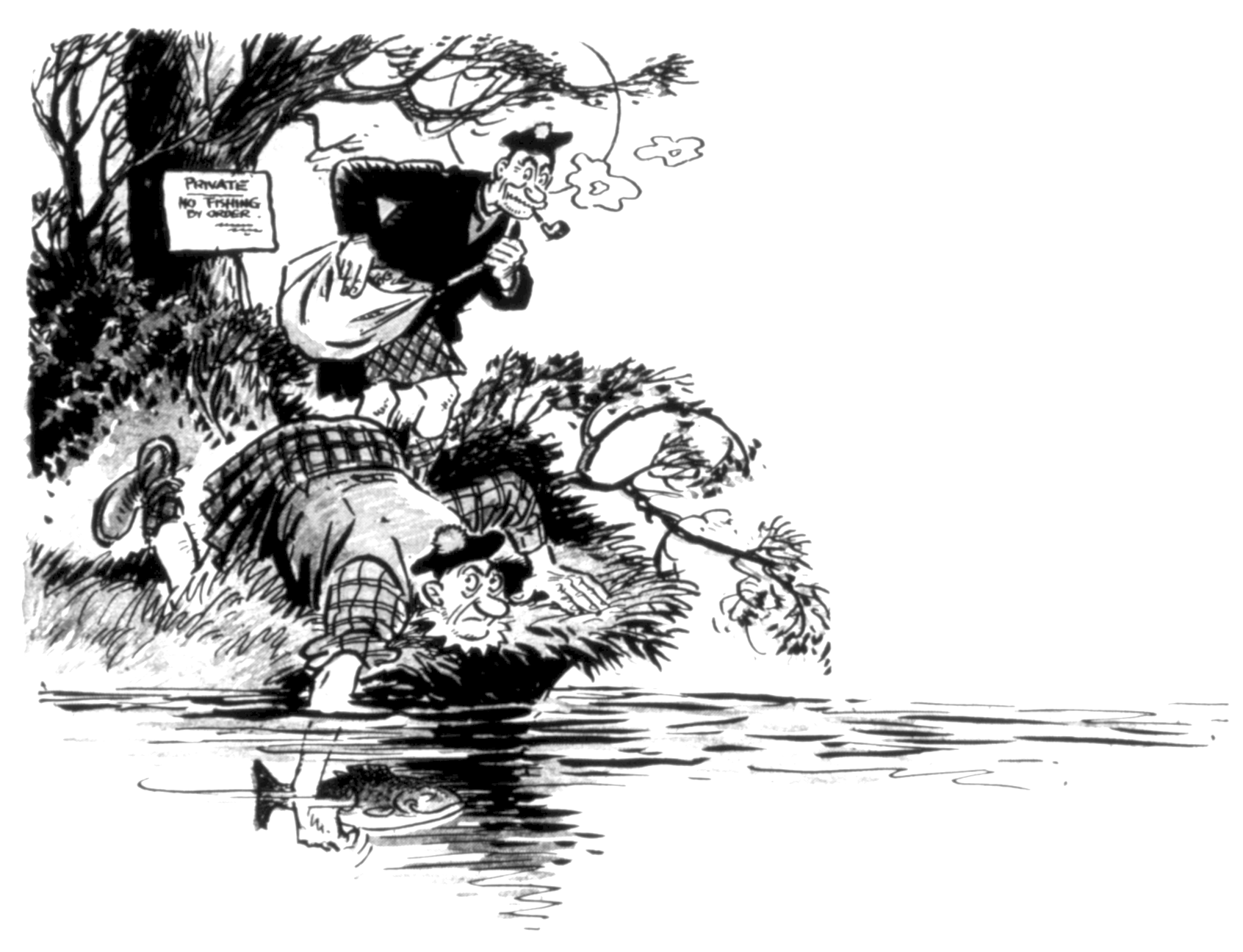
Crouching low, he began crawling on hands and knees toward the boggy bank. Six feet from its edge, he lay flat on his stomach and began inching himself forward like a commando fighter, barely moving. Three feet from the edge, he lowered his head until he was flattened completely. His right arm began to extend. His hand reached the grassy margin and disappeared into it. Slowly, he wormed forward and I saw his arm start to vanish over and down.
I could see he was now so completely advanced to the edge that his shoulder was over the bend and his whole arm must be immersed.
Suddenly, he turned his face toward me and it was lighted with an unholy glee. His mouth was open and his eyes were starting from their sockets.
“Easy!” I warned.
Jim’s eyes rolled as he felt cautiously at something unseen, deep in that shadowy depth. His body tensed.
I saw him suddenly convulse as he made a vicious grab.
“Watch out!” he yelled, heaving.
Then he really DID yell.
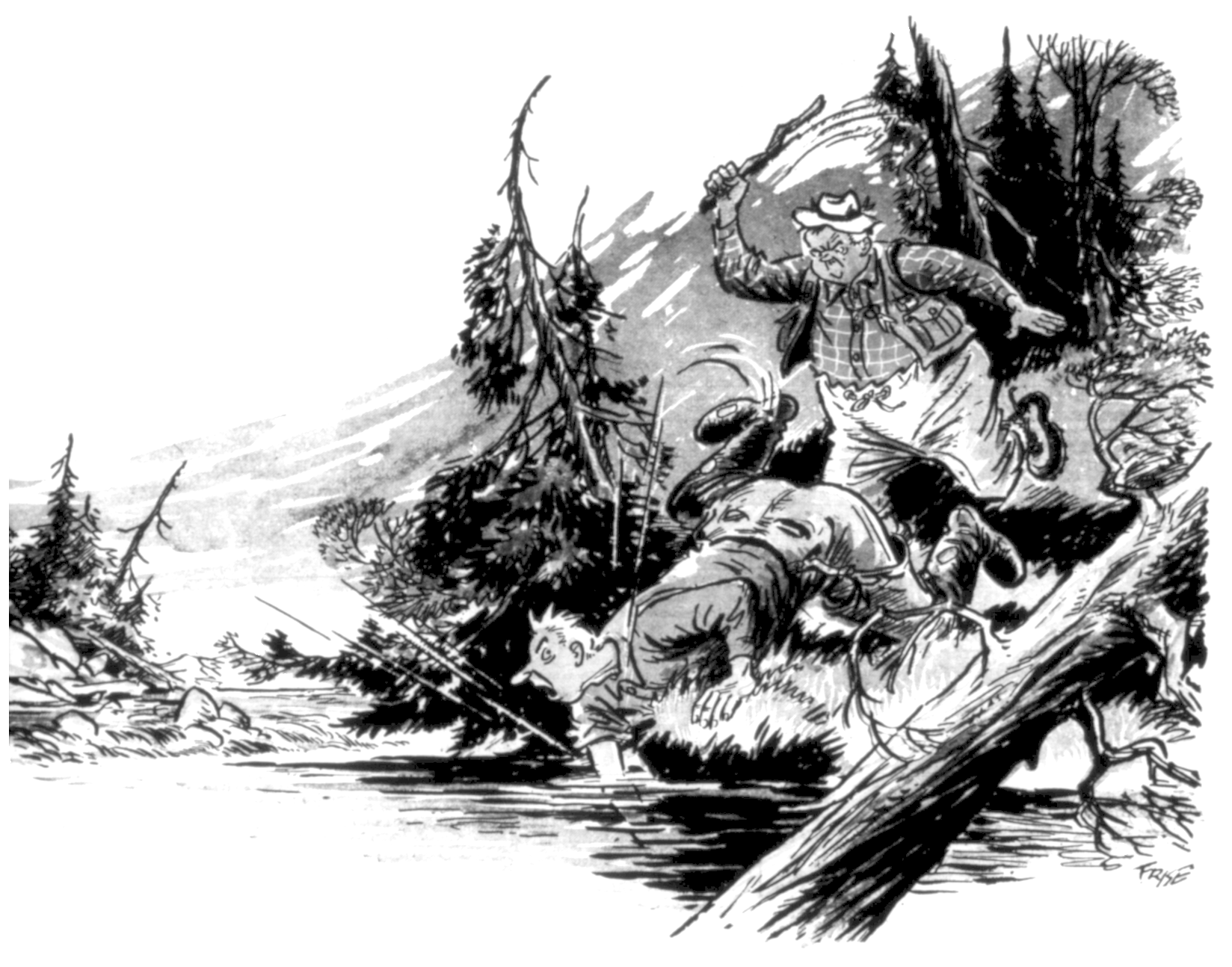
For, instead of pitching a two pound trout out onto the bank, he was grabbed and held by some implacable and unseen force. He struggled furiously, he writhed and whipped around on the bank, digging his knees in, yelling and thrashing.
His arm, well over the elbow in the water, was gripped and held. I rushed forward, seizing an old dead stick. But in his struggles, Jim had muddied the water of the pool, and the current was spreading the silt in clouds. I could see nothing but Jim’s white arm disappearing in the clouds.
“Jim! Jim!” I yelled. “What is it?”
“I don’t know!” gasped Jim, holding his arm still, while perspiration burst in beads on his face.
“Does it hurt?” I begged.
“Like fury,” choked Jim, biting his lip.
“Maybe a snapping turtle?” I cried, poising my stick. “Maybe a giant snapping turtle? Is it chewing?”
“No, it’s just got me…” collapsed Jim.
“Let the mud settle,” I gritted. “Keep still. I’ll get you out of this.”
I crouched on the bank, watching over the side, my club at the ready.
The mud and silt, wafted by the current, thinned, cleared. I had a swift vision of Jim’s hand. Something dark and terrible had hold of it, straight across.
The silt wafted thinner. I caught sight of what seemed be old rusty chain. It cleared more. Like glimpsing the moon through flying clouds, I saw Jim’s hand gripped by a dirty old muskrat trap.
“Look!” I commanded, heavily.
Jim looked. We reached down and pried the trap loose. His hand was red, but not skinned.
“Some poacher,” I snarled indignantly, “abandoned that old trap there…!”
Jim was nursing and rubbing his hand.
“Fly fishermen,” he growled, “have no business…”
“Guddling,” I concluded.
Editor’s Notes:
- The Compleat Angler is a book by Izaak Walton, first published in 1653. It is a celebration, in prose and verse, of the art and spirit of fishing. ↩︎
- Henry van Dyke was a professor of English literature at Princeton between 1899 and 1923. ↩︎
Leave a Reply