
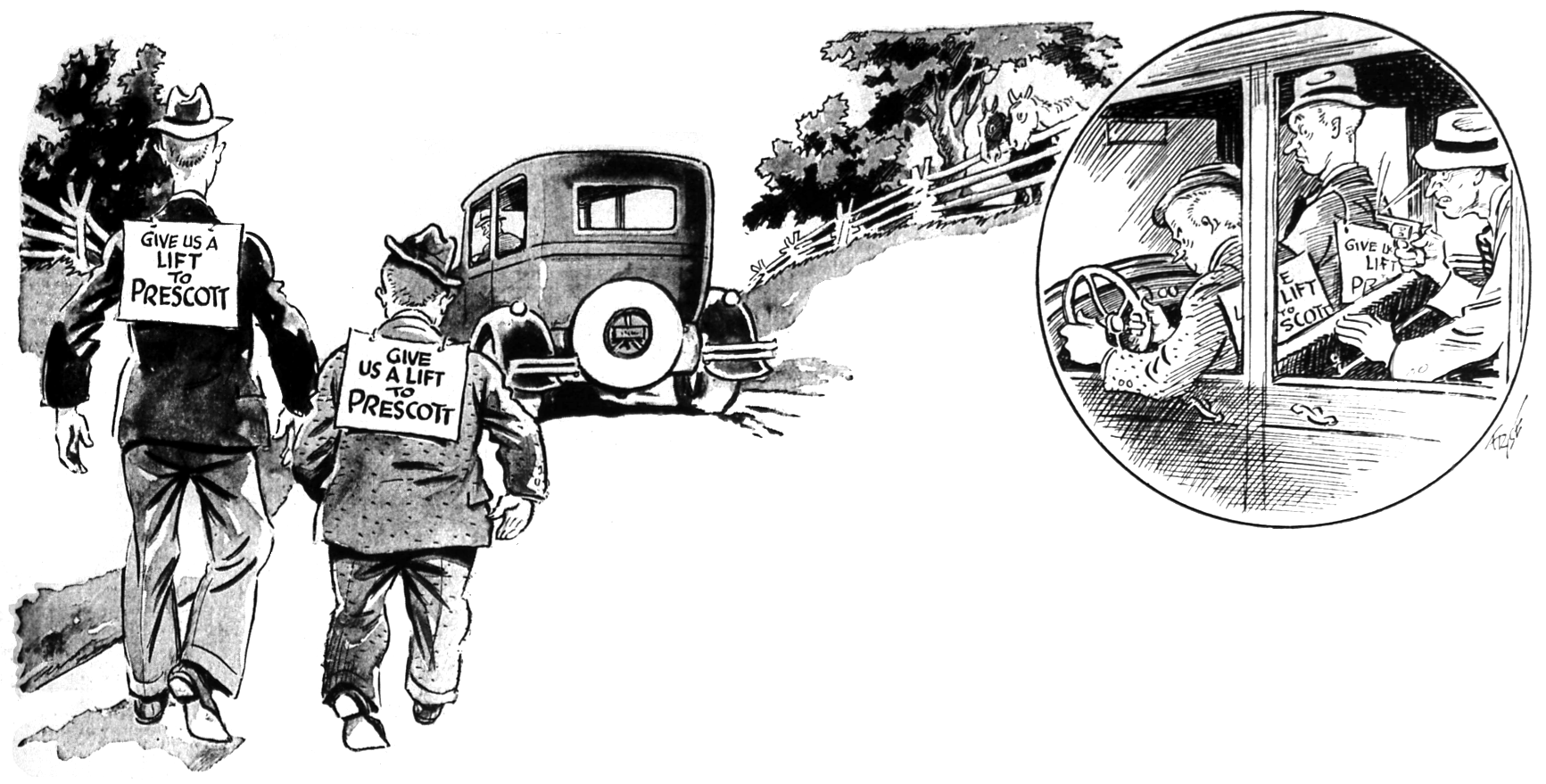
The small man tapped Jim in the back in a way that caused him to sit up very straight and close his mouth tightly
By Gregory Clark, illustrated by James Frise, June 17, 1933.
“Nothing,” said Jimmie Frise, “demonstrates the general stupidity of mankind like hitch hiking.”
“How do you mean?”
“Well, every hitch hiker goes through the same motions. They even use the same thumb. They thumb with the same gesture. They stand the same way, look the same way, all have the same expressions on their faces. You take a thousand different men, all ages, sizes and shapes, and set them along the side of a road, and instantly, they become as alike as posts in a fence.”
“That’s true,” I admitted.
“The nature of man,” said Jim,” “is to be as alike as dandelions. But the way man has got anywhere has been by being different. Why don’t hitch hikers realize that the way to attract notice and get a lift is by being different?”
“I guess there isn’t much difference possible,” I suggested.
“I bet,” said Jim, “I could get a lift from here to Montreal in less time than it would take me to drive myself.”
“You would make a poor hitch hiker,” I said. “If the first fellow picked you up was going to North Bay and you wanted to go to Buffalo, you’d go to North Bay with him just to be agreeable.”
“No, I’ve got a great idea,” said Jim. “I have a contribution to make to the hitch hiking public, and if you haven’t anything better to do this afternoon, we could investigate the hitchery business.”
“It’s all work,” I said, reaching for my hat.
“Just a minute,” said Jim, setting to work at his drawing board. He took two large sheets of heavy drawing paper, and in bold black printed letters, six inches high, he wrote:
“Give us a lift to Prescott1.”
“Now,” said Jim, “we take a string, and we fasten these two notices on our backs.”
“Great!”
“And we just get out on the highway, walk right down in the middle of traffic, heading east. Everybody coming from behind sees these signs. It won’t be long until somebody comes along who is going to Prescott. He will see the sign, and instantly, his reaction will be to take us with him. The average driver is not inclined to pick up hitch hikers, because they may be only going to the next village, or a couple of miles down the road. A driver headed for distant parts hates to waste the time stopping to pick up short haul passengers, whereas, if he knows we are going to the same place he is headed, he will be immediately interested in us.”
“By George, Jimmie, I think you have hit on a wonderful idea. It will revolutionize hitch hiking.”
We took our two big signs and got Jim’s car and drove out the highway well beyond the city limits, and then parked at a gas station we know.
“We’ll be back in an hour or two,” said Jim to the gas man.
“Aren’t we going to Prescott?” I asked.
“No, no,” said Jim. “This is an experiment. My idea is that we should see how many times we can get picked up for Prescott between here and Whitby.”
“Won’t the people be sore at us for stopping them?”
“We’ll explain it to them.”
Cars were snoring eastward as we stepped out on the pavement and side by side walked off, our signs staring boldly back at the oncoming traffic.
Fifteen cars went by, and in every case, the cars slowed up while passengers turned and stared back at us.
“We are certainly attracting attention,” I said.
“Sixteen, seventeen,” said Jim. “I’m counting the cars.”
Eighteen came roaring from behind and just as it swept past us, we heard the brakes go on and the big sedan slowed to a stop on the side of the road ahead.
“We’ll take a little ride with him,” said Jimmie. “To get his reactions.”
We ran ahead to the car and the driver, who was alone opened the door with a grin.
“That’s a new idea, boys,” he cried. “And a swell one.”
“Going to Prescott?” asked Jim.
“Through Prescott,” said the driver, who was a small, weasel faced man with glittering eyes. “Do either of you drive a car?”
“We can both drive,” we said.
“This is swell,” said the weasely man.
“You boys might give me a rest by taking the wheel for a spell after we get going.”
“Sure,” said Jim, who loves to drive other people’s cars.
“Hop in,” said the driver.
We hopped in the front seat with him.
He slammed the gears and the big car leaped away.
“What are you boys going to do in Prescott?” asked the stranger.
“As a matter of fact,” said Jim, “we aren’t going to Prescott at all. We are a couple of newspaper men and we are experimenting with this hitch hiking business. We are introducing some new ideas.”
The stranger looked sideways at us.
“Newspaper boys, eh?” he said. “H’m, h’m!”
He put on more speed.
“How far were you figuring on going?” he asked.
“We thought we would see how many lifts we could interest between here and Oshawa or some place.”
The big car started to slow, but instead of taking to the side of the road to let us out, it turned down a side road towards the lake, and as soon as we were out of sight of the highway, the weasely man stopped it, slid quickly and smoothly out of the driver’s seat and when Jim and I looked out at him, he was holding something in his coat pocket. And pointing it in at us!
“I Got a Gun Here”
“Boys,” said the little man, “you are going for a little longer ride than you intended. I got a gun here. I’m getting in the back seat. You two are going to take turns driving me until I get ready to kick you out.”
“Just a minute,” said Jim. But I slid smartly into the driver’s seat.
“That’s right,” said the little man, opening the rear door and hopping nimbly in. “Now no fooling. We are not going through any towns. We are going around all of them. I know the side roads. When I tell you to turn, you turn, get me?”
“Yes, sir,” said I.
“Just a minute,” said Jim.
But the small man tapped him on the back in some way that caused Jim to sit up very straight in the car and close his mouth tightly.
“Now, start her,” said the little man, “and we’ll go down here and around Whitby, see?”
We jogged around the country road, making a detour past both Whitby and Oshawa.
Then we regained the highway and headed east.
“Make it fifty,” said the little man in the back seat.
I made it fifty.
He sat hunched forward, and kept peering in the reverse mirror over my head. Whenever cars overtook us, the little man crouched down in the seat until they were past. He detoured us around Bowmanville, even around the little gas station towns along the highway.
“Slow up,” he commanded sharply. Ahead we could see a brown uniformed man on a motorcycle. “Go around him.”
We took to the country roads again and went right around a township to avoid the motorcycle cop.
Port Hope, Cobourg, Grafton were neatly circled, the towns and villages ticking by as the big car snored on. Jim sat rigid beside me, never opening his mouth. The little man in the rear had nothing to say beyond giving me directions.
“Prescott,” he said, softly. “Give us a lift to Prescott, heh, heh, heh!”
“This is a good joke on us,” I laughed.
“Shut up.” said the little man.
I attended to my driving.
“Anyway-” I said.
“Shut up,” repeated the little man.
He was half standing up staring in the reverse mirror. Out of the corner of my eye, I could see another big car overtaking us.
“Put her up to sixty,” said the little man.
I put her up. It was a good car.
The car continued to crawl nearer.
“Step on it,” said the little man.
“We’re coming to a town,” I called.
“Shut up,” said the little man.
I reached out with my foot and shoved down. The car seemed to lift.
We went through a town that was just a blur of red gas tanks and white shop fronts.
I heard the car behind sounding its horn in a long, steady blast, faint over the sound of the racing engine.
Then the little man placed his hand on my shoulder.
“Easy now,” he said. “We are coming to a bush. As we come into it, I want you to slow her down. Take the left side of the road and make these guys come up on our right side. Easy now.”
The woods swept up to us. I slowed the car, veering to the left of the road, and the car behind rushed alongside of us. I caught a glimpse of men waving and shouting in it, and at the same time felt the draft as the left-hand door opened, and the little man took a flying leap. Just as I slowed to a stop, he vanished like a rabbit into the brush.
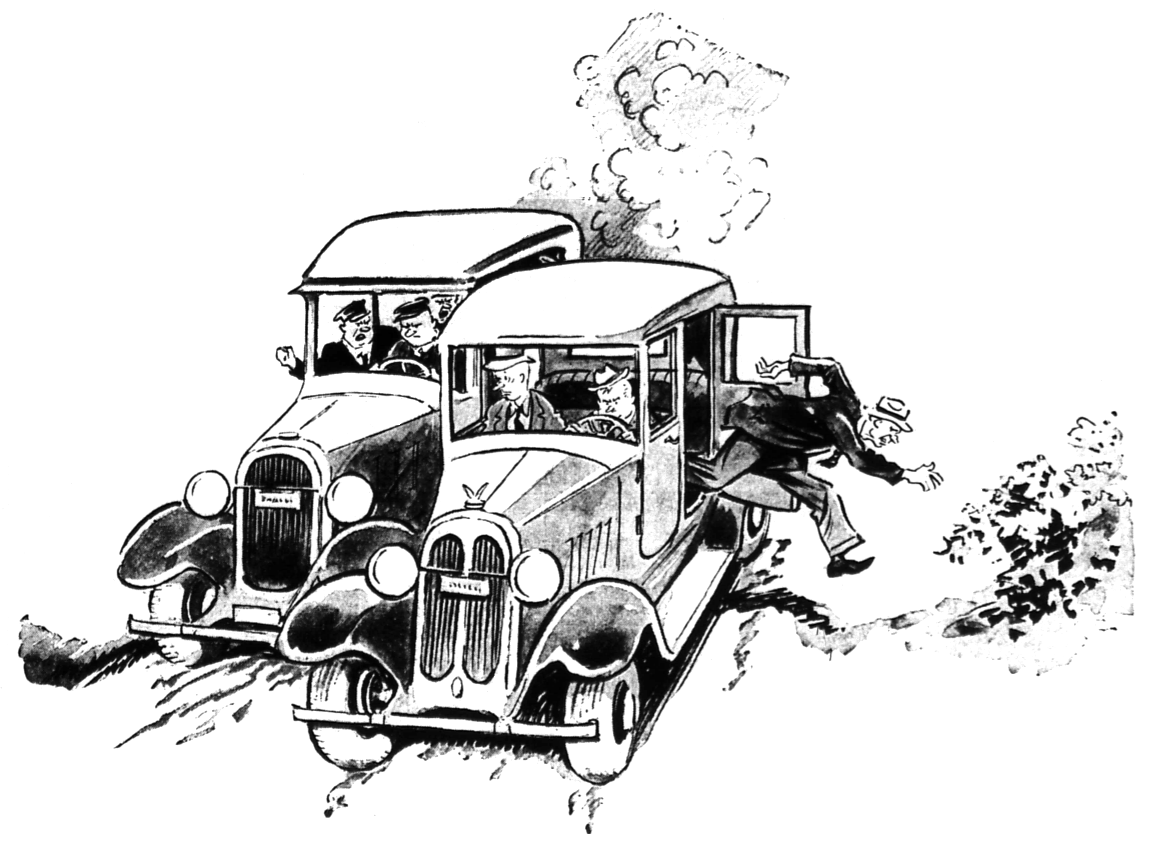
In an instant we were being boarded by big angry men who put handcuffs on Jim and me and locked us together.
“Well, hitch hiker?” I sneered at Jimmie.
“Where’s your partner?” asked one of the big fellows.
But already three of them were shouting off into the bush.
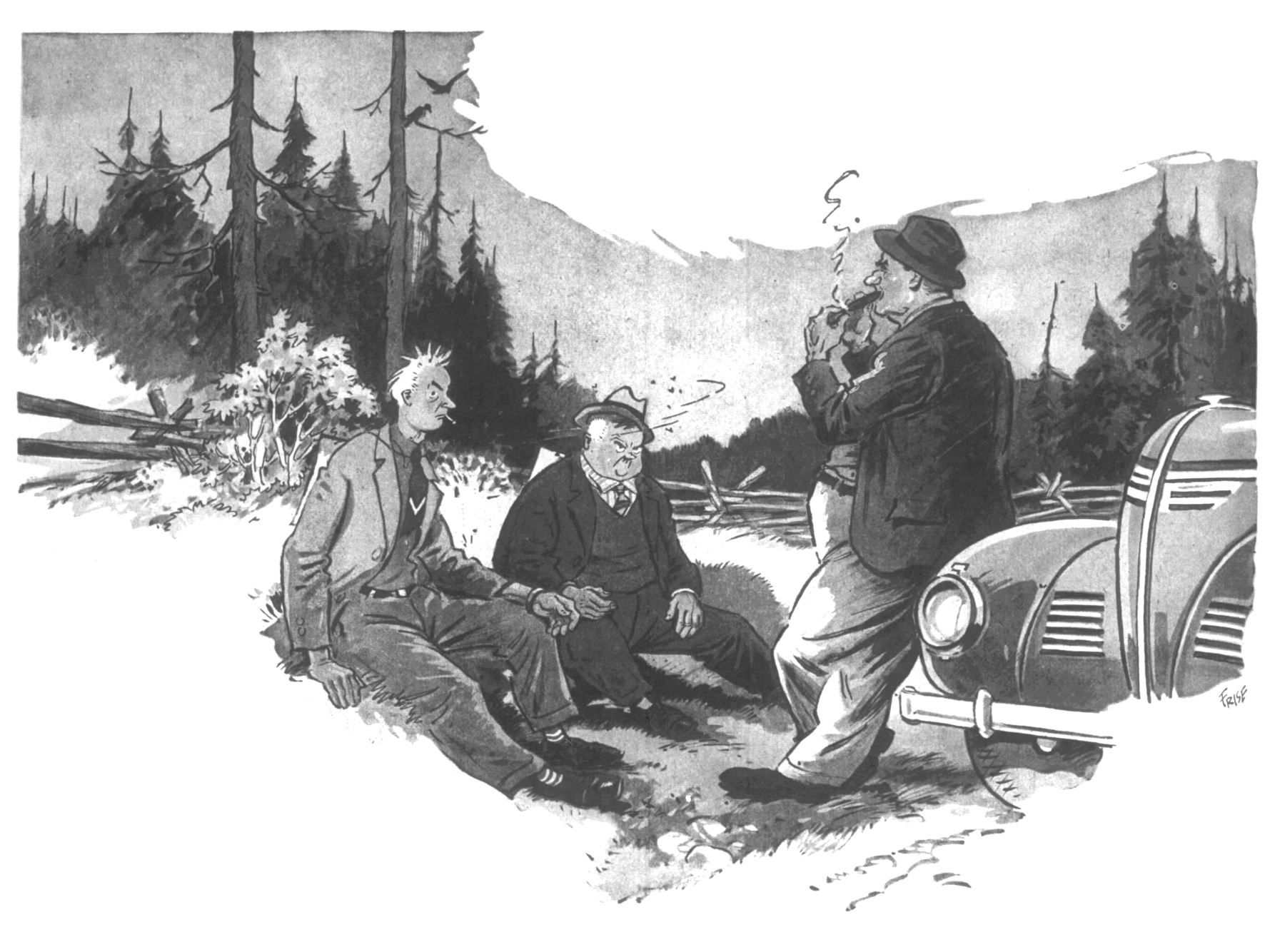
Jim and I were sat down on the roadside.
“What’s the idea of them signs?” asked our new boss, examining our backs.
“We’re a couple of hitch hikers and this bird picked us up,” said Jim. “Then he pulled a gun on us and made us drive.”
“That’s a good story,” said the boss.
“As a matter of fact,” I said, “we are not hitch hikers at all. We are a couple of newspapermen out getting a story about hitch hiking.”
“Yeah? Why don’t you think up a story that both of you can be stuck with?” asked the boss, taking out a cigar.
“We can prove it,” said I.
“Well, maybe so. But I can prove you were driving a stolen car.”
“Do you think your friends will catch that little guy?” I asked anxiously.
“You’ll do, even if they don’t catch him,” said the boss.
Presently, the three other men came out of the woods bringing the little weasely man with them.
“Here,” I commanded, as they brought him close, “tell these gentlemen to turn us loose! Tell them you picked us up on the highway.”
“What are giving us?” cried the little man in astonishment. “I tell you, gentlemen, these two men picked me up outside of Oshawa where I signalled them for a lift. When I saw by their actions and their conversation that they were crooks, I naturally jumped out of the car when it slowed, and tried to hide on you. Just human instinct.”
“He had a gun.” I yelled.
“Nonsense,” said the little man, angrily. “If I’d had a gun I would have forced them to stop, wouldn’t I?”
He looked the picture of outraged innocence.
“These birds,” said the big man who had stayed with Jim and me, “say they are hitch hikers. Then they say they are newspaper guys. Now, gents, just reach in and show us some identification.”
Jim reached into his pocket and felt around. The first thing he found was his little pass to the race track, a sort of little round book on a string.
“Here you are,” he said.
The cop took the pass and read the name on it.
“Lou Marsh2!” he read, staring at Jim.
“Wait a minute,” cried Jim. “I borrowed Lou’s pass.”
“Oh, you borrowed it, huh!”
They put another set of handcuffs on Jimmie and pushed us into the stolen car.
“This is Clark and I’m Frise,” shouted Jim, as we were being bundled in. “We can prove it.”
“Never heard of you,” said the boss cop. “Get in and tell it to the judge.”
“Can I go now?” asked the weasely little man in an injured voice. “I got to be in Prescott to see my old mother who is dying. I’m just a poor man hitch hiking my way home to see my old mother.”
“Do we need this guy?” the cops asked each other, sympathetically.
“Bring him along just as evidence against these two,” they decided.
It was supper time, so we stopped in Grafton for sandwiches. The cops brought them out to us in the car.
Jim always makes sketches in villages for use in Birdseye Center. He took the card off my back and with his handcuffs on, made a few sketches on the back of it.
The cop sitting in with us sat up and watched. He called the others over.
“What did you say your name was?” asked the boss.
“Frise,” said Jim.
“Oh, I thought you pronounced that Freeze,” said the boss3. “I didn’t get you at first. Wait a minute till I take off them bracelets so you can draw better.”
He unlocked the cuffs.
“Draw him,” said the boss, referring to one of his large colleagues. “Make him look like Pigskin Peters in that derby.”
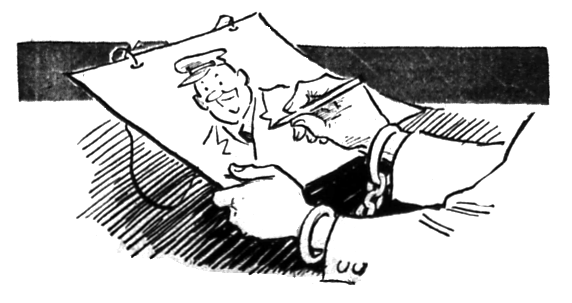
There we were parked on the roadside, with several of the villagers coming and looking in the windows.
“Draw old Archie,” said another of the cops.
And that was the way Jimmie drew us out of the jam.
“You say this little bird here picked you two up in this car?” asked the boss.
“He did,” we said.
The little weasely man knew when he was cooked. He had art, but it wasn’t as good as Jimmie’s.
“Oh, all right,” he said. They took the handcuffs off me and put them on him.
So they drove us home to Toronto, and on the way, I took the sign off Jim’s back, turned it over and printed on it:
“Give us a lift to TORONTO.”
Editor’s Notes: This story was repeated on June 22, 1940 as “Sign Language”.
- Prescott Ontario is about 350 km east of Toronto. ↩︎
- Lou Marsh was the Sports Editor of the Toronto Star in 1933. Since he died in 1936, they had to change the name to Andy Lytle for the 1940 reprint. ↩︎
- I make the note on the website that it is pronounced “fries”. ↩︎
Leave a Reply