"Greg and Jim"

The Work of Gregory Clark and Jimmie Frise

The Visit

Greg clutched his precious paperback. It had to be protected from eager little hands that like to scribble.

Greg was just doing a favor-then the small boy appeared

By Gregory Clark, Illustrated by Ed McNally1, March 27, 1965.

There was a small chunky boy, about five years old, sitting on Miss Pitchett’s doorstep.

I halted. I took a firmer grip on the book in my hand.

“Hi!” said the small boy.

“Hello, there,” I responded cautiously.

I advanced slowly up the walk, rearranging my tactics. For this was wholly at variance with my expectations.

Miss Pitchett, with whom I was not acquainted, had telephoned me before lunch.

“Mr. Clark,” she said, “our mutual friend, Mr. Gillis Purcell2, tells me you have a copy of old Tiger Dunlop’s Statistical Sketches3.”

“Yes,” I said, not without pride. “I have the 1832 edition, published by John Murray in London…”

“Oh, Mr. Clark,” said Miss Pitchett, “My ancestors came out to Canada in 1835, and they bought their land in the Huron Tract directly from Dr. Dunlop, who was the superintendent of the Canada Company. Could I POSSIBLY borrow the little book?”

“Why, of course,” I replied. “It is very fragile, you understand. A little paperback, 133 years old.”

“I would take the greatest care of it,” assured Miss Pitchett. “I live only four blocks over from you. I could drop by at your convenience.”

I did some fast and fancy thinking. Miss Pitchett sounded elderly to me. And it has been my experience that elderly ladies, especially unmarried elderly ladies, who are interested in family history and genealogy are inclined to be long-winded: I didn’t want to be stuck all afternoon with a long-winded lady.

“Why, Miss Pitchett,” I said, “I go for my constitutional every afternoon. And if you live only four blocks away, I’ll be delighted to drop the little book in to you.”

“Thank you,” exclaimed Miss Pitchett. “You can have no idea how I look forward to having this book in my hands. I have read everything about the old Doctor, and own most of the books about him. But I have never laid eyes…”

“It’s a delightful and humorous book,” I cut in. “He was a wonderful old scalawag.”

“My ancestors were terrified of him,” said she.

“Indeed?” said I.

“They were teetotallers.”

“Ah,” said I.

So after lunch, I got down my copy of Statistical Sketches Of Upper Canada, which, on account of its fragility, I keep in a hard-cover slip case. I glanced through it, to refresh my mind with the old boy’s hilarious descriptions of our pioneer cookery and our social customs of those gallant days. Then I set off for my walk.

And on Miss Pitchett’s doorstep sat this chunky small boy.

“Hi!” he repeated, as I came slowly up the steps.

When I rang the bell, he stood up and studied the object in my hand closely. I shifted it to the other hand.

When Miss Pitchett opened the door, he stepped in ahead of me and vanished, to my relief, when Miss Pitchett insisted that I take off my hat and coat for a few minutes.

Her living-room walls were stacked with books.

She took Statistical Sketches from me almost with reverence, and slid the slip case open.

“At last!” she said.

There was a loud clunk from back in the kitchen. It was a refrigerator door closing.

“He must be hungry,” said Miss Pitchett, jumping up. “Excuse me a moment, and I’ll get him something to eat.”

“Ah,” I said, taking Statistical Sketches back from her hand. “Little boys are always hungry.”

I could hear them chatting while I got up and studied Miss Pitchett’s shelves. It was a good collection. She had all 32 volumes of the Chronicles Of Canada (I counted them). She had the same green-and-gold bound complete works of Francis Parkman that I own. She had 10 or more of the Makers Of Canada.

“I had no peanut butter,” said Miss Pitchett, returning. “That’s what he wanted. But I gave him what we used to call a ‘piece’ when I was young.”

“I remember,” I said giving her back the book. “Thick bread and butter, plastered with brown sugar!”

“Right,” said Miss Pitchett, and we sat down to explore.

“I regret,” I said, “that I can’t leave the book with you Miss Pitchett. I remembered, after you phoned, that I had promised it to a young chap who is writing his Ph. D. thesis on the Canada Company.”

There was a sound of dishes rattling in the kitchen. Miss Pitchett sat up anxiously and listened.

“I was hoping,” she said, “to copy parts of it for my collection…”

“Well, perhaps some other time,” I suggested.

The little boy appeared at the dining-room entrance.

“I want another piece,” he said.

“Of course,” said Miss Pitchett, jumping up dutifully and accompanying the boy back to the kitchen.

I certainly was not going to leave Statistical Sketches, that fragile old treasure, in any house with any chunky small boys in it. The older the book, I recollected, the more a little boy thinks he should scribble in it, with pink or orange crayons preferred.

“Perhaps,” I said, when Miss Pitchett returned and began leafing tenderly amid the old brittle pages, “maybe toward summer, you might come over to my place and spend an afternoon or two copying out what you want.”

I figured by summer, this little boy might be off somewhere at a summer cottage with his parents.

“That would be splendid,” said Miss Pitchett, glancing up as the little boy passed in the hallway and proceeded upstairs.

So for a while we two elders sat engrossed with the little book, I finding some specially witty and ludicrous passages for her, which I read to her with what I think is a Scottish accent, like the old doctor’s. But Miss Pitchett could not pay full attention on account of various thumps and bangs coming through the ceiling.

“I had better,” she said, “slip up and see what he is doing.”

“Little boys,” I assured her, “are always up to something.”

So I had time to further inspect Miss Pitchett’s shelves, and they were full of all the right stuff.

“He’s made a sort of a den,” said Miss Pitchett, returning a little breathless, “out of chairs and my bedside table.”

“Small boys like dens,” I explained. “Little girls play house.”

“He’s got the counterpane4 off my bed, for a roof.”

So, a little regretfully, for that young scholar working on his Ph. D. was a sheer invention on my part, I stood up to say goodbye and put Dr. Dunlop in his slip case.

I could see Miss Pitchett was anxious to get back upstairs. The thumps and bangs were becoming a little more violent.

She helped me on with my coat and handed me my hat.

When I went to the door, she asked:

“Aren’t you taking your little boy?”

“MY little boy!” I said, astonished.

“Isn’t he yours?” she asked.

“My dear lady,” I said, “he was sitting on the doorstep when I arrived, and he stepped in ahead of me when you…”

“Good gracious!” said Miss Pitchett, heading for the foot of the stairs.

“Boy?” she called up.

“BOY!” I called up, more masterfully.

He came to the top of the stairs, holding a small china figurine in his arms.

“I found a doll,” he announced.

“Come down,” I commanded.

Miss Pitchett took the figurine from him gently. It was Royal Doulton, the one of the girl in the windswept frock.

“Boy,” I asked, “where do you live?” “Up the street.”

“How far up the street?”

“At the corner.”

“Ah,” said Miss Pitchett, “the apartment house. I THINK now I have noticed this little fellow playing about…”

We escorted him to the door. We watched him hippety-hopping down the walk and up the street.

“Miss Pitchett,” I said, “I have been thinking. I do not believe this young friend of mine, the one who is working on his Ph. D. thesis, will require Statistical Sketches for a couple of weeks or so.”

She took the slip case from my hand.

She understood perfectly.

“But,” I added, “whenever you put it down, I wonder would you be good enough to put it up there, on one of the higher shelves?”

“Oh,” cried Miss Pitchett, “you may be sure I won’t let him in again!”

We shook hands and I left.

But I will spend a couple of uneasy weeks, just the same.

Little boys can do anything.


Editor’s Notes: This story appeared in Ten Cents off Per Dozen (1979) and originally appeared in Weekend Magazine.

  1. Ed McNally was the editorial cartoonist for the Montreal Star and illustrated for Weekend Magazine. ↩︎
  2. Gillis Purcell was the general manager of Canadian Press from 1945 to 1969. ↩︎
  3. William “Tiger” Dunlop was known for a number of things, including  his work in the Canada Company, helping to develop and populate a large part of Southern Ontario. ↩︎
  4. An old-fashioned word for bedspread. ↩︎

Old Archie Reports That There’s No Syrup in the Sap This Season

March 21, 1931

The School for Hecklers

The policeman hoisted me aloft and carried me out…

What chance has a heckler now? Half the audience are ex-hecklers who know all the tricks

By Gregory Clark, Illustrated by James Frise, March 21, 1942.

“With the way business is going,” said Jimmie Frise, “it is about time we began looking around for some nice juicy government job.”

“Why so?” I inquired. “There will always be newspapers, won’t there?”

“Maybe so,” countered Jim, “but will newspapers be bothered with the kind of stuff we can do? That’s the problem we’ve got to face. The world is getting more serious all the time. Everything is being rationed. Step by step, government is taking over everything. One of these days they’ll take over the newspapers.”

“Oh, yeah?” I demanded. “How about the freedom of the press?”

“Well, is that any more precious than the freedom,” retorted Jim, “of a man to buy what he likes and sell what he likes? Is it any more precious than freedom of speech? And there are a lot of guys locked up in concentration camps1, right in this province, who speeched too freely. Ah, no, my boy. one of these days, they will ration newspapers and some chartered accountant will come in as administrator of our newspapers. And the first two guys he will throw out will be us. We’re only frills.”

“Frills!” I snorted.

“Sure,” said Jim. “We’re just a luxury, like ripe olives. What the newspapers will print, under government control, will be the facts. A newspaper will read like a Canadian National time table. You will get the weather forecast and the speech in full of the minister of justice. With applause after each paragraph.”

“How long would the people put up with such nonsense?” I scoffed.

“Quite as long.” submitted Jim, “as they would put up with gas rationing and wage and price ceilings, and rationing of sugar and tires and clothes and all else. In the name of war, my dear sir, we will put up with anything. There is only one good job to have nowadays; and that’s a government job.”

“Well, I never expected to live to see the day,” I heaved.

“Who do you know up at Ottawa?” asked Jim. “We ought to have some pull. Couldn’t you get the job of collector of customs or something for the Port of Toronto? Think of all the fishing tackle that would pass through your hands as collector of customs.”

“Those days are gone forever, Jim,” I sighed. “There was a day when a man with pull could wangle himself into a job regardless of what his qualifications were. But government is no longer merely political. It is becoming industrial, financial, social and everything else. It is becoming expert. There are no better bankers in the banking business than the government has working for it now. And no better industrialists working on their own than are working for the government. In the old days, a smart financial man or a smart manufacturer could make a million dollars as easily as rolling over in bed. But the day came when the government took it all off him in taxes and super taxes. Why should a man worry about his own business and the government’s as well? So all the smart guys are working for the government, making just as much as they had left over after the government was through with them in the old days; and having a lot of fun as well.”

The True Art of Heckling

“I guess,” admitted Jim ruefully, “we haven’t got anything the government wants.”

“We could do propaganda,” I suggested.

“Propaganda won’t be necessary any more,” explained Jim, “when the government controls everything. There won’t be any opposition to propaganda.”

“We could take an active part in politics,” I offered.

“Too late,” said Jim hollowly. “There are about 20,000 guys ahead of us.”

“I attended quite a number of political meetings this last two or three years, Jim,” I said earnestly. “I could get witnesses to prove it,”

“Did you heckle?” demanded Jimmie.

“Heckle?” I inquired.

“You don’t take an active interest in politics unless you heckle,” stated Jim. “When I was a young kid, I loved to go to political meetings to help heckle. Down in Birdseye Center, we had a School of Heckling. It was run by a bad old guy who owned the harness shop in the village. Whenever a meeting was scheduled for our community, old Sam, the harness maker, would start his school for hecklers and we would all gather in the harness shop and learn our parts.”

“You must have been very young,” I suggested.

“Ah, you think of heckling,” said Jim, “as merely asking questions. The true art of heckling is the art of putting a meeting on the bum whether with questions or marbles or chair legs…”

“Marbles?” I protested.

“Look,” said Jim. “The meeting is called to order and proceeds. All is quiet and orderly. The chairman makes his speech. The business of the meeting is disposed of. Then the speakers begin, warming up the audience for the main speaker of the evening who is not yet arrived, but who is momentarily. He, of course, is a prominent politician, making speeches in half a dozen parts of the riding in the one night.”

“It’s the same today,” I confessed.

“Now,” said Jim, “old Sam, the master heckler, is in the audience. And we, his pupils of all ages, from boys of 15 up to old gentlemen of eighty, are discreetly scattered over the hall in little groups. The best way to seat hecklers is this: put the main heckler of the group in the middle, with a guard on either side of him. In the row in front of him, two men, sitting directly in front. And in the row directly behind, three more, to keep people from beaning him.”

“That makes eight hecklers to a squad,” I calculated.

“Correct,” said Jim. “Now, when the candidate arrives, the applause and cheers break out and the hecklers let go a few boos.”

“Correct,” I remembered.

“He has no time to waste,” said Jim. “And as soon as he reaches the platform, the chairman introduces him and he gets going. The first thing that happens, right up near the front row, an elderly gentleman in the audience gets his foot caught in the rungs of his chair.”

“How do you mean?” I inquired.

“It’s very simple,” explained Jim. “As soon as the speaker gets nicely started, you see this old bird up near the front starting to squirm and struggle. Everybody around him tries to help him. He has got his foot twisted around in the side rungs of the chair he is sitting on. The more he struggles, the more excited he gets, and the chair starts banging and people stand up to help him and before they get his foot free, there has been a dandy disturbance. Everybody at the back is shouting ‘sit down’ and the speaker has had to stop his speech, and is looking embarrassed, the way all politicians in a hurry look.”

“Oh, boy,” I gloated.

“When quiet is restored,” went on Jim, “and the speaker gets nicely going again, the marbles start. From three or four different parts of the hall, you hear marbles starting to roll. You hear them fall ticking on the floor and then quietly rolling. At a little distance, you can’t hear them at all. But nearby you can hear them and you can’t help but look down at them and twist around to try and stop them with your foot. If you have four or five fellows with marbles scattered over the hall, and they all start at the one time, you have got people squirming and twisting all over the place.

“Gee, Jim,” I breathed.

“Oh, then there are the questions, asked by the squads,” said Jim, “and the lady who takes ill and jumps up, holding her hands to her mouth and running for the door. That’s usually reserved until right at the place the speaker starts his real oratory. Then there is the late comer. He should be a farmer. He comes in, right at the peak of the speech, and walks up the aisle, to the front, looking for a seat, stopping and looking up each row as he starts back from the front. He should even attempt to walk in two or three of the rows of seats, even when there isn’t a seat. That always creates a swell confusion.”

“Jim,” I interrupted. “You’ve got it. We will found a heckling school. Right here in Toronto. We can get hundreds of students enrolled. We can wreck any meeting in the country. The government would have to reward us with jobs. Maybe they would make us senators.”

“As a matter of fact,” said Jim, “I was noticing just the other day that they are having some sort of reorganization of the council up in George township. The reeve and half the council have gone to war and they are having trouble appointing substitutes.”

“Not a township meeting,” I protested.

“We’ve got to get some practice,” declared Jim. “There is no use starting anything without knowing a little about it. Maybe this heckling school idea is only another hare-brained enterprise. We ought to do a little experimenting, in a small way. before we launch out.”

So we found out that they were having a big meeting in George township on Thursday night. We got 25 cents worth of marbles. I borrowed an old press camera from Tom Wilson, our cameraman. It had no lens, which is the valuable part of a camera anyway; but it did have the flash bulb attachment which was what we wanted. And I loaded my pockets, in true press cameraman style, with the little flash bulbs they use.

The meeting was crowded for a fact. We got there at half-past seven in order to look the ground over, and even so, the hall was almost filled already. Jim got a seat in the second row. And I, identified as a newspaperman by the camera I carried open and ready in my hands, was permitted to sit at the edge of the platform.

By eight o’clock, the hall was full and all the space at the back taken up with standing room only.

The meeting was called to order at 8.05 sharp and the chairman, a very masterful looking gentleman in a blue suit, outlined the situation. He pointed out that two factions existed in the township. These factions had an equal right to be heard. He was going to see they received a hearing. And at this point of his speech, a very large policeman walked slowly down the aisle and wheeled and walked slowly back.

The first speaker was indignant looking gentleman. He was one of those people who was born with an indignant expression on his face. His manner of speech was indignant. He would utter a quick sentence. Then pause and glare around. Then utter another quick sentence. And a long pause, to let it sink in.

This was pie for Jimmie. He got his foot caught in the rung of his chair. He started to squirm. He started to struggle. He began to fight. The chair rattled and banged finally Jim and the chair and everything fell over, causing a great excitement. Fifteen people got to their feet in the first two rows to help him, and the whole hall got to its feet to see what the trouble was. The indignant man was now very indignant, because the pause was all of two minutes and he forgot what he had been saying.

Jimmie kept stirring and fidgetting and rubbing his ankle, which irritated the speaker terribly. Finally, Jim got up and hobbled out to the aisle.

“Is there a doctor in the house?” he inquired, in a hoarse whisper.

Ten rows back, he almost collapsed on his poor ankle, and a young lad of about 15 gave Jim his aisle seat. Jim sank into it.

The speaker had now wound up and was really pounding his fist into his palm. I stealthily slid down off the platform edge and crept along with my camera raised. I huddled there a few minutes, aiming my camera at him. Then I let fly. The flash bulb caused everybody in the place to rise half in their seats. The speaker forgot his argument. I crept back to my place and hoisted myself up on the edge of the platform again.

“Now,” rasped the indignant man, “in the first place…”

Up around Jimmie, in the tenth row, I saw people stirring and twisting in their seats. The marbles had started. Balloons at a hockey game are nothing to marbles. Everybody wants to kick a marble.

“Order, order,” warned the chairman, quietly.

The speaker had ceased speaking and was glaring redly at the meeting. People on the sides were standing up to see what was going on in the middle. I slid off the platform edge and began creeping, bent over, towards speaker again. I aimed the empty camera at him. Bang went the flash bulb.

“He’s a Fake”

“Order!” bellowed the chairman, hammering on the table.

When I turned away from dazzling the speaker, I saw Jim was surrounded by a struggling group of citizens.

All over the hall, people were standing and jumping on their chairs to see the excitement. I started to shove and fight my way up the aisle, my camera held high, as if to try to get a picture of the melee around Jim.

“Hey,” I heard a voice yell, “this bird has no lens in his camera! I know something about cameras..! He’s a fake.”

Hands gripped my shoulders. All was hubbub and riot. Strange angry faces swept around me and I was yanked this way and that. The policeman got me, and after one look at my camera, seeing the big gaping hole where the lens should be, hoisted me aloft and carried me out.

Jim was gripped by two large citizens who happened to find a pocket full of marbles on him.

We went out the door about the same time. And down the steps.

The policeman followed us down and out to our car, professionally.

“None of them tricks around here,” he said, not unkindly. “The minute you pulled that old trick with your foot in the rungs of the chair, there was at least fifty old-timers in that meeting who knew what was up.”

“Well, they didn’t need to get so rough,” declared Jim. “One of those big birds nearly twisted my arm off.”

“Who do you represent?” inquired the cop. “Henderson or Billings?”

“Never heard of them,” said Jim. “We were just out for some fun.”

“Well, times have changed,” said the cop. “People are taking an interest in public affairs now. It isn’t politics they’re interested in, any more. It’s themselves they’re interested in. And when people get interested in themselves, woe betide any monkey business from politicians or anybody else.”

“Have you any kids?” asked Jim. “Here’s some marbles for them.”


Editor’s Note:

  1. Note that at the time, concentration camp would be a generic term for an internment camp of some type. Now the term is more associated with the Nazi interment and death camps of World War 2. ↩︎

“Well, All Right Then!”

March 17, 1928

These illustrations accompanied a story by Caesar Smith about how he was having a hard time getting in with his barber for a haircut because of all the women who were now going to barbers for weaves or bob cuts. So he decides to play the same game and go to a women’s stylist.

March 17, 1928

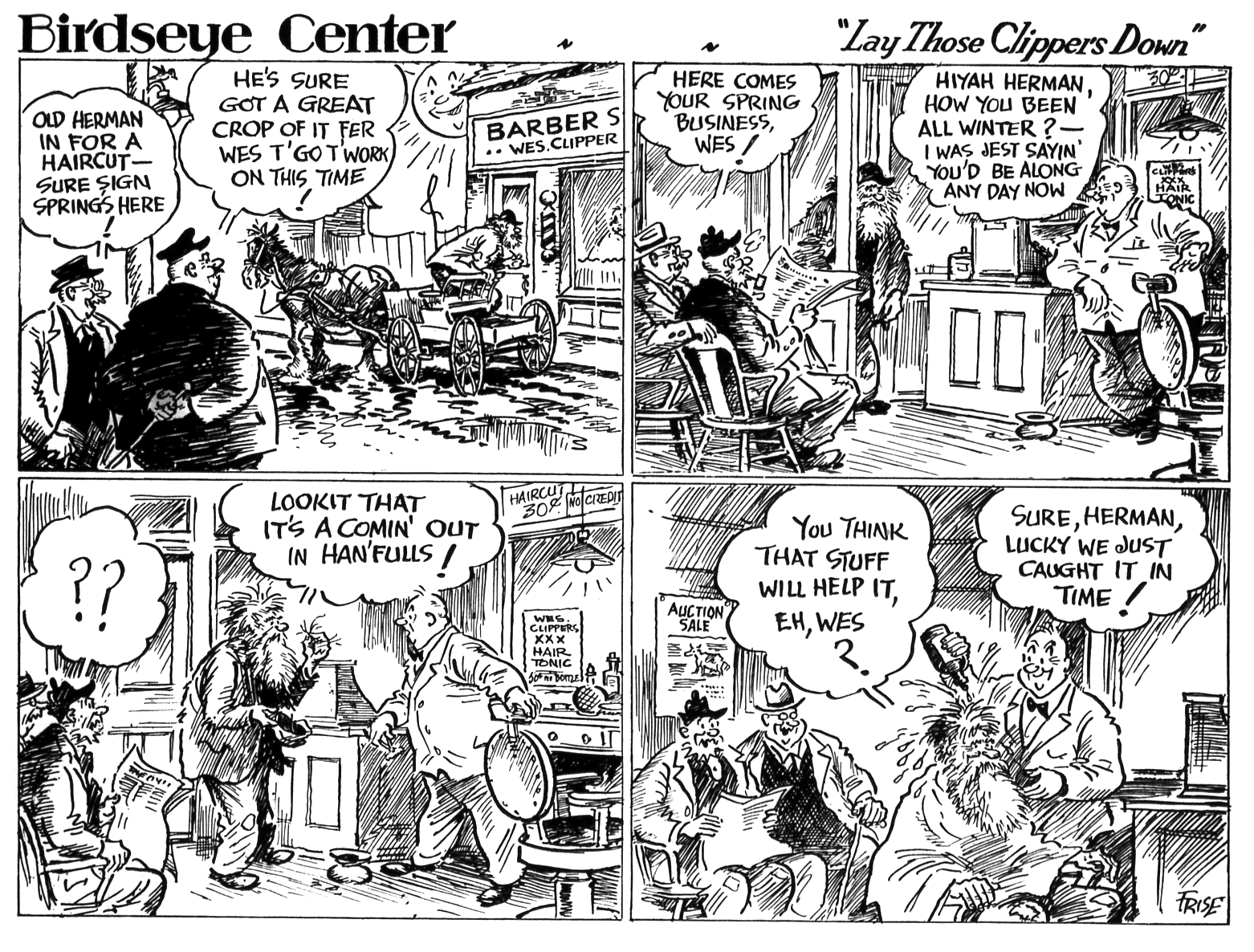
“Lay Those Clippers Down”

March 16, 1946

Beware the Ides of March

“Dog-thieves,” shouted the man, shaking me by the collar and glaring at Jimmie.

By Gregory Clark, Illustrated by James Frise, March 14, 1936.

“March,” said Jimmie Frise, “is the most miserable month of the year.”

“Especially,” I contributed, “the middle of March. Because by the end of March you can smell April.”

“March,” went on Jim, “is like three o’clock of the morning of the year.”

“All my friends who are bums,” I stated, “tell me March is a terribly hard month for them. They can’t make a touch. Not a touch. It is as if, in March, people have come to the end of their kindness.”

“It’s like that hour,” continued Jim, “before the beginning of the dawn.”

“Well, I know that hour,” I cried. “For two years in the war I saw every dawn. Winter, summer, storm, or fine. I saw the dawn. In the trenches we stood to arms, every man jack, cook, bugler and all, at one hour before the dawn. And there we stood, millions of us, all nations, friend and foe, in league-long lines, hushed, waiting, watching, tense.”

“It was the hour of attack,” said Jim.

“Like some queer, pagan, ghastly worshippers, we stood,” I recited, “in those foul ditches looking up at the black and dreadful sky. Little winds moaned. It was cold, with a ghostly cold. It was the hour before the first cock crew. The hour when bones rise out of the ground in a danse macabre. And all around us were bones. Bones of our comrades, our companions, of only yesterday.”

“You know dawns,” admitted Jim.

“Aye,” I said. “I have no love for the hour before the dawn nor for the month of March.”

“The ancients said,” declared Jimmie, “that March was the season of disasters.”

“So it would be,” I explained, “because the blood in us is running cold and thin after the long winter. Our hearts are colder, our emotions checked and sluggish. Wars might start in March, massacres, pogroms. The best instincts of humanity are mere stubble by March.”

“And in September, at their full flower and fruit,” said Jim. “Ah, how I love September.”

“I love June,” I admitted. “June, about the sixth.”

“Let us watch our step this month,” said Jim, who was at the steering wheel, and we were nearly home. “Let us tip off our friends to be watchful. Let us try to be kind and friendly. Let us try consciously to inject a little warmth of heart into life in this exhausted and embittered season.”

“Maybe we could see a bum any minute,” I agreed. “I’ve got a dime1. It would be nice to just pull up beside the curb and open the door and suddenly toss a bum a dime.”

“You’ve got the idea,” said Jim.

We drove along. How dirty the streets, with their foul shoals of ice and snow in the shelter of the houses all along the south side of the streets. The old tin cans, papers gummed into the slush and ice of a whole winter. The untidiness of March, the usedness, the second-handness.

The Little Brown Dog

A lady in her house dress was standing out on the sidewalk and as we passed her I saw she was weeping. Her face was screwed up and she was huddling her arms about her, clutching her elbows in her palms.

“Whoa, Jim,” I commanded. “What’s the matter here?”

Jim backed the car. I leaped out and hurried to the lady.

“My little dog,” she wept. “She’s gone. I can’t find her anywhere. I’ve been in all the yards. Not a sign.”

And she stopped speaking because her voice had gone up into only a squeak.

“Ma’am,” I said, “we’ll help you find your dog. What kind of a dog was it?”

“A little brown dog,” wept the lady.

“What breed, ma’am?” I asked.

“I forget,” said the lady, biting her lips. “A little brown dog. A dear little one.”

“Pekingese?” I inquired. “Pomeranian?”

“No, no,” wept the lady. “A little brown one, about like that. O-ho! I have had her six years and she never disappeared before.”

“A lady dog, ma’am?” I inquired.

“Yes, her name is Dollie.”

“We’ll drive around the block,” I comforted her. “We’ll find her. She hasn’t been gone long?”

“About half an hour,” the lady squeaked, wiping her nose in a small ball of hanky.

“We’ll get her in no time,” I assured her, starting for the car.

“What is it?” asked Jim eagerly.

“She’s lost her dog.” I explained, “so I said we’d drive around a block or two and find it for her.”

“Well,” said Jim, starting the car, “it isn’t exactly a disaster or a massacre. But after all it is the month of March.”

“It’s a small brown dog,” I informed Jim.

So we drove around a block, slowly, looking in all the side drives and stopping at each turn to look up and down all vistas. There were plenty of dogs. But no little brown ones. When we came past the lady again, she was still standing hugging her arms around her and looking down side drives and calling, “Dollie, Dollie,” in a high, anxious voice.

I waved reassuringly to her and called out the window:

“We’ll do a couple more blocks.”

And she said “Thank you” heart brokenly.

“Curious,” I said, as we turned to circle another block, “the way some women love a dog. Almost like a child.”

“Lots of men go kind of crazy over a dog, too,” said Jim.

We saw wirehairs and spaniels, police dogs and Bostons, but no little brown dogs. Then we saw a small brown spaniel, and slowed up, but it was named Joe, as a little boy told us. He hadn’t seen any dog you would call Dollie around.

In the distance we saw a flock of dogs romping on the street, so we drove away up and studied them. But there were no little brown dogs there either. Just to be sure I called “Dollie” out the window, but none of them looked at us. They were busy.

“Aw, let’s go home,” said Jim.

“There you go,” I said. “March has got you, too. We can do a couple more blocks without doing ourselves any harm, and think of the decent thing we would do if we could restore that lady her dog.”

“All right,” said Jim, and we turned another way and made a circle of two more blocks. We saw setters and terriers and Scotties; we saw a great big black Newfoundland and a dachshund, but no little brown lady dog.

Seized By the Collar

“Listen,” said Jim, “a dog always turns up. Let’s go on home, rather than go back and tell the poor woman we saw no sign of her pup. It will be kinder to leave her thinking we are still chasing all over creation looking for it than to turn up and say we haven’t seen it in ten blocks.”

“I suppose,” I confessed. “But it is a pretty Marchy trick just the same. I bet if this was June we’d keep on looking.”

“Forget it,” said Jim, and steered for home.

But hardly had we got into our stride before there, trotting down the sidewalk on little twinkling feet, with a plume of a tail curled back over her back, was the cutest little brown you ever did see.

“Dollie,” I hailed merrily.

And the little creature halted, wheeled, set its head on one side and looked up at us brightly. “Hello, Dollie.” I said warmly.

“Pick her up,” said Jim.

So I got out and went to Dollie. But Dollie, with large bug eyes pointing in two opposite directions and with a look of constitutional alarm in both of them, started to waddle off on her mincing tiny feet. I followed, coaxingly.

“H’yuh, h’yuh,” I wheedled, “Pfft, sktch, sktch, h’yuh, Dollie.”

Jim coasted slowly alongside of us.

“Jim,” I said quietly, “park and come and help me. She is naturally timid. She’s lost and nervous. We’ll have to corner her.”

So Jim, with a loud sigh, parked the car, got out and joined me. Dollie had halted at a side drive and was looking back suspiciously at us.

We walked casually closer. I turned in the side drive just as she did. I ran and got ahead of her and, spreading my arms wide, cut off her retreat while Jim, dashing from behind, swept Dollie up in his arms, and we walked out the drive.

“Nice Dollie,” I soothed, patting the head of the little gold-fishy looking dog, who wriggled and yapped in a silly little voice.

We tossed her in the back seat and got aboard. As Jim drove off, I thought I heard a shout, and looked back, and saw a man looking out the front door of the house we had been alongside. I naturally supposed that he was perhaps curious at what we had been doing in his side drive. But there was no use stopping and going back, just to satisfy idle curiosity.

We drove five blocks back to where the lady lived. But she was not in sight when we slowed up.

“Toot your horn a few times,” I said, “and I’ll try this house here, where she was in front of.”

Another lady answered the door. No, she said, there was no dog lost there. So I tried the houses next door, both sides.

“Would you know of a lady, a neighbor,” I asked at these houses, when they said they had no dog lost, “who would have lost a little brown dog?”

They thought, and looked up at the sky and put their fingers on their teeth, but couldn’t think of any such lady.

“Maybe,” called Jim, above Dollie’s loud and angry yapping, “she lives across the road. Try a couple of houses on this other side.”

So I was just asking at the third house when a car came up with a rush, pulled in just ahead of Jim’s car, and a man in his shirt sleeves leaped out and tore around at Jimmie. I heard loud shouting between them and hurried across. The stout, dark, shirt-sleeved man had Dollie in his arms and was standing with one foot inside Jim’s car, shaking his huge fist under Jim’s nose.

“Sir.” I protested, coming up.

“You,” he yelled. “You little dog-thief. I’ve got you both, eh?”

With his free hand, his fist hand, he seized me roughly by the overcoat collar and gave me a shake.

“Pardon me,” I said. “Pardon me, my man.”

“I’ll my man you,” he yelled. He was one of those stout dark men with black, sort of bloodshot eyes, who are usually retired around fifty years of age, and like to be in shirtsleeves, and mostly you see them working around their houses, putting up pergolas or making stone terraces.

Looking For a Lady

So I just let him hold my collar. I have found that if you just let a man hold your collar, he gets tired of it in a minute.

“No fines for you,” continued the man, and people were coming to their front doors, and home-goers were pausing on the sidewalk. “I’ve been watching out for you for weeks. This is three times you have stolen my dog.”

I heard an ominous mutter from the gathering spectators, and two or three men walked nearer.

“Dog thieves,” announced the coatless-man, giving me another swing by the collar and taking kick at Jim’s shins in the car. “You know the racket? Steal a dog and then collect the reward. Look at them! Well dressed, with a car, even if it is an old junk heap.”

“Just a moment,” shouted Jim. “We were helping a lady find her dog.”

“Oho,” roared our captor. “Listen to that for a tale.”

“I was just looking for the lady when you came along,” I informed him.

“Looking for the lady,” yelled he. “You were in the very act of trying to snatch another dog here when I came along.”

“I was calling from door to door to try to find the lady,” I declared.

“From door to door?” screamed the man. “Looking for a lady? You were helping her find a dog?”

“We saw her standing on the street, right along here,” I protested anxiously; “she was crying, and we said we’d help her find her dog. From her description…”

“Haw, haw,” bellowed the man, smiling fiercely around at the half a dozen spectators now closing rather tightly around us. “Haw, haw, they saw a lady crying on the street! Haw, haw! Gentlemen, what will we do with them? I see you are all dog lovers. Do we wait here and hand them over to the police, who will let them off on suspended sentence or something? Or…?”

And he grinned fiendishly around the circle of faces.

“Or,” he roared, “will we all take a kick at them that will be a lesson to these kind of birds never to show their ugly mugs in this neighborhood again? Hey?”

“A good idea,” muttered everybody, “that’s the stuff, deal with it, community spirit, that’s the stuff.”

Strange how a crowd – even a crowd of your own good neighbors – is always on the side of the accuser in a case like this. Around us, not a friendly eye showed. As far as these seven or eight gentlemen and ladies were concerned, every word our accuser had to say was true. Any dogs I have ever talked to have told me the greatest fear a dog has is to be down. A dog must keep his feet. For the instant it down, in a fight, every dog is against it. It is the same with humans. Accuse, and every eye narrows against the accused.

“Jim,” I said, quietly, “say something amusing and friendly. Don’t argue. Be witty. Attract a smile.”

But inch by inch and step by step, the kindly home-going citizens were edging closer, forming a ring around us, closing in for the kill.

And just as I felt fresh hands take hold of my collar, I heard Jim yell:

“There she is!”

And along the street, with a little brown dog in her arms, came our lady, weeping no more, but with her face radiant and her head up.

“That’s the woman,” I shouted. “Ask her, ask her!”

The lady came up and, on seeing us, announced gladly that we were two gentlemen who had offered to help her find her dog.

“I found her,” she added. “I found her playing along at the corner. The darling.”

And she kissed it.

Hands fell away from us. But faces did not relax. In fact, the man in the shirt-sleeves still scowled suspiciously at us.

“Well,” he grunted through his nose. “Maybe so. Maybe so. But I still don’t like your looks. I still think it was just a frame-up. If any more dogs are lost in this neighborhood…”

And h shoved out his jaw at us, menacingly. And mutters and mumbles from the rest of the neighbors accompanied me as I got back into the car.

“Thank you, all the same,” called the lady with the little brown dog.

“Don’t mention it, ma’am,” I assured her.

So we continued our way home.

“March,” said Jim, snapping his teeth. “I guess the less you do in March, the better.”

He ran and got ahead of her and, spreading his arms wide, cut off her retreat… March 18, 1944

Editor’s Notes: This story was repeated on March 18, 1944 as “No Love for March”.

  1. Ten cents in 1936 would be $2.20 in 2025. ↩︎

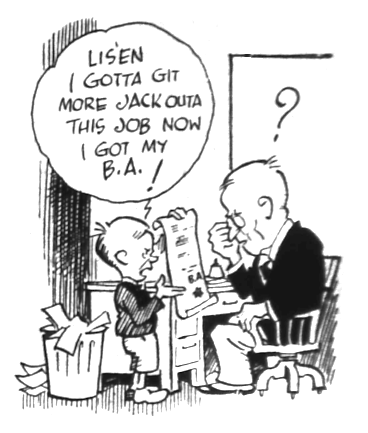
B.A.’s for Office Boys

March 10, 1928

These illustrations accompanying an article by Charles Vining about diploma mills where anyone could get a degree through the mail. As part of the investigation, Vining had the office boy at the Star Weekly get a degree.

March 28, 1928

What Price Chivalry!

March 11, 1939

Hat’s Off!

The commissionaire escorted us rapidly down the sloping paraquet. “Our hats, our hats,” I protested hotly.

By Gregory Clark, Illustrated by James Frise, March 6, 1943.

“How about a movie?” suggested Jimmie Frise.

“That’s rationed, too,” I stated. “At the least, it’s as good as rationed. All the shows in town are war pictures. And that makes them rationed, doesn’t it?”

“There’s a dandy murder mystery at one of the neighborhood theatres up in the north end,” said Jim, studying the ads in the newspaper.

“Well, that’s rationed, too,” I insisted, “because we haven’t any gas to drive away up to the north end. And I’m certainly not going to spend two-and-a-half hours in street cars to go look at a murder mystery.”

“It’s funny how rationing rations far more than the item under control,” admitted Jimmie. “Now, I was going to suggest we spend tonight tying up a few trout flies. The season is only eight weeks away. Yet we would both feel ridiculous tying trout flies.”

“When they rationed gasoline,” I submitted, “they rationed a thousand other things besides. Trout flies are one of them. Because we certainly aren’t going to get any trout fishing this spring. We can’t drive. We can’t go by bus. And it would be sinful to take up space on trains…”

“Besides,” said Jim, “there are no hooks to be bought for trout flies.”

“And since nobody can get any shotgun shells,” I added, “there aren’t any duck feathers to be had for trout flies. Yes, sir. With a little skill in rationing, you can pretty near cut off all the normal activities of the human race.”

“Well, it’s a total war,” explained Jim.

“But they don’t have to make all the movies war movies,” I protested. “I think the moviemakers are a pretty dumb lot. Here is the biggest chance in their history to establish themselves as a great literary force. Now, more than ever in history, is the time to produce great literary masterpieces that not only will help the public escape from the woes of war, but will remind mankind of the greater, more eternal values of life. But what do the moviemakers do? They produce newsreels with a little story mixed up in them. Every movie producer seems bent on producing artificially a more realistic newsreel of war than the newsreels themselves. They don’t realize how hungry humanity is, right now, for a spiritual and emotional experience that will remind them of the depth of beauty and meaning of human life, and help them, escape from the idea that humanity is a pretty hopeless and helpless muddle.”

“The producers are all working hard,” Jim said, “at propaganda.”

All This Rationing

“Well, I sighed, “if they can all be lined up for propaganda as easily as they are now, we are going to see some fun when the war ends, and half of them are propaganding for the great social changes that are foretold, while the other half are propaganding for the old order.”

“Pshaw,” said Jim, “the social changes are as good as in already. What do you think all this rationing and control is but the training we are getting for the socialism to come?”

“Unless,” I submitted, “we get a good strong party that presents as its platform the getting rid of all the controls and rationings. They’d get a pretty terrific following.”

“Listen: “This rationing,” said Jim, “will have effects that never can be eradicated. When you put both the rich and the poor on one patty of butter per meal, do you imagine that will ever be forgotten?”

“Who by?” I inquired.

“The poor,” said Jim.

“My dear sir,” I cried. “I don’t know much about socialism, but I know enough about it to know you’ve got it entirely backside foremost. The idea of socialism isn’t to make everybody do with one patty of butter. It is to give everybody all the butter they need. It is not to give everybody the same. It is to make sure that a few don’t get all they want, while the many have to lead lives of quiet desperation in order to get what little they can.”

“You have to have some incentive…” began Jimmie.

“Don’t say it!” I cried. “Don’t say it, Jim. It is the worst blasphemy ever uttered against humanity. If the incentive of gain were the only thing that kept mankind alive, we would all have passed off the face of the earth 5,000 years ago. Any one of the hundreds of times in human history when no gain was possible would have wiped us out. No, sir; men work for the sheer love of work. And the greatest proof of it are those rich men who are among the most ardent preachers of that incentive stuff.”

“But we wouldn’t work so hard…” began Jim.

“Why should we?” I demanded. “That’s the whole question in a nut shell. Who says we have to work hard? Only the guys who, for no practical reason on earth, want to bully mankind into giving them a million times more than anyone else, and a million times more than they deserve, for all their brains, ingenuity and willingness to work themselves. Just because a guy is no unnatural and inhuman that he wants to collect a billion dollars, why should we let him make boobies and coolies out of all the rest of us?”

“Without leaders, in industry, finance, and…” tried Jimmie.

“Utter hooey,” I assured him. “Take those same guys and cut their salaries to $2,500 not $25,0001, and they would still want to be boss, they’d still work like horses, they’d still use their brains, and energies exactly as they do now. They’ve been kidding us. We’ve let them get away with murder. They can’t help working. They can’t help being clever and ingenious. It’s the way they are born.”

“Do you mean to say,” scoffed Jimmie, “that if we cut the head men down to the same wages as us, they would continue to work as they do, while we go fishing…”

“Certainly,” I replied. They couldn’t be loafers if they tried. You are a loafer because that is your born nature. Or you are a working, scheming fool because that is your nature. If all the money in the world won’t change you and me from being loafers at heart, why do you imagine all the money in the world would change the boss from being the boss.”

“Then?” cried Jim, amazed.

“Take the money away from him, and watch him be himself anyway,” I triumphed.

“I don’t believe it,” muttered Jim incredulously.

“The real enemies of the big social reforms coming,” I submitted, “are not going to be the rich men. Not even the sons of rich men. The real body of public opinion which is going to fight the reform are going to be the gamblers. The guys who live moderately by their wits. All of us you see jammed into the Gardens to watch hockey games, and at the races. The hundreds of thousands among us who believe that winning is a matter of brute strength, skill and smartness. The worshippers of sport. Those are the guys who are afraid of social justice, not the rich industrialists. Every measly little bird you see in our city, with crafty bloodshot eye and a cunning shut mouth – he’s the enemy of reform. He’s the bird who doesn’t want to work. He wants to live by his wits. Very few of them are rich. Countless thousands of them, however, will fight with all the genius of foxes and weasels against any system that prescribes honest work as the basis of their livelihood.”

“You’re pretty tough on sport,” protested Jim.

“I just used sport,” I explained, “to make a quick picture for you men in the mass. You could say the same about the movies or a political rally. The next time you hear anybody talking about incentive and private enterprise, make immediate inquiries about him. And ten to one you’ll find he is a promoter, whose only work is chiselling a few dimes off the man who makes something and a few nickels off the man who buys it.”

“This is tough stuff,” complained Jimmie.

“Listen,” I said loudly, “a man likes to work if for no better reason than to escape, for a few hours a day, from his wife and kids.”

“Put that in a movie,” scorned Jimmie.

“How about a movie?” I demanded. “There is nothing else to do.”

“Will you even go to a war picture?” asked Jim.

“Yes,” I said bitterly. “And first will be a newsreel full of battle. Next will come a Canada’s War Effort short about making torpedoes2. And then the feature, an unsinkable sergeant who shoots Japs out of every coconut tree and marries an heiress in the W.A.A.C.’s.”

“Aw,” said Jim.

But we went.

Behind Big Hats

And the theatre was jammed. And we went all the way down to the front, with an usher, and found no seats. And then we hunted for ourselves, and off to one side, we got two seats together, climbing all over twelve people’s feet at the very moment the hero of the feature was clutching the W.A.A.C.3 to his many medalled bosom.

And when we got seated, we found that two ladies sitting directly in front of us had those big pie-shaped hats that curve upwards in front.

“Madam,” I whispered between them, “would you mind taking off your hats, please?”

Both ladies turned sharply, sat forward so as to bring a sufficient hauteur into the gesture, and then slowly relaxed back, without touching their hats.

I bundled my coat up for a cushion and sat on it.

But still I couldn’t see past those two hats.

“Can you see, Jim?” I inquired loudly.

“If they’d sit still, I could catch glimpses,” confessed Jim.

The ladies had the habit of leaning together and then drawing apart, a habit not uncommon among those who, while not wanting to discuss the picture play by play, still wish to communicate to each other their appreciation of the finer points of the film.

“Usher,” I called modestly, to an usher, hustling up the aisle twelve seats away.

“Sssshhhh,” said six people. I looked around.

“Can you folks see?” I asked those directly behind me.

“We can see but we can’t hear,” replied a sour lady.

Suddenly, I had an inspiration. I took my hat from under the seat and put it on my head.

Jimmie looked at me with delight, and promptly put his on.

“Hey, there, hey, cut that out,” came several voices back of us.

“If these ladies,” I announced resolutely “can wear their hats, so can we.”

As I turned around, someone from behind swiped my hat off my head, and it bounced off Jimmie and went into the darkness three or four seats to the west.

Meanwhile, the two ladies had leaned forward slowly in their seats and turned equally slowly, and were surveying the disturbance with high disdain.

“Pass me my hat, please,” I requested.

Jim’s was still on his head. After a few scuffles, my hat came back to me and I placed it at once on my head.

Now fifteen or twenty people were standing up behind us and among the angry outcries were calls for “usher, usher.”

We sat grimly, holding our hats to our heads.

Deep-Rooted Customs

A social revolution is a sudden thing. At first, just a few angry outcries, lost amid a widening mutter and murmur of discussion. Then all of a sudden, everything explodes.

My hat was jerked from my head and I didn’t even see it depart. Jim’s I saw go sailing ahead fifteen rows. Ladies began screaming. One of the proud ladies in front, with the offending hats, rose to her feet and shouted into the darkness:

“George, where are you. Come quick!” And from three rows behind, two gentlemen, apparently the husbands of the offenders, came hurdling and grunting, and all was great confusion of shoves and hoists and bunts with knees, until I found two ushers helping me to escape, Right behind me, two more ushers were helping Jimmie along.

And without any delay whatever, we were hurried out the doors where the large elderly commissionaire at the ticket escorted us rapidly down the slanting parquet.

“Our hats, our hats,” I protested hotly.

“Inquire for them,” said the commissionaire, “at the box-office after hours.”

And he dusted us out on to the sidewalk.

This being a neighborhood theatre, we did not wish to attract the attention of any people who might know us by standing on our rights or even our dignity. So we pretended we were just leaving the theatre anyway, and we hurried a few doors east and went into the ice cream parlor and got a sheltered booth in which to recover our composure.

“Well, anyway,” I stated, “my hat was an old one, and I was thinking it was time I got a new one.”

“The same here,” said Jim. “But that just goes to show you. You can’t try innovations. You can’t easily upset old, established customs.”

“I’ll bet those ladies have got their hats off now,” I argued. “It takes a few revolutionaries like us to bring about social justice.”

“I bet they still have their hats on,” retorted Jim, “and I bet not only do they feel like social heroines, but half the people around them are looking admiringly at them.”

“If their husbands hadn’t been sitting back of us,” I stated, “I bet we would have won the argument.”

“Naw,” said Jim, “it is you that doesn’t understand human society. Things are too deep-rooted even for justice. It is an old, deep-rooted custom for ladies to wear their hats in movies, even if they constitute a public nuisance. But it is unheard-of for men to wear their hats in theatres.”

“But how about justice?” I demanded heatedly.

“Okay,” smiled Jimmie, smoothing his ruffled hair, “how about it?”


Editor’s Notes:

  1. $2,500 in 1943 would be $44,800 in 2025. So $25,000 would be $448,000. ↩︎
  2. Not the same thing, but if you want to watch Canadian Army Newsreels, they are on Youtube. ↩︎
  3. W.A.A.C. was short for Women’s Army Auxiliary Corps, a term used in various wars and countries for women who volunteered to help free up men for combat roles. It became a catch-all term for women in the military, though there were other acronyms. In Canada in World War 2, they were the Canadian Women’s Army Corps (CWAC). ↩︎

Plain Man

Premier Frost (r), meets with Col. George Weeks (l), Minister of Cuisine, and Duncan Sinclair.

By Gregory Clark, March 1, 1952.

To offset the rigors of civic life, Ontario’s Premier Frost1 holds sessions of his Kitchen Cabinet in a country cabin

An Old Ontario Expression

Premier and Mrs. Frost were in Port Arthur and Fort William not long ago in connection with a civic function. At the reception, a little old lady came up and, after a few minutes conversation, said to Gertrude Frost:

“Everybody told me how plain you were. I’m so happy to find it is true.”

Mrs. Frost patted her hairdo, and, at the first opportunity, looked at herself in her compact. For down around Lindsay, “plain” means only one thing. It means “homely.”

A few minutes later, the little old lady’s husband presented himself to Mrs. Frost.

“When my wife told me how plain you are,” he confided to the prime minister’s wife, “I knew you wouldn’t mind me coming up and speaking to you.”

It then dawned on Mrs. Frost, who is a highly personable woman, that in the Port Arthur and Fort William idiom, “plain” means “unaffected.”

With a large wicker market basket on his arm, the Prime Minister of Ontario2 reaches into his pocket for his keys.

The contents of the basket are discreetly hidden under a green cloth.

The prime minister is a big, strongly-built, long-legged man who walks with a barely perceptible limp. He is wearing old hunting clothes – canvas pants, a hip-length quilted hunting jacket, red-lined cap and lumberman’s rubbers. All nicely worn.

He finds the keys and selects one. With it, he opens the back door of the log cabin, set deep in the snow. It is not one of these fancy imitation log cabins; its timbers are more than a century old and they are chinked roughly, in the old fashion.

Inside, it is icy cold. But the prime minister lets out a hearty yell, and the two or three men coming through the snow behind him echo the cheer.

They are what is called his Kitchen Cabinet. They stamp into the room.

The log cabin consists of three rooms. In the far-end one are two double beds, with homemade quilts on them. This middle room we are in has three rocking chairs in it, a bench, a couple of less noble chairs and a Quebec heater3, which the prime minister immediately attacks, with kindling in his hand.

The other end room of cabin is the kitchen, small because of the largeness of the cook stove.

The No. 1 man of the prime minister’s Kitchen Cabinet the Minister, let us say, of Cuisine – is Col. George Weeks, manager of the Victoria and Grey Trust Co., of Lindsay, Ont., a 30-year chum of the prime minister. The others in the party might be Jack Deyell, who owns a printing business in Lindsay, or Judge McGibbon, or Ernie Fee, of Fee Motors, Ltd., Lindsay. They dump down their parcels and haversacks. The minister of cuisine takes the prime minister’s wicker basket off the table and carts it into the kitchen, along with his own packages. He whips off the green cloth.

Four steaks, maybe, or a large hunk of peameal bacon: chops maybe, thick; loaves of bread, pickles, potatoes, onions.

“Wow!” says the prime minister, looking in from the middle room, where the fire is now hustling.

“Aaaah!” says the minister of cuisine, unwrapping his own contribution to the kitchen table, which may be more steaks, or a hoarded roast of venison. And he attacks the big stove with kindling.

The weekly meeting of the Kitchen Cabinet is now in session. To this log cabin, with one or two or three of his oldest friends. Leslie Frost, landslide prime minister of Canada’s richest and most industrialized province, comes every weekend from the capital city of Toronto, where he has no home but only a hotel room.

You might suppose this log cabin is away in the wilderness. It is only 10 miles from Lindsay, which is the Frost home, and Lindsay is 78 miles from Toronto. Not merely is it only 10 miles from Lindsay, it is only 100 yards from the Frost summer cottage on Pleasant Point, Sturgeon Lake. Some miles away in the Haliburton backwoods, Leslie Frost found an old pioneer log house, built of broad-axed square timbers. He had the timbers brought down to the open field behind his summer home, and the cabin was erected. It is his hideaway. And unless the business before the Ontario Legislature is really desperate, every weekend of the year, session or no session, and no matter how cold the winter, Leslie Frost, in his fishing clothes or his hunting clothes, in season, beats it away from the great world in which, almost unwillingly but certainly without any great intention, he finds himself enormously involved.

Not every weekend does he take his friends. Often it is his wife, Gertrude, who goes with him to the sanctuary of the log cabin. Whatever it is that Frost has got which so attracted the Old Man Ontario spirit of the Ontario voters last November that they returned his government to power with the overwhelming majority of 81 seats out of the 92, it is here in the quiet that he keeps it alive and unimpaired.

And it was here, in one of the three big rocking chairs of the middle room, that I talked to him, sitting in his mother’s old rocker, in an attempt to get a sort of profile of this small-town lawyer who guides, if he does not indeed control, the destiny of an enormously wealthy and tremendously expanding industrial province.

In the first place. he is not a small-town lawyer. That is one of those handy newspaper phrases that are entirely misleading. More misleading though enthusiastic descriptions have been uttered of Leslie Frost than of most contemporary public men. They say he is a great, good-natured, easy-going character. But he can get as mad as a hornet. And no less easy-going man ever chased an elusive phrase through 40 pounds of legal volumes. He is an insatiably curious and tireless man.

As for being a small-town lawyer, he and his brother, the late Cecil Frost, KC, who was his partner in Lindsay ever since they graduated together from Osgoode Hall in 1921, were two of the best-known lawyers in Canada – in courts of all degrees, in city and town – and built up a law practice and an insurance business that was so lucrative that everybody in politics knows it was a great personal sacrifice for him to enter politics at all

Sitting there in his old hunting clothes in the big rocking chair, he nonetheless conveys the impression of all these very misapprehensions: he does seem like a big, easy-going, kindly country lawyer. He resembles physically and very remarkably the English actor, Michael Redgrave, whom I met last summer.

His speech is quiet and filled with plain English. It is full of such phrases as “You’re right!” and “That’s a fact!” or “Now, let’s see!”

He is no orator, no spellbinder, either on the platform, in the courtroom or in a log cabin. He has a habit of pausing abruptly in the midst of an easy and casual flow of words. He reflects. Like a hunter following a track, you see him scanning the ground. Then he proceeds with what he has to say.

And after a little while with Leslie Frost, the characteristic that you have been puzzling to find becomes suddenly clear.

He may be a lawyer, he may be a businessman, he may be a politician – but what he is, above everything, is a wise counsellor. It was in that character that he built up, with his brother, a prosperous legal practice in Lindsay. It was with that characteristic that he made himself countless personal friends in Lindsay and throughout the counties of Victoria and Haliburton, in all the little villages and hamlets with such endearing names as Manilla, Little Britain, Fingerboard, Coboconk, Omemee, Buckhorn, Janetville, Norland, Elsie.

He was 39 years old, and with no thought of public life in mind, when his reputation as a wise counsellor and the wide local popularity it had inspired, shoved him into an election in 1934. That was in the whoop and hurrah of the Hepburn era. Frost was beaten. But in 1939, he was elected. From his first entry into public life, he was earmarked for office. Though in the Opposition in 1939, he was delegated by George Drew, the Conservative leader, to be financial critic of the government. And when, in 1942, Drew formed a government, Leslie Frost was appointed provincial treasurer and minister of mines.

That was in the midst of war. But it was also, in some sense, the real beginning of that enormous industrial expansion of Ontario, caused by war production, which has not slackened since. And to get this man, rocking in a chair in a log cabin, into full focus, the simplest thing to do is to state in plain figures the rather staggering statistics of the money he as provincial treasurer, has had to find, account for, provide and spend in the 10 years he has been provincial treasurer, and the three years he has been prime minister.

This is what has happened in Ontario, in its expansion as an industrial province, since he took over the account books:

In the last year of the Hepburn regime, the budget showed Ontario’s expenditures for 1942 were $96,337,015.

Frost’s budgets show the subsequent provincial expenditures to have risen from $92,000,000, when he took over, to $250,000,000 last year! This year’s budget, to come down soon, will be bigger still.

How does all this spending jibe with the figure of that good gray character, Old Man Ontario? Since 2,000,000 of Ontario’s 4,500,000 people live on the land, and since a great many of the other 2,500,000 who live in communities are village and small-town people, how does it come about that the man who handles the spending of all that money was returned to power in a political landslide? Don’t the little people worry about money any more?

Well, in the nine years of Frost budgets, there never was one cent of deficit. Each year there was a surplus, ranging anywhere from $1,000,000 to $25,000,000.

And here, in a rocking chair in his old hunting coat, with the Quebec heater humming, sits the man who has to say “Yes” and “No.”

I had the budget statistics in my notebook as we talked. And I told him I was trying to rationalize them in terms of a small-town lawyer. Frost smiled and shoved his hunting cap back on his head, as though the room were getting warmer now.

“Well,” he said, “there were quite a few people elected besides me last November.”

Which is true. He has a fine company of men in his cabinet; and, because of his characteristic habit of consulting high, wide and handsome, has many a good adviser among the rank and file of the membership of the House. He sits in his cabinet as the chairman. And if he is a wise counsellor by nature, habit and training back in Lindsay. Little Britain, Omemee. Buckhorn and Fingerboard, it is not much of a move to become a wise councillor at the big table in Queen’s Park.

Besides which, of course, he has his Kitchen Cabinet. Every weekend.

“In 30 years,” says Col. George Weeks, who is the cook at the log cabin and a very gifted cook against whom even Mrs. Frost is not keen to compete – “in 30 years, there has never been a political gathering of any kind at that summer cottage or that log cabin. Now, mind you, I don’t say we don’t talk politics. But there has never been a gathering of politicians.”

In fact, it goes farther than that. With very few exceptions, Leslie Frost has never invited any of his political colleagues down to Pleasant Point. It is strictly a retreat, a hideaway from the big world. And on the couple of occasions on which big shots in the business or political world were so ill-advised as to come down uninvited and unheralded to the log cabin, just to “drop in” on Leslie Frost, they got what might be called a frosty reception. His cronies say that the premier never gets mad about big things but always about little things like that.

Two years ago. Premier Frost’s large, amiable imperturbability was broached by one of the more gadfly members of the Opposition in the Legislature, and he lost his temper in the sudden, spectacular fashion common to the imperturbable. The account of it made the headlines, of course. And a couple of days later, he got a personal note from the late Mackenzie King, perhaps one of the last such letters the old statesman wrote, in which he cautioned Frost against allowing anything to shake his temper, and to be sure to take plenty of relaxation away from the pressure of office. Premier Frost treasures that letter among his most precious possessions.

“As a matter of fact,” he admitted, in the old log cabin, “I have to confess I try to model my own political life on that of Sir John A. MacDonald and Mackenzie King. I have read all their speeches, studied their lives, to try to convert, into terms I can understand, their political attitudes to what is good for Canada and good for us all.”

Leslie Frost is 56 years old. He was born in Orillia, Ont. He and his brother, Cecil, who was a year and 10 months younger, went to World War I as lieutenants and came home captains, both badly wounded – Leslie with a severe hip injury that hospitalized him for 17 months. He and Cecil, most devoted brothers, went to Osgoode Hall, in Toronto to study law, and then bought a practice in Lindsay, a town not far from Orillia, in which they were on familiar ground.

They married sisters, the daughters of John Carew, MLA, of Lindsay. The Frost boys being the sons of “Daylight Bill” Frost, of Orillia, who held nearly all the elective offices in that municipality, there was consequently a fairly lively awareness of politics in the whole Frost-Carew family setup. Cecil became mayor of Lindsay and president of the Ontario Conservative Association. But Leslie was approaching middle age before he even thought of entering public life.

Leslie and Gertrude Frost, therefore, have no great pretensions about public life or politics. They have no children. They have never set up a home in Toronto, despite Frost’s 10 years of service as a cabinet minister and prime minister. They have a beautiful red brick house in Lindsay, a cottage down on Pleasant Point located exactly on the site of a former small settler’s cabin which, in 1921, the two young captains home from the wars rented and lived in, six months of the year, commuting each day by steamboat up to Lindsay, until they got their law and insurance business perking.

And they also have this log cabin in which the so-called small-town lawyer, who only gets mad at little things, can, each weekend, take wise counsel with himself, his wife and his old, old friends, so that, on Mondays, he can go back happy to his office as chief administrator of a $250,000,000-a-year enterprise – a province bounding ahead into an industrial destiny that beggars the dreams of only 10 years ago.

About the only thing Premier Frost didn’t like about last November’s election was that he missed the deer hunt.

“What kind of a deer hunter is he?” I asked one of his cronies.

“Awfff!” snorted his friend. “About the same as he is a fisherman.”

“And what’s that?” I asked.

“Instead of sitting still and fishing,” explained his chum, disgustedly, “he keeps saying, ‘Well, I think I’ll just row around that next point and see what’s beyond there…’ The man is desperately curious. Hunting, he’s always got to see over the next hill. I never saw such curiosity. Of course, he gets his deer, too.”

“And fish?” I queried.

“Oh sure,” admitted the friend. “That is, unless he comes across some old ruined log shanty, or hears of an Indian burial ground or something. The guy is a historian gone wrong.

There isn’t an old homestead, a pioneer family, a long-abandoned lumber camp or sawmill within miles and miles of Lindsay that Les Frost doesn’t know all about. He can give you the vital statistics, names, dates and every last pernicketty particular…”

I might conclude this sketch of Premier Frost with the remark that while I called uninvited at the log cabin on Pleasant Point, he did not get mad, but, on the other hand, offered me a lift back to Toronto in his car. He drove me right to my home, away across the other side of town, and then, at my invitation, came in and shook hands with my wife and daughter, just to show them what a big guy I am to have prime ministers trotting me around.


Editor’s Notes: This article appeared in Weekend Picture Magazine.

  1. Leslie Frost was Premier of Ontario from 1949 to 1961. He became Premier when we was elected leader of the Conservatives on May 4, 1949 after George Drew resigned to run for federal office. His first election as Premier occurred on November 22, 1951, a few months before this article. ↩︎
  2. The term “Prime Minister of Ontario” remained in colloquial use until the government of Bill Davis formally adopted the usage of the term Premier in 1971. ↩︎
  3. A Quebec heater historically refers to a type of tall, cylindrical, cast-iron wood or coal-burning stove used for heating homes and cabins.
    ↩︎

Page 2 of 115

Powered by WordPress & Theme by Anders Norén

"Greg and Jim"