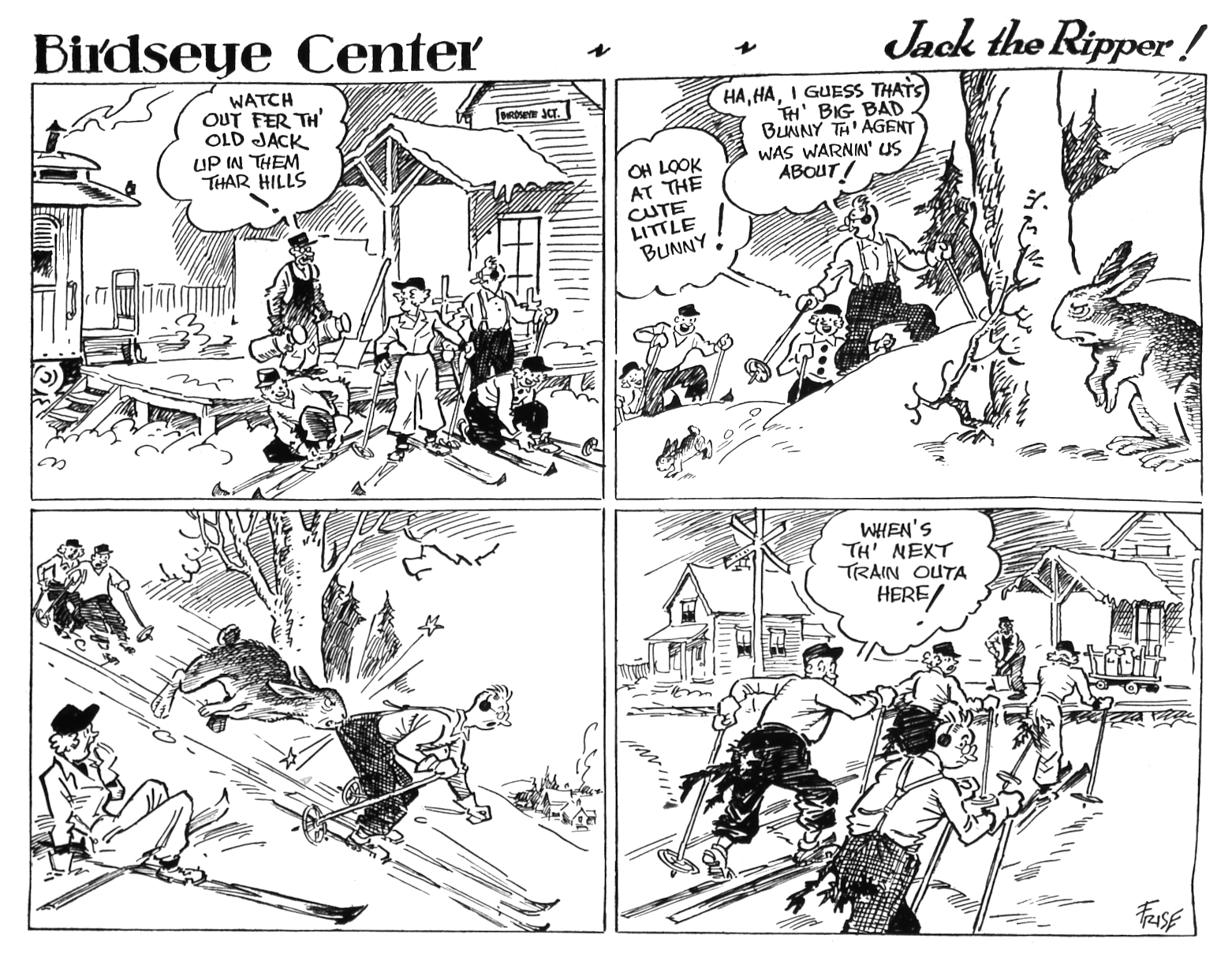
By Gregory Clark, Illustrated by Jim Frise, February 28, 1948.
“What’s eating you?” demanded Jimmie Frise.
“Pigeons,” I informed him dully.
“Ah, those beautiful creatures!” cried Jim, enchanted. “Symbols of peace and serenity! From the earliest times, doves and pigeons have been beloved of mankind as the inseparable harbingers of happiness and good fortune.”
I cocked a lack-lustre eye on him.
“Pigeons!” mooned Jimmie. “I used to keep them as a boy. In ancient days, every home that was a home had a dove cote1 or pigeon loft as an integral part of the house structure. The pigeon…”
I interrupted him bluntly.
“How would you like,” I demanded, “to have a bunch of pigeons come every morning, at daybreak, and start yelling outside your window?”
“Yelling!” protested Jim.
“It’s the worst kind of yelling,” I yelled. “It’s subdued yelling. When you’re sound asleep, at the break of day, busy with the loveliest sleep of all – those couple of hours from dawn on – you suddenly become aware, through your dreams, of a horrible and mocking sound. It sounds like demons moaning. It sounds like lost souls, half a mile away, yelling in torment. It sounds like somebody starting to throw up.”
“Oh, what a horrible misrepresentation of the cooing of doves!” cried Jimmie, shocked.
“Jim,” I stated desperately, “for the past 10 days, a gang of rowdy pigeons has adopted my house. Somebody in the neighborhood, I suppose, has got sick of them and driven them off their premises. And they’ve squatted on mine. I won’t have it.”
“You’ll get to love them,” assured Jim.
“To me,” I glared, “those last couple of hours of morning sleep are precious beyond anything else I can possess. By daybreak, I’m really coasting in sleep. I’m deep, dark, down in such a bower of lovely sleep that I… I…”
I took a deep breath and went on:
“Jim, they not only yell and gobble and quack…”
“Not quack!” corrected Jim doggedly.
“They not only emit,” I declared, “the most insidious, penetrating and disturbing sounds with their beaks, but they scratch with their toenails. From the crack of day, they all start waddling restlessly around, back and forth, back and forth, like the feeble-minded creatures they are, just scratching their toenails on the galvanized iron eaves, on the raspy roof shingles. What’s the matter with pigeons? Why don’t they sit down and relax like anybody else?”
“It’s their nature to be active,” submitted Jim.
“Active!” I sneered. “Not only do they keep up this endless mooing and gagging, not only do they keep endlessly scratch-scratch-scratching back and forth on the roof: but every few minutes, they jump up and take a short fly, of about five yards, with a lot of whistling and whooshing of wings, only to settle right down again and start that lunatic toenailing back and forth, back and forth… And a poor guy trying to sleep…!”
“Look: why don’t you get up and shoo them away?” asked Jim kindly.
“I do; and they come right back!” I groaned.
“What are you going to do?” asked Jim – quietly, for he could see I was a desperate man.
“Jim, I’ve done it!” I informed him. “I’ve got a trap made. With slats and chicken wire. I’m going to set it up tonight, on a little shelf sort of place above my window. I can reach it from an attic window. I’m going to bait the trap with dried peas. And when I hear the fool “things in the trap, I pull a string. And bingo! I’ve got the pigeons!”
“And then?” inquired Jim, sternly.
“Well, they’re trespassers,” I asserted. “I could wring their necks. Or I could cart them down to the Market and give them to one of those poultry butchers.”
“Pardon me,” said Jim coldly. “But do you realize that pigeons come under the heading of livestock? How do you know that those pigeons aren’t the prized possession of some pigeon fancier in the neighborhood?”
“Any pigeon fancier,” I retorted, “who can’t feed his birds enough to keep them around home isn’t entitled…”
“Oh, yes he is!” assured Jim. “At this season of the year, the pigeons are beginning to feel the first faint notions of spring. They get restless and explore around. All I want to do is warn you that maybe those pigeons on your house may be racing pigeons, worth hundreds of dollars.”
“Oh, nonsense!” I said.
“I’m telling you!” insisted Jim. “You’ve got to be careful fooling with pigeons. There’s a lot of law involved…”
“Okay!” I announced. “You come with me. You know so much about pigeons. You come and help me trap them. And then, if I keep them a couple of days maybe the owner will come hunting them up. You know how kids will spread the news. If he wants them, he can have them: after hearing an earful from me. Otherwise, if nobody claims them..!”
Jim, shaking his head, got his coat on and we went over to my place. In the yard, I showed him my trap; an arrangement made out of an old box and some slats and bits of chicken wire. It had a simple flap front that fell when pulled by a string.
It was no trick at all to carry it to the attic and put it out on the ornamental shelf above my bedroom window. No trick at all to set the front flap to fall, by a yank of cord from my window below. And just as I said, all the kids in the neighborhood were gathered to watch the installation. Both girls and boys, they clustered from far and wide below while Jim and I worked out the attic window.
“What’re you gonna catch, Mr. Clark?” yelled one of the nosiest little girls of the neighborhood. “Pigeons?”

“No, muskrats,” I replied disagreeably. “Now, run along; beat it!”
Which brought all the more.
“Anybody who owns pigeons around here,” I muttered, “will know about this before tomorrow.”
When the trap was set, I sprinkled a handful of dried peas on its floor.
“Now,” I said, “at the crack of dawn tomorrow…”
“You won’t have to wait until the crack of dawn, interrupted Jimmie.
For like vultures wheeling came a flight of seven pigeons, their wings V-ed, floating and flapping overhead while they came to peer at the new contraption under my roof edge.
“Why, the blame things!” I ejaculated, as we ducked in the attic window. They can even hear the rattle of a few dried peas!”
We hastened down to my bedroom, where, leaning out the window, I reached the dangling cord of the trap and drew it tenderly within.
“They’re very trusting,” said Jim, “when it comes to food. Give them a little time. Let one in the trap. The rest will follow.”
The seven landed on my roof and came and peered, their heads bobbing as if on rubber necks, over the eave trough. True to their character, they anxiously and aimlessly waddled this way and that; bobbing, peering.
“Grrrr!” I growled, my hand trembling on the trap cord. “Listen to their toenails! See what I mean?”
“Those are fine birds,” commented Jim, as we crouched behind the curtains.
Without much delay, the leader of the flock, or its most foolish member – I don’t suppose there is much difference – flipped lightly off the eave trough down into the trap.
One, two, three – the rest followed. And slam fell the front flap. Seven startled, indignant pigeons were flapping frantically inside the box.
Jim and I galloped to the attic, reached down and secured the flap. And the wild yells of kids up and down the block spread the news that Mr. Clark had trapped 100 pigeons.
We lifted the crate in through the window. We carried it down to the back cellar, which is cool yet not cold; the ideal place, in Jim’s opinion, in which to keep the birds prisoner until such time as their owner was located.
We set the trap on an old washtub bench and I turned on the lights. The birds were still flapping and fluttering in bird-brained irresponsibility. The more tenderly we approached them, the more panicked they became.
“They’re so…” sighed Jimmie, “… so gentle, so timid, so childlike. Of all birds.”
As we sat, they quieted; though they kept twisting and turning among themselves. I had never bothered much to look closely at pigeons. They were things seen mostly, you might say, out of the corner of my eye.
“Man,” I said, “look at the colors on that one!”
He was not merely lustrous. He was opalescent. For all the indignity of his situation, he stood with a proud look: his breast high; his eye like a jewel. Over his beak there was a tiny white ruff like a comb.
“Jim,” I claimed, “he’s beautiful.”
“More than that,” amended Jim, “he’s valuable. See that ring on his leg? That’s his registered number, I bet. He’s probably a famous racing pigeon. Maybe worth $200.2“
“Holy smoke!” I muttered, getting around the side to look at some of the others. They were all characters. They were blue and gray and white. They were plump, strong, compact. They ALL had rings on their legs.
“Perhaps,” I suggested, “maybe I ought to release them this once, after a warning…”
We heard the buzz of the doorbell overhead in the kitchen; heard footsteps answering; and then a male voice – a loud male voice.
Then footsteps across the kitchen and the cellar door opening.
“You down there, Dad?”
“Yes.”
“A gentleman to see you.”
And down the stairs came large legs followed by a large bully, if ever I saw one.
He was a stranger to me, though I believe I had occasionally seen him around the corner drug store.
“Ah!” he barked, halting on the bottom step. “My pigeons!”
“I’m glad to hear it,” I retorted promptly, being a great believer in taking the offensive with large men. “These birds have been trespassing on my…”
“Trespassing, eh?” sneered the bully. “Fine. That’s fine! Well, your dog has been trespassing on my verandah. So I’ve got him outside in a crate, too!”
“My dog?” I inquired lightly. “Oh, no. My dog doesn’t trespass on anybody’s verandah. Besides, she’s not a him. She’s a her. And she’s never out of our garden.”
“I think I know your dog when I see it,” declared the big bully. Advancing truculently and seizing the cage full of birds, he lifted it in his arms.
“You can come and see,” he glowered, marching up the cellar steps.
We followed. We went out the drive. In the open trunk of his car was a crate. And in the crate, very dejected, sat Rusty, Jimmie’s Irish water spaniel.
“Why,” cried Jim hotly, “that’s MY dog!”
“I always thought…” protested the bully, “I always took this for HIS dog!”
We hastily lifted Rusty and crate out of the car trunk and the bully set his pigeon crate in its place.
“When the children,” declared the bully, agitatedly, “told me about my pigeons being trapped, why, I just thought…I just… well, you see, this dog is always trespassing around my place…”
He paused, and took out his handkerchief and wiped his brow.
“No, by Jove, he doesn’t trespass!” he declared loudly. “He’s as welcome as the flowers in May; and has been for years! Many’s the time I’ve come near to making you a proposition for this dog, Mr. Clark. Many’s the fine visit we’ve had together and many’s the fine walk. I live ’round on the other block…”
“Well, now, Mister… Mister?” I replied.
“Hoogenbeck,” he supplied. “Joe Hoogenbeck.”
“Well, now, Mr. Hoogenbeck,” I said warmly, “about the pigeons. In the last few days, they’ve been coming onto my roof at dawn and waking me…”
“Pigeons,” said Mr. Hoogenbeck, with dignity, “can’t wake you if you’ve got an easy conscience. That’s an old saying.”
“I don’t think,” cut in Jim, hoisting Rusty out of the crate, “they’ll wake Mr. Clark after this.”
So Mr. Hoogenbeck and Jimmie shared Rusty for a few minutes while I went and peeked in at the pigeons.
Editor’s Notes:
- A dove cote is a structure intended to house pigeons or doves. Dovecotes may be free-standing structures in a variety of shapes, or built into the end of a house or barn. They generally contain pigeonholes for the birds to nest. Pigeons and doves were an important food source historically in the Middle East and Europe and were kept for their eggs and dung. ↩︎
- $200 in 1948 would be $2,725 in 2025. ↩︎

By Gregory Clark, February 27, 1915.
One-Fifth of Enrolment Will Possibly Enlist in Canadian Expeditionary Forces.
Sturdy Patriotism of President Falconer Largely Responsible for Splendid Showing.
Not more than three months ago a good many men were looking slant-eyed at the University of Toronto, sniffing and snouting excitedly, and demanding the instant pulverization, of three very inoffensive professors who were so unfortunate as to be of German blood. Some members of the University’s own governing board publicly denounced the gentle and humane way in which the three professors were side-tracked, and demanded that the president accord them the very treatment the abhorred Germans would have doled out had the incident been in a German town. The result of that whole affair left a very unpleasant regard for the University in a section of the public mind. Varsity was quietly labeled as a secret hotbed of sedition, whose staff was in sympathy with Germany.
Let those who have been so loud in condemnation of the president and his “half measures” turn an eye on Varsity to-day. So far, one hundred and eighty-six students who have already enlisted have been granted their year – that is, marked as having passed the examinations they would have been trying this coming April. Eighty-six of these are with the first contingent and are now somewhere in the fighting zone. One thousand eight hundred students are enrolled in the Varsity Officers’ Training Corps and are drilling and attending military lectures. Each day sees another batch of men applying at the registrar’s office for permission to go to the front. With the closing of the term in April and with the opening of a training camp outside the city exclusively for Varsity men, the number of students actually going to the front will be, according to the word of a man intimately identified with the military movement at Varsity, not two hundred, as it now is, but six hundred, which is one-fifth of the male attendance at Varsity.
A Patriotic Centre
For the fact is, despite the snuffings and snoutings aforesaid, which were mostly on the part of those who fancied they could discredit certain members of the governing board of Varsity for political reasons, the University is one of the most practically patriotic centres in Canada. There is a daily practice of patriotism in drills and in attendance on dry technical lectures on military topics. What other body of men – banks, factories, shops, foundries -would so unanimously devote its leisure to drilling? And the drilling has not ceased with the novelty of it.
The handling of the military movement at Varsity is a delicate job. In a body of young men in which there is fraternity, rivalry, and ambition, it is no easy matter for one man to see another don a uniform and depart amid applause. The wonder is, indeed, that when one Varsity man went, the whole establishment didn’t go! There are, therefore, many sensitive young men at Varsity to-day. How to make it easy for the students to go and yet not force them into going, how to maintain the proper display of patriotism without making several thousand sensitive young fellows feel that they are committed, is the big problem at Varsity, the man who is handling it, and handling it successfully, is President Falconer.
Difficulties Increased
The difficulties facing President Falconer were tremendously increased by the German professors affair. War-time and an uncertain public temper: a deficit of $80,000, to be paid by a publicly controlled Government: and three Germans to be disposed of with the assistance of a warring board of governors! Of course, we now admit that the president took the only course in keeping with British fair play. But starting with such a muddle, the whole situation at ‘Varsity has been easy matter to handle, and to have got 200 away already and the whole institution maintaining a natural pitch of patriotic spirit, is the neatly diplomatic and tactfully developed situation to the credit of President Falconer.
It is planned to open a training camp exclusively for Varsity men after the close of the year, in May. It will be somewhere outside the city, possibly at Long Branch or Niagara. It will be conducted by the Officers’ Training Corps under Col. Lang. As many as want to go to the front can then go, and, considering the need in the Imperial army of men not only trained as officers, but as engineers, surveyors, linguists. doctors, and all branches of education ‘Varsity will no doubt see her opportunity.
The Faculty of Medicine has done most in recruiting. The Medical College, by no means the largest college. has sent over 60 students and members of the teaching staff. Arts have not done so well, considering their numbers. But the Arts enlistments will no doubt be swelled by Victoria College, which has taken the greatest interest in the military movement. The opening of the training camp will without doubt see 600 recruits from ‘Varsity.

Marcell waves were a popular hair trend in the 1920s, along with bobs.

By Gregory Clark, Illustrated by James Frise, February 20, 1943.
“Forty cents!1” protested Jimmie Frise loudly. “Forty cents to develop a film!”
“Ah,” I explained, “but that includes printing the snaps, too. If they’re any good.”
“Forty cents,” muttered Jimmie. “I bet there isn’t two cents’ worth of chemicals used. In fact, the way they put through 500 amateur rolls of film at one time, in a bathtub, I bet the chemicals wouldn’t cost a fraction of one cent per roll.”
“There’s the overhead,” I explained.
“Some little old dirty damp darkroom,” snorted Jimmie. “In some back attic of some old downtown warehouse.”
“Okay,” I submitted. “Then why don’t you develop your own rolls? You say it used to be a hobby of yours when you were a kid.”
“As a matter of fact,” declared Jimmie, “everybody who takes pictures should develop his own. Not only is it a fascinating hobby. It rounds out the whole art of photography. All over this city are nice, happy people with cameras, shooting pictures for all they’re worth. Pictures of soldier sons or soldier sweethearts in their new uniform. Pictures of new babies. Pictures of new brides. A lot of happy, eager people doing their best to capture in pictures a moment, a mood, a crisis of joy or happiness. And then what happens?”
“I know,” I said. “They can’t buy any film.”
“No,” cried Jim. “Suppose they have a film. In 100 different places, at different times of day, by different lights, sunlit, dull or almost dark, these pictures are taken and then rushed to the corner drug store. From the drug store they are collected by the bathtub corporations that develop and print the pictures. The precious, hope-laden films, shot by all these expectant amateurs, are rushed downtown to some damp mass production darkroom, where the whole works are dumped into hog troughs, bathtubs and vats with 19 cents’ worth of chemicals taken from barrels. The whole lot is swished and whirled around for a few minutes and then fished out.”
We Shouldn’t Dogmatize
“What do you expect for 40 cents?” I inquired.
“Well,” declared Jim, “every one of those films in those hog troughs and bathtubs was taken under different conditions of light, under varying conditions of expertness. To get the best out of them, every one of them should, be developed separately, in front of a ruby light, the operator watching with expert care to see that the utmost value of the film is preserved, giving it neither too much nor too little development…”
“Maybe you can get that kind of developing,” I suggested, “by paying for it. But it would be a lot more than 40 cents for a roll all developed and printed.”
“I’ll bet you more swell pictures,” declared Jim, “are ruined by mass development than by amateur shutter snapping.”
“What do you expect?” I demanded. “This is democracy. This is not technocracy. Under our system, anybody is free to buy a camera and shoot pictures. Some buy cheap cameras and never learn how to run them. Others buy costly cameras and make a technical and intricate hobby of it. The ones who buy the cheap cameras and never learn how to operate them are perfectly content to take their films down to the drug store and let the bathtub boys develop them. If they turn out lousy, the least surprised of all is the owner of the cheap camera who doesn’t know how to run it. That’s democracy. It permits anybody own a $500 camera or a $2 camera: whatever you like. It also permits anybody to become his own amateur developer. It also permits a bunch of the boys to organize a little company and gallop around daily, by motor car, to all the drug stores, picking up rolls and pitching them into bathtubs.”
“Democracy,” agreed Jim, “gives elbow room for all the saps. Imagine a guy paying $500 for a camera.”
“And imagine a guy,” I inserted, “paying $2 for a camera and then not knowing how to run it.”
“The more money spent, the bigger the sap,” maintained Jim.
“False,” I decided. “Because maybe the guy who spent the $500 has plenty of money, and if he hadn’t spent it on a camera he might have spent it on a 10-year subscription to all the professional hockey games until the end of the season of 1953. You can never dogmatize about the way a guy spends his money. Maybe the sap who bought the $2 camera and then didn’t learn how to operate it spent $498 on a lawyer to get him out of a breach-of-promise suit. No, sir. You never can say one man is a sap and another isn’t. The safest course is to believe that everybody is a sap. Then you can’t go wrong.”
Sly Digs At Democracy
“Is this a veiled attack on democracy?” inquired Jim sternly.
“Not at all,” I assured him. “The question is: Does democracy breed saps? Or do saps breed democracy? Hitler tried to find out. So he’s finding out.”
“Look here,” exclaimed Jimmie, “you’ve been taking some pretty sly digs at democracy lately. What goes on? Where do you stand?”
“It isn’t democracy,” I explained. “It’s just humanity. Look: we live under a free, democratic system of government in which the elected representatives of the people sit in parliament. Is that agreed?”
“Correct,” said Jim stoutly. “Representative government.”
“Okay,” I submitted. “An election is coming along. So, in the riding in which we live a meeting is held to choose a candidate for the Liberal party. Is that meeting announced? Maybe. If it is, would you and I give up movie to attend it? Maybe. At any rate, in St. Hoosis Hall in our riding on the 27th a meeting is held of the St. Hoosis riding Liberal Association. Forty-seven guys turn up, of whom 16 are professional politicians, each bringing a friend, making 16 more, and the rest of the 47 are guys out for a walk to the corner to buy cigarettes who, seeing St. Hoosis Hall doors open, walked in.”
“Aw now,” protested Jim.
“Meantime,” I went on, “in St. Pollywog’s Hall, in the same riding, the St. Hoosis riding Conservative Association is holding its nomination meeting. It being Toronto, no fewer than 51 people are in attendance. Maybe the same night, in a church basement or in a dancing academy up two flights, the C.C.F. are holding their nomination meeting. It being a slightly northerly section of Toronto, no fewer than 60 people are present.”
“Aw,” said Jimmie.
“Now,” I explained, “besides these riding associations there are the provincial party committees. And besides the provincial and district committees there are the federal party headquarters, with big offices in Ottawa. Now, who do you think is the chairman at each of these three nomination meetings here in St. Hoosis riding in Toronto? Is it just some guy was on his way down to the corner to buy smokes? Or is it somebody they even know about away up in Ottawa, in those national head offices? Which do you think?”
“Aw,” protested Jimmie loudly.
“At any rate,” I pursued, “at each of these three meetings, you might describe as secret societies except there isn’t a tyler2 at the door, highly successful nominations are arrived at. Speakers speak. The calamitous state of the country or vice versa, is dealt with. The candidates are introduced – that is, in case the local boys have fallen out – and then all those entitled, that is, the authentic and accredited members of the St. Hoosis riding Liberal, Conservative or C.C.F. Associations, are called upon to vote. Thus are chosen the people’s representatives in our free, democratic system of government.”
“Aw, that’s cynical,” protested Jimmie.
“Look.” I cried, “you can have your choice: three. The election comes along, and it’s like Christmas. We have three Santa Claus parades instead of one. The three parties parade their people’s choice up and down, and we line the thoroughfares, cheering madly and choosing our one true, genuine Santa Claus. And when it’s all over, the people’s choice is elected. The representative of the people. One of these three guys selected, very, veeeery cautiously, at a little semi-private meeting in a semi-private ward by a little gathering of professionals.”
“We could all attend if we liked,” cried Jimmie.
“So could we all develop our own films,” I submitted. “But it’s easier to just drop them in the drug store on our way past.”
“What you’ve just said upsets me,” muttered Jim. “You make it all sound so cynical.”
“What I’ve just said,” I retorted, “is not mine at all, not a all, not a word of it. It has been said by this country’s very best men, its greatest editors, its greatest preachers, teachers and statesmen for 100 years. If you don’t care for good pictures, okay: let the bathtub boys do your developing and printing. If you don’t care about government – which is how you and your children are to live – okay, leave it to the bathtub boys.”
Jimmie sat silent and grim for a long minute.
“I haven’t got,” he said at last, “a really decent picture of you in my whole album. I’ve got a few snaps of you up fishing at Lac Alexandre and a couple of deer hunting poses. But with that swell old camera of mine I’m entitled to a real, true, characteristic picture of you. We’ve been partners a long time now. I want you to quit at 4 today and we’ll call at my house…”
So we quit at 10 to 4, which is all right for creative workers like us, who are just as liable to run into a million-dollar idea, or a ten-dollar one, which is just as good, riding on a street car as sitting at a dumb desk; and we got to Jim’s before 4.30 p.m., with a fine, ambient winter afternoon light. And Jimmie got his camera and his light meter and sat me on the veranda pillars and made six shots of me at various angles, and I made six shots of him.
“Now,” said Jim, triumphantly, “surprise!”
Unknown to me, he had bought a supply of chemicals, developer and hypo3. And a box of print paper.
And, taking me down to the fruit cellar, he explored amid the barrels and boxes and emerged with a portable ruby light of ancient vintage and several old-fashioned black trays.
“Wonderful,” I crowed. “Why didn’t you tell me you had this equipment long ago. We could have had barrels of fun.”
“After I was first married,” said Jim, “I tinkered with photography. I haven’t even seen this stuff in 25 years. But I knew it was here.”
Jim washed out the trays in the laundry and brought them in full of water of the right temperature. A big tray for washing. lesser trays, one for the developer and one for the hypo or fixing bath. He set them all out in precise like a hostess arranging a table before the guests arrive.
“Orderly procedure,” he explained, “is the whole secret of the job. As a matter of fact, developing and printing pictures is childishly simple. Organize it and you can’t go wrong.”
He then explained to me the process. With the ruby light casting its warm and secret radiance around, we would unroll the spools and then immerse the negative in the developing tray, running it, by a process of up and down, through the chemical for a period of from three to eight minutes, watching all the time, in the glow of the ruby light, to see how fast the developer worked and how the impressions on the emulsion side were coming.
Then, rinsing the film in the water bath, which, under ideal arrangements not possible in a fruit cellar, would be running water, the film would be dipped and run up and down in the fixing bath until all the emulsion was good and hard.
“Then,” said Jim, “15 minutes in the water to wash, and we hang her up to dry. Tonight, after dinner, you come over and we print. Printing is the sport. You can really experiment for artistic results. You can enlarge parts of it. For example, that one I took of you in profile, I’ll enlarge just the head. If I’m any judge, there was a Byronic pose to that one…”
“Come on, come on,” I urged, removing my coat. “Which will I do?”
“I’ll mix the chemicals and you do the slow, even running up and down of the film through the bath.”
“Okay,” I said.
“One last look,” said Jim, checking over each tray, each package of chemical, each spool, all in readiness. “Okay.”
He turned on the ruby light and reached up and switched off the bright bulb.
In the dim ruddy glow, there was an air of mystery, of science, of exploration.
“Wait a minute,” cautioned Jim, “until our eyes get used to the light.”
Main Thing is Ideals
“Stand back a minute,” said Jim, leaning over the trays. And with a spoon he measured out the chemicals, smoothing off the chemicals like a chemist himself. With a stick, he stirred.
“Okay,” he said. “Unroll the first negative.”
I reached and got one of the spools and broke the seal. Carefully I peeled off the outer covering until I came to the film, which I detached according to Jim’s instructions. It was wiry and curly.
“Hold it carefully by the ends,” said Jim, “and now run it slowly and evenly through the bath.”
He stood, superintending. And I dipped the film in the tepid chemical and felt it soften as it slid up, down in the solution.
“How’s it coming?” demanded Jimmie, bending down to get the film between him and the ruby light. “Is it soft?”
“It’s getting wiry again,” I said. “It was soft at first.”
“Whoa,” commanded Jim. “Hold it still in front of the light.”
I held it dripping over the tray while Jim leaned close and peered at it against the red light.
“H’m,” said he.
And before I could utter a word, he reached up and turned on the bright light overhead. In his hand he held one of the packages of chemical, which he was studying intently.
“Just as I feared,” he said bitterly. “You put it in the hypo first!”
“I,” I yelled. “I put it in the hypo!”
So we agreed that, even if we do try to do things right, whether it has to do with representative government or merely developing photographs, it very often means only a lot of fussing, with little result.
“With saps like us,” I explained to Jimmie, after we had properly developed the second roll and found that I had had my finger in front of the lens each time, “the main thing is we at least have high ideals.”
“That’s what really matters,” confessed Jim.
Editor’s Notes:
- 40 cents in 1943 would be $7 in 2025. ↩︎
- A tyler in Freemasonry is an appointed officer stationed outside the closed door of a lodge room to guard against unauthorized intruders. ↩︎
- Hypo is is the traditional term for Sodium Thiosulfate (
), which is used to fix, or stabilize, images as a final step in the photographic processing of film or paper. ↩︎

Here is another submission by Jimmie into the Goblin Magazine. And, no, I don’t get it either. I’m guessing “A.T.” next to the signature wrote the gag.


By Gregory Clark, Illustrated by James Frise, February 13, 1937.
“I may be a little late,” said Jimmie Frise, “coming back from lunch. Just tell anybody that asks I’ve gone up town.”
“Pool again, eh?” I supposed.
“What of it?” asked Jim, a little grimly.
“Oh, I don’t know,” I said. “It just seems a little odd to me that you can mix around with those pool sharks. They’re not your kind.”
“Oh, yes they are,” said Jim. “What do you know about it anyway. You’ve never even been in a pool room.”
“I go by what I hear,” I informed him. “Pool rooms are joints.”
“Call them billiard parlors,” said Jim. “See how that sounds.”
“Even so,” I disagreed.
“Listen,” said Jim, “some of the finest men in this country are billiard players. Many of the finest homes in Canada have billiard rooms. All the best and most exclusive clubs have billiard rooms where our leaders in industry and finance play every noon hour. In fact, the billiard rooms are the most crowded rooms of all.”
“I was referring,” I said, “to pool rooms.”
“What’s the difference?” demanded Jim. “Billiard rooms for rich guys. Pool rooms for poor guys. It’s the same thing.”
“There are better ways to employ your lunch hour leisure,” I declared.
“I suppose,” sneered Jimmie, “you mean I should come to lunch with you and listen to you and your fishing friends gassing about trout fishing and trout flies and four-ounce rods and 4X gut and so forth?”
“The trout season,” I stated, “is only eleven weeks away. It’s time you were thinking about your plans for the coming season.”
“I like a little action,” said Jimmie. “I never could figure out what all you thousands of lunchers have to gas about all through a long lunch hour. The sight of them mystifies me. Sitting blathering.”
“Many of them,” I advised, “are talking about sport, like us anglers.”
“The greatest modern sport,” announced Jim, “is blather. The reason golf, fishing, shooting and that sort of thing is popular is because it gives, for the least effort, the most amount of blather. Ten months you sit on the tail of your coat blathering about fishing, for two months of fishing, during which you actually fish about three or four times.”
“I don’t disagree with you,” I confessed.
“Give me action,” said Jim. “Even Russian pool. You can play it all the year round. You don’t just talk about it.”
“Of course, Jim,” I explained to him, “the age of action is coming to an end. The great age of action is right now in its last stages. The sooner we realize that, and take up conversation as the only course open to us, the happier we will be.”
“Do You Call That Action?”
“Why,” scoffed Jimmie, “there never was a greater era of action in human history than the present. What are you talking about?”
“Action?” I inquired. “Now?”
“Yes, action, now,” cried Jim. “Never in human history has there been such action as in these last few years. Think of the highways, boiling with traffic to the ends of the earth. Planes racing through the sky. Great cities towering into the heavens, filled with an action incomparable in all our long story.”
“My dear boy,” I protested, “how ridiculous. Come to the window.”
We stood at the window looking down into the street, with the traffic jamming past, hundreds of cars moving in a great parade.
“Do you call that action?” I inquired.
“I certainly do,” said Jim.
“Every man in that whole parade,” I informed him, “is sitting down.”
“What of it?” asked Jim.
“Do you call it action,” I demanded, “with everybody sitting down?”
“Er…,” said Jim.
“Only seventy years ago,” I told him, “and there are dozens of men in this building that old, when men wanted to do anything, there had to be action. They had to stand up and walk. You speak of aeroplanes streaking across the sky. Sure. They can cross the continent now in a day. Seventy years ago, when they wanted to cross the continent, that called for action. It took weeks to plan and organize the trip. Action. They had to drive covered wagons. Paddle canoes and row York boats. Action. They had to climb mountains and cut roads. Cross plains and deserts, carrying their supplies and water. Action. Action. Action.”
“What I mean by action,” began Jimmie.
“Just a second,” I interrupted. “When things were made, a few years ago, blacksmiths had to toil and labor. Now a skinny little guy turns a handle or presses a button on a giant machine. Action is already vanishing from the earth. In olden days, when Nelson wanted a ship, it took hundreds of men, toiling for months by hand, to make him his Victory. When Nelson sailed into action, it was action. They ran in close to the enemy, blew him to blazes and then boarded him with pike and cutlass. Action.”
“Ha, ha,” laughed Jim. “How about the last war? Twenty million men killed in action.”
“Killed in inaction,” I corrected. “Never was there a more dreadful example of the decline of action as that last war. Millions of men herded into trenches, where they stood, perfectly helpless, to be slaughtered by machines. Waiting in cellars and dugouts for death to come hurtling out of the sky. In old wars, there was action. Armies marched on foot. They met. They attacked each other with axes and spears and stabbed and jabbed and had some fun. Modern war is a dreadful thing of inaction. Men stand and wait. Machines do the rest.”
“Er ” said Jim.
“Never in the history of the world,” I insisted, “has action, by which I mean the activity of men, been less. We are marching steadily towards the end of all action. The day is not far distant when all mankind will have nothing to do but just sit.”
“And talk,” said Jim.
“Yes, sit and talk,” I agreed. “I am an angler. But the fish are vanishing. Presently, there will be no fish left for me to catch. But if I can talk about fishing for ten months of the year, it won’t be so hard for me to talk about it for twelve months.”
“I’ll play pool,” chose Jim.
“No, there won’t be room,” I explained. “The human race is multiplying so fast that in another couple of hundred years there will be no space left for action of any sort, least of all for idle pool players. The end of the picture is simply this-the entire human race, packed closely together, sitting talking.”
“Tough Game, Dis Russian”
“It’s a swell prospect,” said Jim.
“Come to lunch with me,” I said, “and meet the anglers.”
“Come pool shooting with me,” countered Jimmie, “and get a little action.”
“A lot of action,” I scoffed, “there is in poking a few oversize marbles around a table.”
“There’s a lot more action than you suppose,” said Jim. “Billiards is a real game. It can be played all year round. It can be played by young and old. Size or strength do not count. It trains your eye and mind. Develops your faculties. Teaches you control, judgment, caution.”
“I have all of those things I need,” I informed him. “I’m too cautious as it is. My eyes see more than I can take in. My judgment informs me it is better to sit and talk than to go around pool rooms and other joints looking for action.”
“You’ve never been in a pool room?” asked Jim.
“Never,” I said, proudly.
“I never took you for a man,” mused Jim, “who entertained prejudices, without knowing anything about the subject. I thought you had an inquiring mind. I thought…”
“If you put it that way,” I agreed.
So we went out and had a stand-up sandwich at a counter and then got Jim’s car at the parking lot and drove uptown to one of several pool rooms which Jimmie frequents in his almost religious quest of mankind. Jim says it must be dreadfully dreary knowing only one class of people.
We entered a shabby little tobacco shop, which from the outside appeared to be nothing more than a tobacco shop. But back of the tiny store, there was a large, dim, smoky pool room, with six green tables planing off into the foggy distance, green-shaded lights suspended above the table and a hum of human sound as, around each table, groups of men, with their hats on and their coats off, bent and straightened at this curious game of poking man-sized marbles around.
The proprietor, a cat-like little man with an eye shade, with a purring voice and a permanently crouched attitude, greeted Jim heartily.
“Chimmie,” he cried. “It’s a pleasure.”
As we walked back of the partition, and entered the big room with its tables, nearly everybody knew Jim and hailed him loudly and affectionately as Chimmie. Most of them held cigar butts clenched in their front teeth, and wore their hats on the back of their heads. We strolled along to the far end of the pool room and there we found a sort of high bench running along the wall like in a shoe shine parlor. Green plush. Up on to this we hoisted ourselves to watch the game at this farthest table.
“Howsa goin’, Chimmie?” cried a long limber man, with gold teeth, enthusiastically. “Play ya soons dis is over.”
“Okay, Smiler,” agreed Jim, pushing his own hat back and suddenly looking very tough. Jim shifted his cigar to his front teeth. Suddenly my amiable friend Jimmie was transformed, by these slight alterations and by a sort of inward change, into as hard-boiled an individual as there was in the whole place.
“Fine looking bunch,” I said quietly.
“What’s dat?” said Jim, and the expression in his eye caused me to overlook the matter.
We watched. The game was Russian pool1. Jim explained to me, out of the corner of his mouth, and with sundry curious expressions and technical terms, that the white ball was the shooter, and the other four balls, red, blue, green and yellow, each had a different value. If you sunk each ball in its proper pocket, you made the number of points the ball was worth. If you sunk it in the wrong pocket, you were deducted the value of the ball and lost as well all the points you had so far scored.
“But dat,” explained Jim, “ain’t de woist of it. De game is a hundred, see? If you makes your hundred, see, you is okay. But suppose you is ninety-six and sinks de yellow ball which is woit nine points, see?”
“How interesting,” I agreed, sitting back a little from this Dr. Jekyll and Mr. Hyde of my own intimate acquaintance.
“Well, den,” said Chimmie, “you busts. You goes right back to nuttin’ again. She’s a tough game, dis Russian.”
By the time the game before us ended, a good many of the players had finished their games at other tables and the pool room was emptying. The cat-like proprietor walked, crouched and purring, amid the tables, and as the crowd thinned, I noted that only the cream of the collection were being left, the cigar-buttiest, the hat-tiltedest, the side-talkers. A sinister air seemed to flow around me.
Jim’s turn finally came and taking off his overcoat, he jumped down and took a cue and chalked up, while the boy in the white coat came and set up the five colored balls for the new game between Jim and the curiously slender, gold-toothed man named Smiler.
Smiler won the toss and the break and caromed and pocketed a score of 22 in no time. And then accidentally sunk the blue ball in the yellow pocket.
“Cheese,” said Smiler, “I can’t hit an elephant with a scoop shovel. I been shootin’ like dat all week, Chimmie.”
Chimmie carefully hung up his hat. Slowly chalked his cue. Rolled up his sleeves. The yellow ball was hanging right over its pocket.
Chimmie leaned out and rested his entire upper works on the pool table. He set his cue against the white ball and made a few tiny, experimental passes with the cue tip.
A sudden sharp stabbed silence filled the room.
All eyes turned to the far end, at the doorway. Standing staring sternly at the partition were two very large men in fedoras.
“Nix,” hissed Smiler.
Chimmie, all in one graceful, snakelike motion, laid down his cue, withdrew his length off the table, swept up his coat, hat and me, taking me by the elbow. Almost without a sound and certainly without a single pause in one long continuous motion, Chimmie swept us backward where a door was already opening to the hand of Smiler.
“Come on,” said Chim.
Smiler led, with long legs flinging slush and mud, down a narrow lane walled with garbage cans and packing cases, around couple of bends, through a shed, around a stable, up another lane, and over an eight-foot fence. They boosted me over. I got splinters in my hand as I was flung into the yard of a surprised-looking little house. Down the alley we sped, and into the street where, suddenly slowing, we formed three abreast, walked, with unconcern, but with slush and mud on our coats and pant legs, down the street, like three citizens returning from lunch to their affairs.
“Well, said Smiler, “Chimmie, dat was a tough break.”
“It’s de foist time,” said Chim, “I’ve had dat yellow ball hung on de pocket like dat for munts. Munts and munts. Of all de luck.”
“Pardon me,” I said, “but what was all the excitement, if I may ask?”
“Poor old Hoibie,” explained Chimmie, “was pinched again. Tree times in a year.”
“Pinched. What for?” I demanded.
“A little hand book he runs,” explained Smiler. “Just a little book on de races, see?”
“Why did we have to run?” I demanded.
“If you is found in,” explained Smiler, “you is found in, see? Found in a gambling joint, see? Ten bucks and costs.”
Smiler accompanied us around about to our car and bade us adieu.
“Well,” said Jim, Jim once more, with no cigar butt and looking just the same as ever, “well, you saw a little action after all.”
“I got splinters in my hands. I nearly fell in that muck in the lane,” I admitted.
“You got action, though.”
“Yes,” I agreed. “I suppose, in the field of morals, there will always be action. Even when there is no other action any more.”
Editor’s Note:
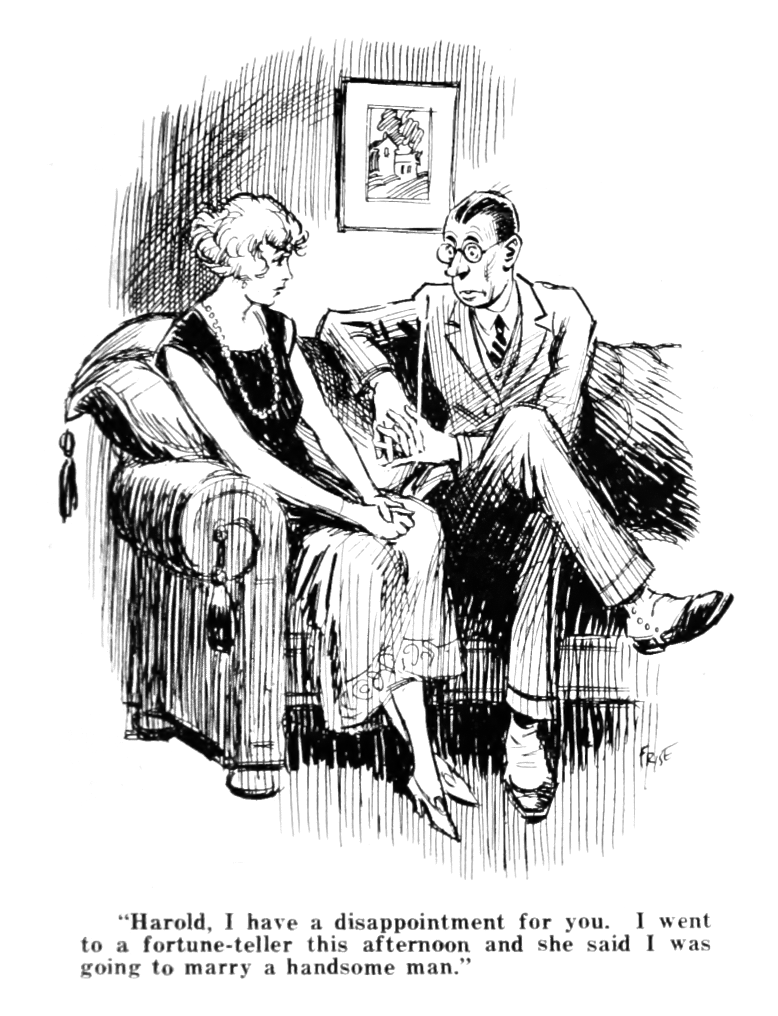
The Goblin, February 1924.
College humour magazines were all the rage in the 1920s. Typically they included jokes, cartoons, and short stories. The University of Toronto got in on the act with “The Goblin” magazine which began with the cover date of February 1921. Jimmie started contributing in the April 1923 issue by designing the cover. By December 1923, he was contributing not just covers, but cartoons inside for almost every issue until November 1925. After that, his contributions were only sporadic. The Goblin ceased publication with the May 1929 issue.