By Gregory Clark, Illustrated by Duncan Macpherson, May 27, 1950.
“Quick!” came the hoarse voice of my Cousin Madge over the telephone. “Come in your car!”
“But…uh…” I explained.
“Quick! I have no time to argue!” chopped Cousin Madge. “Drive me to the hospital!”
She hung up. I hung up, and leaped for my hat and the car keys on the mantel.
Every family has its Cousin Madge – one of those grand old girls; spinsters, yes; a little violent and opinionated, maybe; but commanding. And the family, while it may not exactly revolve around her, certainly can be set in large circular motions by her.
I ran for the car. What could be wrong with poor Cousin Madge? A heart attack, possibly? Or a violent onset of gallstones? Cousin Madge is large and meaty. It is only three blocks to Cousin Madge’s from my place. And I got there in record time. I backed into her side drive so as to be able to speed away, the minute I had the dear old girl in the car.
She came bursting out the front door.
“Easy!” I begged, scrambling out to assist her.
“Get back in!” she barked, as she bounded down the steps.
“What is it, what is it?” I quavered, taking her arm.
“It isn’t me,” she cried, backing powerfully through the car door into her seat. “It’s a blood transfusion.”
“Blood ..?” I checked, hurrying around to my door of the car.
“I just heard it on the radio,” puffed Cousin Madge, as I started out the drive. “A poor man is dying down at the Presbyterian Hospital for the want of some Jantze Four1.”
“Some what?” I pleaded.
“Some Number One!” yelled Madge, patting her hat down into position for a fast ride. “Some Group A. Step on it!”
I stepped on it. The Presbyterian Hospital is a good six miles across town.
“I don’t get it.” I ventured.
“I’ve got it,” declared Cousin Madge, grimly but proudly. “My blood is one of those rare types that only maybe four per cent of the human race has got. Jantze Four, some doctors call it. Others call it Number One type, or type A. And this guy is dying; so they put out an emergency call on the radio…”
“My dear Madge,” I protested, slowing the car a little. “You can’t give blood transfusions at your age.”
“Listen!” hissed Cousin Madge, reaching over with her left foot and stepping on my right foot on the gas. “I gave blood 22 times during the war.”
“You were five, eight years younger.”
“Get cracking!” grated Cousin Madge, giving her hat another jerk and leaning forward. “This is my business. If there one thing I’ve got lots of, it’s blood. And if am the fortunate possessor of one of the rare types of blood, who am I to decline it to a poor man who is a fellow Jantze Four?”
“I think you’re crazy,” I muttered, as we hurtled through the busy streets.
Cousin Madge sat in haughty but slightly forward-crouching silence for a couple of blocks.
“It might occur to you,” she said, finally, “that it has not been my privilege to give life to any children. But if I can give life to some poor devil…”
“Pardon me, Madge,” I offered humbly.
So we dodged and darted through the city streets while Cousin Madge did a little quiet sniffling.
“I hope,” she gulped, “I hope we’re not too late, that’s all! And I was just sitting here wondering if the Presbyterian Hospital would take my blood. I’m an Anglican, you know.”
“Madge!” I scoffed. “Blood is non-denominational! Blood, you might say, is international. What a silly thought!”
“Oh, you never know!” asserted Cousin Madge. “I’ve never been in the Presbyterian Hospital. Maybe they have some rules. I’m not too sure I would want any Presbyterian blood…”
“If a man is dying…” I pointed out.
“We all have our principles,” declared Cousin Madge firmly. “If they start asking me my religion, I’ll say I’m Presbyterian.”
“Good for you!” I agreed.
And with a final swoosh, we rounded the wide bend in the approach to the Presbyterian Hospital and skidded through the gates onto the gravel.
Cousin Madge bounded out, leaving me to park the car. She headed powerfully for the entrance doors. By the time I reached the lobby, there was no sign of her.
“Did a lady…?” I queried the nurse at the desk.
“Blood transfusion?” the girl clicked. “Down that corridor. Turn left, and the fourth door…”
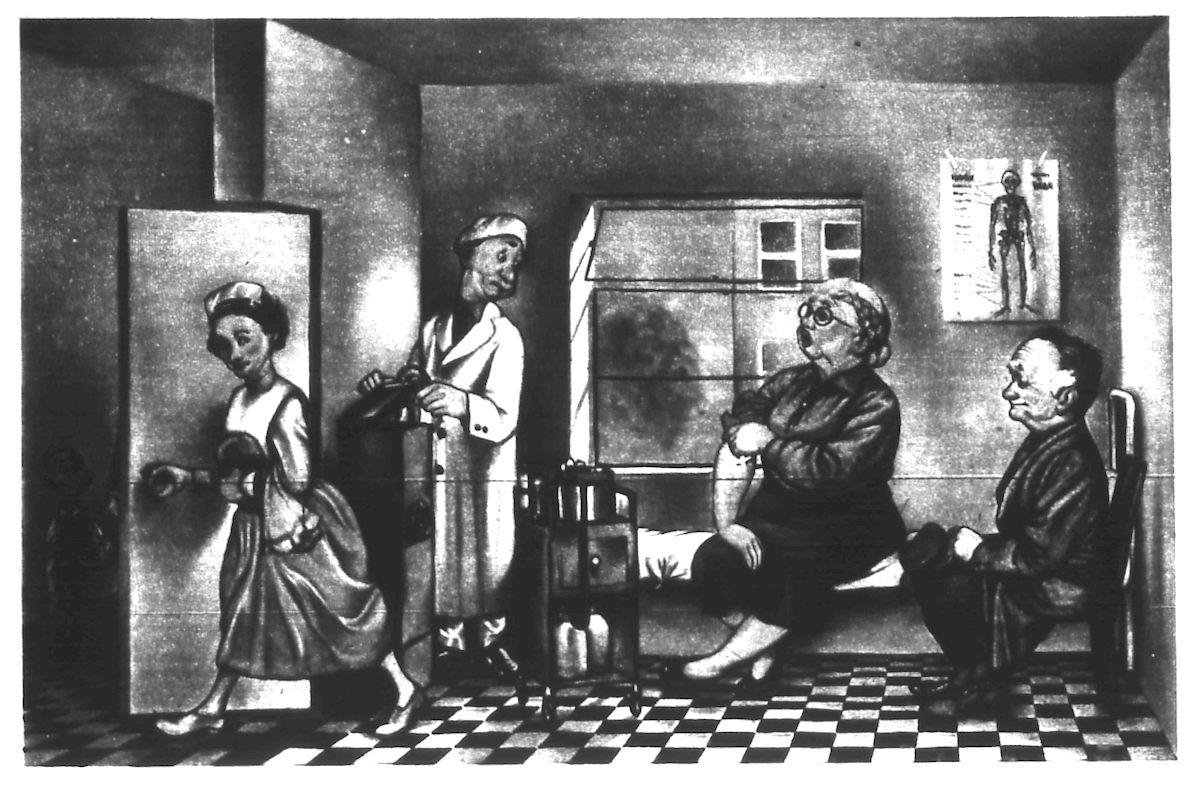
The door was open when I reached the blood transfusion clinic. And there was Cousin Madge, her hat and coat off, rolling her right sleeve up, and directing a young male technician in white, as well as a nurse, how to proceed with their business.
“This arm,” barked Cousin Madge, “has the fewest scars on it.”
“Let’s see the other,” suggested the technician meekly, after a glance at Cousin Madge’s forearm.
“This one, you hear?” bellowed Cousin Madge. “Look here, young man, I was giving gallons of blood while you were still in short pants.”
“Yes, ma’am,” said the technician. “Please come inside to the cot.”
“How much do you want?” enquired Cousin Madge, generously. “Fifty cc’s?”
“That will be wonderful,” said the nurse.
I followed cautiously to the door of the inner office.
“Is this your husband?” asked the technician.
“My cousin,” corrected Cousin Madge. “But let him in, I want him to see this…”
Cousin Madge sat on the cot and rolled herself back.
It was obviously an emergency, the way the technician and nurse worked. They swabbed Cousin Madge’s forearm with alcohol. The technician examined the inside of the forearm closely for an instant. Then he whipped a black bandage, such as they choke your arm with for blood pressure count, and wrapped it around Madge’s upper arm.
“Open and close your hand,” commanded the technician.
Cousin Madge opened and closed her fist. This was to pump the blood into her forearm to cause the veins to stick out, so the technician could select a good spot for the needle.
Before my horrified gaze the young white-clad man calmly picked up a slant-pointed needle, attached to a rubber tube, and plunged it into Cousin Madge’s lusty vein.
She did not even wince.
The technician hastily undid the bandage. On a low table, I noticed a glass jar about the size of a pint pickle bottle. And suddenly, into it from the rubber tube, squirted the bright red fluid of Cousin Madge’s life.
After a momentary stare, I began to feel slightly dizzy.
I averted my gaze and stared at the white wall.
I took a very deep breath.
“Hey!” charged Cousin Madge. “Get him out of here!
The young nurse took my sleeve and led me into the outer room.
“Lie down on that couch a minute,” she smiled.
“My blood…” I woozied, “my blood isn’t the right type…”
“Oh, we’re not taking yours,” she assured me. “Bit on the side of the couch and bend over, with your head as low as you can put it…”
So while I sat with my head resolutely bowed to my knees, the nurse returned to the inner room and Cousin Madge.
After a few minutes, I felt a little easier and sat up. An elderly doctor appeared at the door.
“How’s it coming?” he asked tersely.
“Squirting like a fire hose,” replied the technician. “I’ll have fifty cc’s in another five minutes…”
“Give me,” commanded the older doctor, “40 cc’s when you get it.”
“Right, sir!”
The older doctor vanished silently.
And suddenly in the humming hospital the druggy-scented hospital, full of quiet, swift footed people in white and slow-moving patients humbly carrying their hats and wandering the corridors or slouching on the benches and chairs, I got a sense of the drama that is staged here, day and night, minute by minute. Out the door from the inner room sprang the young nurse, holding the blood-red bottle as if it were indeed a chalice.
The young technician appeared and smiled at me. “You can come in now,” he said.
Cousin Madge was reclining on the cot, as large as life. Her arm lay with a white pad of cotton covering the needle puncture.
They only took 40 cc’s,” she scoffed. “I could give a bucket.”
“We needed the 40,” explained the young fellow, “right away. It was a case of speed.”
“Wasn’t I fast enough, letting it down?” scorned Cousin Madge.
“You were wonderful,” assured the young man. “In five minutes it will be tested, in the lab; and then it will be going into the patient.”
“Tested?” bit Madge.
“We have to confirm,” said the young fellow, “the type, and make sure there is no infection… uh…”
“You’ll find that,” cut in Cousin Madge, “good, pure, 100 per cent blood. It will be a tonic to him.”
“I’m sure it will,” said the young technician, earnestly.
Cousin Madge studied him up and down.”
“Are you a Presbyterian?” she asked.
“No, ma’am, I’m a Baptist,” said the young chap.
“Isn’t this the Presbyterian Hospital?” enquired Madge.
“Oh, yes, that’s just its name,” explained the technician.
“Personally, I’m an Anglican,” announced Cousin Madge, mildly.
“Indeed,” said the technician, removing the dab of cotton from Cousin Madge’s arm and inspecting the little blue mark.
He then took a fresh bit of cotton and secured it to her arm with a small piece of adhesive.
He glanced at his watch.
“You should rest 15 minutes…” he began.
Cousin Madge swung her legs off the cot.
“Listen, young man,” she said, “I’ve been through this too often to be coddled around like a beginner. What do you serve your blood donors in the Presbyterian Hospital after the ordeal? Scotch whiskey?”
“Tea, madam,” said the boy, “or coffee.”
“During the war,” related Cousin Madge, as she rolled her sleeve down, “I had snorts of brandy, glasses of sherry…”
The young nurse came sweeping back into the room, extending an envelope towards Cousin Madge.
“What’s this?” she said.
“Twenty-five dollars!2” cried the pretty nurse.
“Pardon ME!” snorted Cousin Madge, drawing up. “I am not a professional donor. This was voluntary.”
“Mr. Ginsberg insisted,” assured the nurse, “that I MUST give this to whoever offered their blood.”
Cousin Madge reached for the envelope.
“Mr. WHO did you say?” she checked.
“Mr. Ginsberg,” said the nurse, “who’s going to be rallying in half an hour.”
“I’ve got an idea!” exulted Cousin Madge.
She thanked the young technician, she kissed the young nurse, she waved me ahead of her out the door to act as her equerry. And we sailed down the hall and out the big doors and over to my car.
“Drive north!” rang Cousin Madge imperiously. “Drive north to the boulevard and turn west.”
“It’s a long way round…” I offered.
“North!” commanded Cousin Madge.
So we drove north to the boulevard and then west. And when we came abreast of St. Joseph’s Hospital Cousin Madge directed me to turn in the drive.
Out we piled and entered the wide doors of the older and even quieter hospital than the Presbyterian.
At the switchboard sat a black-clad sister.
“You have a drive for funds on now, sister?” enquired Cousin Madge.
“It ends today,” said the sister.
“Did you go over the top?”
“Not,” smiled the sister, “quite.”
“See if this will do it, maybe,” said Cousin Madge, handing in the envelope with the $25 in it.
If didn’t, it should have.
“Blood, by gum,” resounded Cousin Madge, as we re-piled ourselves into my car, “is just plain human!”
Editor’s’ Notes:
- The first doctor to recognize the different types of blood was Jan Janský in 1907. He classified blood into four distinct groups (I, II, III, and IV). Type 4 is the modern Type AB. ↩︎
- $25 in 1950 would be $340 in 2026. ↩︎