
By Gregory Clark, Illustrated by James Frise, April 18, 1942.
“Air,” said Jimmie Frise, “is about the only thing they can’t ration.”
“And water,” I suggested.
“Even water is rationed, indirectly,” asserted Jim, “through the rationing of the things you put in water, like sugar, tea, coffee, soap. But air is free. It is the one thing they can never control.”
“How about poisoning it with poison gas?” I inquired.
“Purely incidental, and purely temporary,” said Jim lightly. “They have rationed what we eat, what we drink, what we wear. They have controlled our roof and shelter. How we live, what we can buy, where we can go – all these things are under control. The only thing we can count upon in unlimited quantity is air.”
“Let us breathe deep,” I said devoutly.
“Sometimes,” mused Jimmie thoughtfully, “when I look upon the civilized world of Europe and America in their present condition, I have to smile even in the face of all the tragedy. For in this vast, storm-tossed scene, the only person who is free or happy is the person who has nothing.”
“Nothing?” I questioned.
“Those who are suffering the most, right now,” stated Jim, “are those who possess the most. The rich. The prosperous. It goes for countries as well as for individuals. Compare the freedom today of a hobo and a great industrialist.”
“Most great industrialists are in the war up to their necks,” I asserted. “It is only the would-be industrialists, the ones who couldn’t quite make the grade, who are yelping.”
“I am speaking,” said Jimmie, “of freedom and happiness. If the rich man is a good man, he is working as never before in his career; a prisoner of his great possessions, all of which must now bear fruit as never before. If he is a bad man, think how he must be agonized by the taxes, the restrictions, the controls.”
“A hobo is a happy man,” I agreed.
“The nations that are suffering the most,” went on Jim, “are those that have been accustomed to the most. And is true not only of possessions like money or property. It is true of men with sons. The man with the most sons today, whether they are in the war or not, is the unhappiest. And it is true of education and other spiritual possessions. The man with the most brains, the man with the greatest intelligence, is today the least happy and the least free. He is a prisoner of his thoughts, the way the wealthy man is prisoner of his possessions.”
“A hobo,” I agreed, “sitting on the side of the road, not even thinking, is the happiest man in the world today.”
“And the freest,” pointed out Jim.
Small Farm Best
“What makes you smile, then,” I inquired “when you look upon a world in such a mess?”
“Just the thought,” explained Jim, “that all over the western world of Europe and America we have been so desperate to gain the very things that would steal our freedom. The more you own and the more you know, the less free you are. And in the golden age of the past century, we have, like maniacs, been fighting to get into prison. We have invented and manufactured and amassed every conceivable thing. We have pursued knowledge and education like madmen. And having got it all, we now know that a small house, in the midst of a few acres of land, with a well and a rope to lower a bucket, and a plow and a horse and a haystack, are all that the human spirit can possess without going nuts.”
“Why, Jim,” I protested, “that’s worse than communism.”
“It’s the next thing after communism,” agreed Jimmie. “Communism is old stuff. It’s over and done with. It’s here. Now we’ve got to look beyond, to the next stage.”
“You’d have us all peasants,” I snorted.
“Several thousand years ago,” declared Jim, “the Chinese tried civilization, as we know it, and discarded it as silly. By painful experiment, they discovered that possessions are merely a burden. Only the fools submit to possessing things, beyond the merest essentials. A cup, plate, knife. That’s about all a man needs. And usually he can borrow them, from some fool who has two.”
“Have you gone Oriental?” I demanded.
“We’re all going Oriental,” said Jimmie. “We are all wishing we didn’t have half what we’ve got. Already, we are giving things away. And the first things we are giving away are our most cherished beliefs. The next thing will be our property. It’s too much trouble.”
“What started this?” I muttered unhappily.
“It started,” remembered Jimmie, “with me saying that the only thing they couldn’t control was air.”
“And a fine remark that was,” I submitted.
“What I had in mind,” said Jim, shifting his feet from the office window sill to his desk, “was a boat.”
“A boat?” I protested, since most of these casual ideas of Jim’s are tied up to a stump somewhere.
“A sail boat,” said Jim. “There’s nothing like a sail boat. A dinghy. Or a little sloop of some kind. With a sail boat and air, you are the nearest thing to being free there is in all the world.”
“Aha,” said I, seeing light.
“We thought when we invented engines for boats,” said Jim, “that we had made a great step forward towards freedom. But a boat sails the sea today at its peril. And you can’t get fuel to run even a little launch.”
“I can still paddle a canoe,” I asserted.
“If you are well and strong,” countered Jim. “But you can be as weak as a cat and still go places in a sail boat. The wind takes you. And they can’t control wind. Or ration it. That is why the Chinese still like sail boats. We call them junks. Were we ever wrong!”
“What could we do with a sail boat?” I inquired.
“We could go to work in a sail boat,” said Jim calmly. “We could keep it tied up to a wharf out at Sunnyside. And in the morning, we could come down the street, get in the boat and sail down to the foot of Yonge St. There, we could get permission to tie it up at one of the company piers. And at the end of the business day, we could walk down to the lakefront; get in the boat and sail home westward to Sunnyside again.”
“If the wind was right,” I interposed.
“We can always tack,” asserted Jim, the sailor.
“And take half the morning,” I scoffed.
“We could get up early,” retorted Jim. “And besides, business life isn’t going to be half as strenuous as it was. With gas rationing and crowded street cars and everything, business just isn’t going to be in a position to expect people to be at work on time. Anyway, it will be the bosses who will be latest.”
“I suppose we are going to take life a lot easier,” I admitted, “now that the means of speed are being taken from us.”
“Would you go shares in a sail boat with me?” demanded Jim.
“Are you serious?” I retorted.
“Perfectly serious,” declared Jim. “We can’t go touring in the country because of the gas rationing. So we will go sailing on the lake. We have no means of taking a load of anything from here to Hamilton. But if we have a sail boat, and a fair wind, we can get to Hamilton in five hours. A boat with sails is, in view of the circumstances in which we find ourselves, the most practical possession in the whole world.”
“We’d look ridiculous coming to work in a sail boat,” I scoffed. “In Toronto.””
“Let us hope we will never look more ridiculous,” said Jimmie. “In Toronto.”
So I said I would go halves on a small, cheap sail boat with him. Whereupon Jimmie picked up the telephone very business-like and called a man.
“Wait a minute, wait a minute,” I protested; because you don’t agree to a philosophical proposition like a sail boat as if it were an ordinary business deal.
But Jim had, it seems, already done quite a bit of snooping for a sail boat and had located just what we wanted from a man down near the foot of Cherry St., towards Ashbridge’s Bay.
A Home-Made Dinghy
“We’ll be out to get her,” said Jimmie over the phone, “at about 2 p.m. We’ll sail her to a boathouse I know up at Sunnyside.”
“Hah,” said Jim, hanging up.
“How much?” I inquired grimly.
“Fifteen bucks, each,1” said Jim. “Sail and all,”
“It can’t be much of a boat at that price,” I submitted. “I’ll bet anything you like that boats are more in demand now than ever.”
“Thirty bucks,” said Jim. “Hull, sail, mast, boom, rudder and gear, all in first-class shape.”
“It doesn’t sound reasonable to me,” I muttered.
And when we arrived at the old tumble-down boathouse on Toronto Bay down beside the coal piles, and were led through a sort of Davy Jones’ junk shop of boats and the carcasses of old boats picked clean long ago, and were shown our dinghy, it was obvious I was right.
It was a home-made dinghy about 10 feet long. It was old. It was warped. Its mildewed sail, when we unrolled it, was patched and patched over the patches. The ropes looked rotten to me. But Jim was undismayed.
“What do you expect for $30?” he demanded haughtily when I attempted to point out some of the deficiencies.
“I’ll put a pail in,” said the tired old boy who closed the deal with us. “She’ll probably leak a little at first.”
“Naturally,” said Jim. “They always leak at first.”
The three of us hauled and lifted the dinghy out of the old boathouse and down to some decaying wooden piles in the water which used to be a dock in the great old days of sail. We lowered her, and the water spurted through all the seams.
“Let her fill up for a little while,” sighed the old boy wearily, “while we step the mast and rig the sail.”
The mast had a bend in it. Two of the rings that hold the sail to the mast had broken away from the sail, and the old man had to go and slowly find a cigar box with sail needle, thread and a sailor’s palm2. And he sewed the rings back on.
Then we stepped the mast, and wedged it into place with some wooden chips. The rope broke twice while hoisting the sail, but the old boy went slowly away again, into the staggering boat house, and brought some marlin twine with which to splice the rope.
“You can bail now,” he gusted heavily. “See if she leaks faster than you can bail.”
I got down and bailed. It took 17 full pails and 20 short dips to reach the floor boards. An invisible slow trickle was still coming in which you could see if you sat and watched one special spot on the floor boards.
“Aye, ye, Sir!”
“Let her soak overnight, Jim,” I suggested, “and we’ll come down tomorrow and take her away.”
“When I buy a boat,” said Jimmie, “I’ve got a boat. I’ll sail and you bail. It’s a swell southwest wind. We’ll be at Sunnyside in less than one hour.”
I dipped a few more part pailfuls out. I glanced across the bay. Toronto Bay is not exactly a noble body of water. But it is an expansive, dirty and cold one from over the deck of a small, wet, leaky dinghy.
“Okay?” cried Jim.
“Aye, aye, sir,” I said with a feeble effort.
Jim in his young days, before the old war, used to be quite a sailor on Toronto Bay. Personally, I like prairies. Or, better, mountains.
The old man took hold of the mast and headed her into the breeze. Jim got set at the tiller and close hauled her. Then the old man gave us a shove and we were off.
“Bail,” said Jim, calmly; and the boat heeled slightly over in the breeze, causing the little water in her to slosh down to the low side, wetting my feet and legs clammily.
“Head straight for the Western Gap,” I warned, as Jim with a fixed grin only to be seen on the faces of amateur sailors, hauled hard and headed our craft for Hanlan’s Point.
“We’ll beat up, a little,” hailed Jimmie, “and then run down on the gap.”
I bailed. The dinghy’s heeling over had discovered new and larger cracks in the hull, and I suddenly found the water was coming in at least as fast as I could bail if I bailed all the time.
“Hey, Jim,” I warned. “Don’t waste any time. Don’t get too far from shore.”
“She’ll tighten up,” halloed Jim, “in no time.”
The mast creaked. The sail, which had more creases in it than any sail I had ever noticed, slatted; small things popped and rattled; something groaned; and the water slapping the hull seemed just outside. It seemed, I should say, almost in.
“Jim, steer closer to shore,” I commanded. “This water is getting ahead of me.”
“Bail,” ordered Jim cheerfully, hauling the sheet tighter.
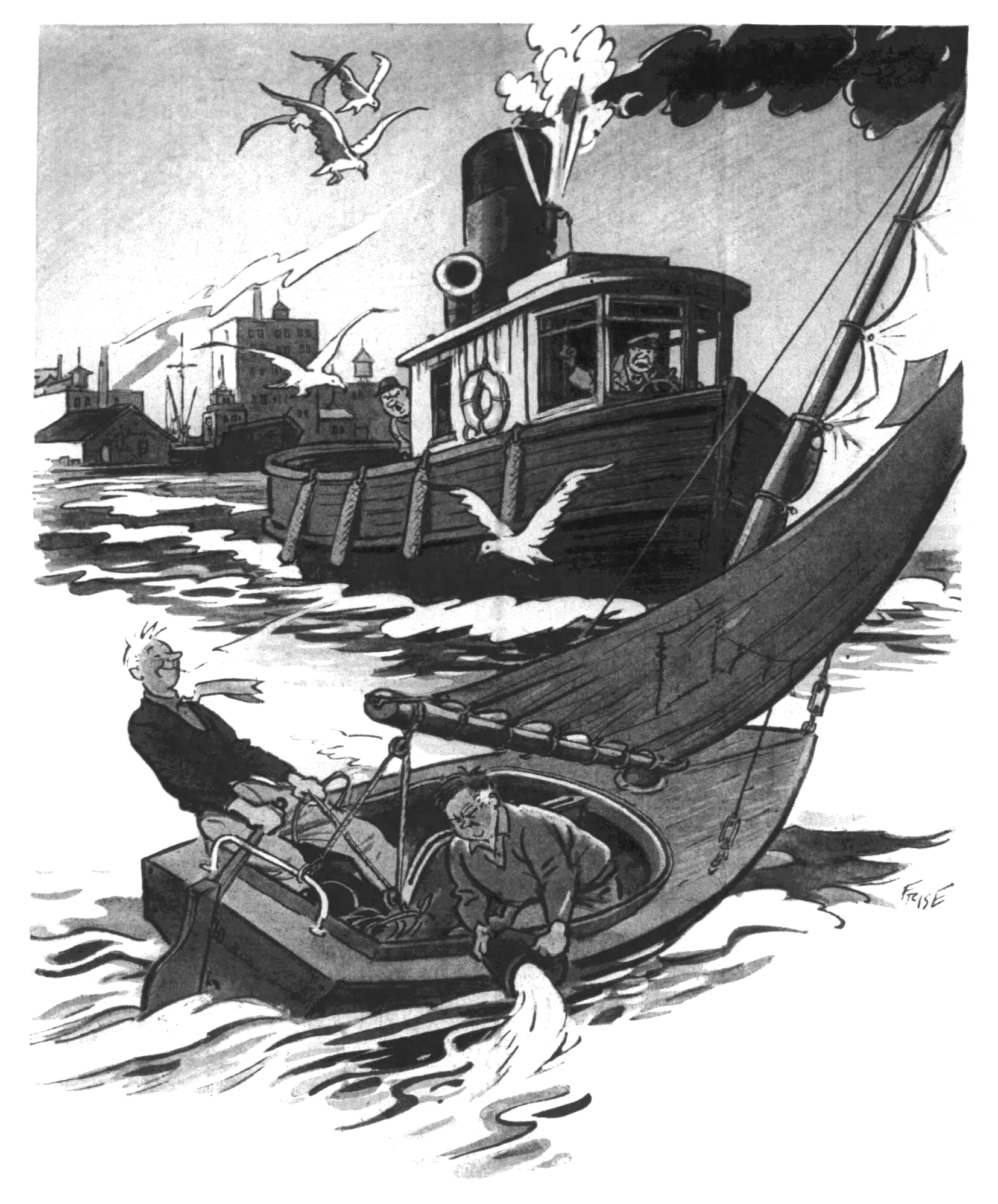
Suddenly a hoarse whistle roared almost in my ear, I straightened to behold a tug bearing square down on us.
“Jim!” I roared.
“Sail has the right of way over steam,” said Jim, with a confident and dreamy smile on his face. And he never even shifted muscle.
The tug, with another fierce toot, swerved slightly and passed behind us so close that the captain could have spit aboard us if he had had a spit ready. But he heaved a few big, loose cusses aboard us instead.
Shipwrecked
The swell from the tug came rushing high and crested straight for our stern.
“Jim, look out,” I shouted.
But Jim just leaned farther out and took another haul on the sheet. The big wave lifted us the way a lady lifts a rug to shake it. It gave us a shake and a snap.
The mast cracked, right across, like a stick of macaroni. The sail, with a calm slow bulge, folded quietly down on the heaving water. The dinghy, with Jim crouched beside me, remained flat.
Slowly the tug made a large circle and came back to us at quarter speed.
“What’s the big idea,” said the master hoarsely, “sailing an old hencoop like that around at this time of year? Don’t you know the frost ain’t out of spars yet?”
“Can you tow us?” demanded Jim coldly, a man of sail to a man of steam.
“To Hanlan’s Point, and no further,” said the master. “I’m tyin’ up there for the night.”
“Very good,” said Jim.
So they took us aboard and we hand-reefed the sail back aboard the dinghy and laid it, mast and all, inboard and Jim lashed her down.
“If she fills,” warned the tug master, “I don’t stop.”
“Go ahead,” said Jimmie.
And the tug, which was full of rumble and roar and power, leaped to life and surged and plunged across the bay to Hanlan’s Point, dragging the dinghy close behind, nose uplifted, in the churn and wake.
At Hanlan’s we paid the skipper $2 for his consideration and then found a local man who said we could haul our dinghy up on his lawn until we could make arrangements to sail her on the next leg of her journey westward. Then we took the last ferry home.
But there was a high gale of wind last night.
And I have hopes that when we go back tomorrow, the dinghy will have washed away.
Editor’s Notes:
- $30 in 1942 would be $572 in 2026. ↩︎
- A sailmaker’s palm is a specialized leather tool worn over the hand, featuring a metal thimble plate with divots to safely push thick sewing needles through canvas, leather, or heavy fabrics. ↩︎
Leave a Reply