
By Gregory Clark, April 25, 1953.
When the porter conducted me down to my reservation, seat 5 in the chair car, I glanced covertly around at the chairs adjacent. It was an eight-hour journey ahead of me, the whole long day. I looked forward to spending the trip snoozing, gazing out the window at the coming of spring, reading a little bit, snoozing some more. And everything could be spoiled if, in one of the seats beside me or across from me, some chatterbox of a casual acquaintance were to be my neighbor, who would gas and blather away, mile after mile, hour after hour.
What might be worse, of course, would be two middle-aged women with brand new hairdos, on their way to some convention, who, in strident society voices, would ruin the whole journey by tirelessly interrupting each other, debating their plans. It was with pleasure I noted, with my first cautious glance, that my immediate neighbors were complete strangers, already deeply immersed in their newspapers, and not at all the chatty type. The seat directly across from me, chair 6, was not yet occupied. I hoped for the best.
I got a couple of magazines and a good fishing book out of my bag and disposed the bag and my coat up in the rack. I shook out the morning paper, swung my chair firmly around to face out the window, and snuggled down for a pleasant and restful eight hours.
Just as the train started, I noticed out of the corner of my eye, the porter approaching with a bag. Behind him came an elderly man. I was lucky. It was a stranger. With a little shrug of content, I snuggled deeper in my seat. He was in chair 6.
I heard him thank the porter quietly. His voice was deep and kindly. A beautiful voice.
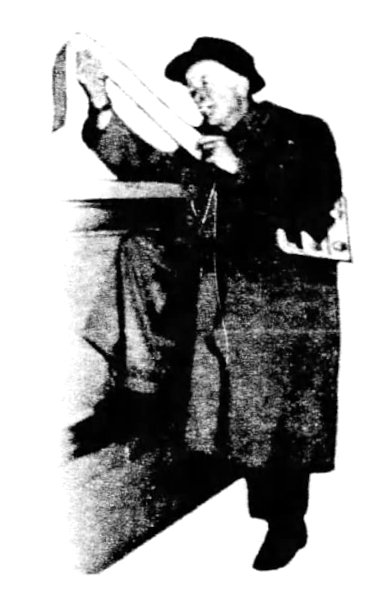
After watching out the window at the passing suburbs in the bright morning, I decided to swing my chair around casually and have a look at chair 6. He was just lighting a cigarette and had one of those 35-cent paper back novels laid ready on his knee.
His head was shaggy, gray and noble. His profile was intensely interesting, a strong curved nose, splendid rugged forehead, humorous mouth. His eyes glanced out from under bristly brows. And he was tanned, even at this time of year, a deep, grained brown. Not a Florida tan, I thought to myself. This is a man from the North. Perhaps he is some famous mining geologist from Yellowknife.
His tweed suit was rough and costly. My glance ran down to his boots: they were those soft, walnutty ankle boots, obviously handmade. By Lob, of London, I bet myself, or at least by Tricker, also of London1.
He picked up the cheap paper novel and opened it with a sigh of pleasant relaxation. The more I looked at this magnificent old man, the more excited I became. Across his chest he wore an old-fashioned watch chain from which dangled some curious charm. On his left hand, I saw the iron finger ring of the Engineers. There could be no doubt about it; across from me sat one of the great Canadians. I cleared my throat and rattled my newspaper. He was already lost in page one of his tawdry novel.
After a while, I swung around and tried to enjoy the passing fields and woods. But I felt easier when turned slightly, so as to be able to seize an opportunity, if it presented itself, of opening a conversation. He swung his chair to face out his window.
An hour went by, two hours. He never took his eyes off his book. And he read dreadfully slowly. What a way, I thought, for a man of his stamp to waste his time, reading trash. I dipped into my fishing book. I glanced through magazines. I coughed, sighed. When he goes to lunch in the dining car, I figured. I will follow, in the hope of getting to the same table. But he fell asleep at lunch time; and after a long wait, I went in without him. He came in, to another table, just as I was preparing to leave.
The miles, the hours clicked by. I never remember a more restless journey. Not once did the distinguished old man meet my glance or indicate the slightest awareness of me, He was literally sunk in his book.
We neared the journey’s end. I thought perhaps he would finish the book in time for five minutes, 10 minutes, so that I could at least discover who and what he was. But it was a race between him and the book and the train. It was a dead heat. We lumbered into the station. People were all putting on their coats, as was I.
He finished the book and tossed it aside, stood up with a bright, kindly gaze around. He smiled at me, I at him, as he put on his hat.
“Do you know,” he said, “I believe I have read that damned book before!”
And I never did find out who and what he was.
Editor’s Notes: This story appeared in Greg’s Choice (1961).

Leave a Reply