
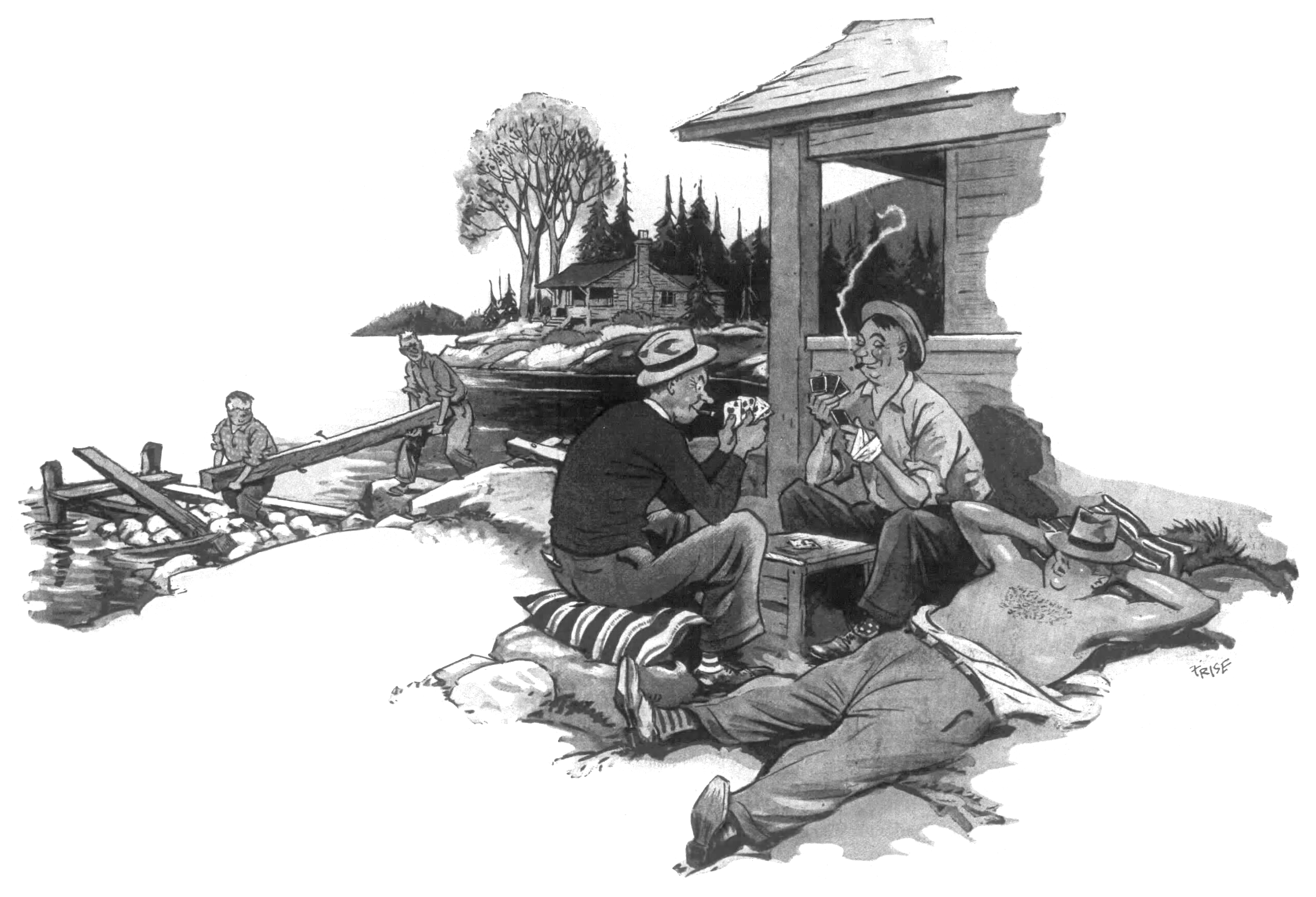
By Gregory Clark, Illustrated by James Frise, May 20, 1939.
“Trouble never ends,” sighed Jimmie Frise.
“What’s gone wrong now?” I sympathized.
“You know that swell wharf I built at the cottage last summer?” said Jim. “One of the neighbors was up at the Point last week-end and he tells me the whole thing is wrecked.”
“How?” I demanded indignantly, for hadn’t I helped Jimmie talk about that wharf all the winter before last?
“The ice,” said Jim. “The break-up of the ice in the spring. It just wrecked the whole thing. Bust the cribs and scattered the stones all over. Twisted the planks. A lot of them washed away and were lost.”
“Ice is powerful,” I agreed.
“My neighbor figures,” said Jim, “it will cost about $501 to have the thing repaired. There’s never any end, is there? Just when you think you’ve got level with the game, something turns up.”
“How much did the wharf cost in the first place?” I asked.
“Fifty dollars,” said Jim. “But up in Muskoka, it’s all the same. Building a new wharf or repairing a busted one, it’s $50.”
“Don’t be silly,” I protested. “You can get some of the local men to repair it for $10.”
“No,” said Jim; “up in the summer cottage belt it’s different. They don’t figure it by the hour or the material. They have a price for a job. A wharf costs $50. It doesn’t matter what kind of a wharf it is. Any wharf is $50. Sometimes you get the best of the deal, sometimes the local man gets the best of it. But on the average it works out about fifty-fifty.”
“Why don’t you get the man that built this one and tell him the job wasn’t strong enough?” I demanded.
“Docks are always built,” explained Jim, “with the understanding that natural forces don’t count. No, I know my Muskoka. There is nothing for it. I’ll be stuck 50 bucks.”
“How badly ruined it?” I inquired.
“One of the end cribs,” said Jim, “is entirely wiped out, the logs all gone and the stones strewn all over the place. The planking is ripped off, some of it is under water and some of it sticks up in the air. It’s a mess.”
“Why not wait until you go up in July, before you spend any dough on it?” I suggested. “Fifty dollars next July doesn’t look half as bad as $50 right now.”
“A couple of good windy days,” said Jim, “and my neighbor says the whole thing will be strewn along the shore for miles. I’m going to write up to the boys tonight and tell them to go ahead and mend it. A summer cottage without a good wharf is like a house without a garage.”
“I was just thinking, Jim,” I submitted. “What is there to repairing a dock? Building a dock, I agree, is something requiring knowledge and experience. But mending wharf should be largely a matter of lifting and heaving.”
“I can see you lifting 40-pound rocks to put in the crib,” smiled Jim gratefully.
“I wasn’t thinking of me,” I smiled back very wily. “I was thinking of Skipper and Vic and Bumpy. Big, strong, athletic birds. Always wasting their strength on golf and squash racquets and climbing hills on fishing trips.”
“Aaaaah,” said Jim, lifting his eyebrows.
“I’ll Co-ordinate the Work”
“How would this work?” I submitted eagerly. “Invite the whole gang of us up for a fishing week-end. The trout will be just at their best next week. There’s some real good fishing at Port Sydney and other places less than 10 miles from your cottage. A fishing week-end. And no expense except the grub, which we will take with us, and do our own cooking. It will appeal to them. A lovely cheap week-end after trout at Jimmie’s cottage.”
“Then what?” asked Jim cautiously.
“When we arrive,” I dramatized, “there will be your wharf, all bust. You’ll see it first and be heart-broken. Everybody will sympathize with you. All our high spirits and excitement at arriving at the cottage will be dampened by the sight of you standing staring at your wrecked wharf, see? You can’t get it out of your head. You’ll walk down and stand dejectedly looking at it while we are busy carrying the luggage up to the house. I’ll call the attention of the boys to you. You’ll come up and stand around with a woe-begone air.”
“Then?” urged Jim.
“Why,” I cried, “I’ll assure you it is nothing. That the gang of us can put it right in an hour’s work.”
“It will take more than an hour,” said Jim. “It might take a whole afternoon. We would have to drive logs down and make a new crib, fill the crib with rocks and spike down all the planks. It will be a messy job.”
“Once we’re at it,” I assured, “we won’t quit. Men like seeing things done.”
“Not Bumpy and Vic,” said Jim.
“Old Skipper will be the slave driver,” I declared.
“And what will you be?” asked Jim.
“I’ll be the foreman,” I submitted. “I’ll co-ordinate the work. Naturally, nobody expects a man of my size to lift big rocks, and nobody would want to be on the other end of carrying a log with me. I’m too short for that kind of work. It is my size that drove me into brain work.”
“I haven’t much hope of the bunch of you giving me much help,” said Jim. “It seems to me I would be letting myself in for a lot of hard work while you all went fishing.”
“Don’t you want to save $50?” I demanded. “And if you can save $50 by merely using the help of a few hearty and athletic fishing partners who are guests at your summer cottage-“
“I suppose there’s no harm,” mused Jim. “After all, if they don’t want to help-“
“Jim,” I stated firmly, “you underestimate the nature of your friends. There is good in the worst of men. Just you start to work on that wharf and see how quick those birds will I come to your aid.”
“It seems a dirty trick,” said Jim, “to invite them up for a fishing week-end and then run them into a lot of work.”
“My dear man,” I cried, “what’s the difference between a fishing trip and a dock building trip? All a city man wants is a week-end in the open. A little exercise and fresh air. And in every man there is a love of constructing things. I know men who are addicted to wharf building. It’s fascinating.”
“Okay,” said Jim, “we’ll try it.”
So we got on the telephone and called the gang up, it being only Monday; and framed up a week-end party. It was to be on the cheap. No expense. Jim would buy the provisions and we could divide it five ways, and that’s all the expense we’d have, outside the gas.
“They’re all tickled to death,” I pointed out to Jim. “A cottage week-end isn’t to be sneezed at in times like these. Nobody has any money to throw away on expensive fishing trips.”
“Or on busted docks,” said Jim reflectively.
“That’s it in a nutshell,” I exclaimed. “In times like these people have a lot more heart than in piping times. You’ll see. The boys will be tickled to death to put their backs into the job.”
And Friday afternoon we all begged off work and met at Jim’s and shifted all the luggage into two cars and so set off, in the high spirits of May, for Muskoka, which we reached in three hours, right at Jim’s cottage.
Our entry was dramatic. My car being in the lead, I saw to that. The gate leading up from the shore road to the cottage is always a little rusty at the first of the season and I took a good minute to struggle with it, allowing the second car, with Jim in it, to catch up and stop behind us. Skipper had bailed out of my car and Bumpy and Vic piled out of the other, to stretch their legs.
“Good heavens,” shouted Vic. “Look at the wharf.”
And we all looked at the wharf. A long and heavy silence held us. In the silence Jim, very dramatically, took two or three hesitating paces forward and stood with his back to us, silently regarding the ruin. His back was eloquent. A good actor can do more with his back than with his face. Jim’s shoulders sagged.
“Aw, Jim,” I said, deeply, “what a mess.”
“The ice must have done it,” said Skipper, the practical one.
“Boyoboyoboy,” said Vic and Bumpy, sympathetically.
“That dock, boys,” I submitted, “was brand new last season.”
“I remember hearing you birds planning it all through the winter before last,” said Skipper. “Why didn’t you plan it right?”
“Could you have planned it better?” I demanded.
“Dock building is my specialty,” said Skipper. “You ought to see the wharf at my place on the Kawarthas.”
Jim had walked slowly and tragically down to stand and look closely at the wreckage.
“Then, Skipper,” I said, “you’re just the man Jim needs. Go on down and look the situation over while I get the stuff out of the cars and the cottage opened up.”
I drove in the lane and Vic followed in his car and Bumpy came with us and we shifted the bags on to the veranda and opened up the cottage and got the windows open and had a quick look around to feel the mattresses and see which beds we’d choose. There is an art to arriving at a summer cottage week-end party.
By the time Jim and Skipper came up rom the shore we had a fire on and the lamps lighted against the evening that was falling. Jim had a long face and Skipper was detailing firmly just how you should slope a crib to stand against the strain and stress of the spring breakup of the ice.
“Cheer up, Jim,” I shouted. Let’s forget the wharf for tonight. Let’s have a good supper and pleasant evening, and we can see about the wharf tomorrow.”
“I bet it will cost 75 bucks,” groaned Jim.
“Pshaw, no,” scoffed Skipper. “I bet it won’t cost more than 50.”
“How bad is it, Skipper?” I inquired, handling the frying pan full of eggs and bacon very skilfully. “Do you suppose we five might be able to make any sort of a repair job of it? After all, 50 bucks-“
The Excuses Begin
“If I had four good men,” said Skipper, “four good men, I said, who would obey my orders, I could have that wharf shipshape in one morning’s smart work.”
“Skipper,” I cried, “you have four good men!”
“There is nothing I would rather do,” announced Bumpy. “In fact, I love heaving things around. But only the middle of the week, my doctor went over me very carefully and told me to give up squash rackets for a while and to do no strenuous work of any kind for a period of two weeks, when he is going to give me another going over.”
“There’s a funny thing,” exclaimed Vic. “I’m taking out some new insurance, and they found something a little wonky with my blood pressure. Just two, days ago, that was. I have to come back in week to have another test. So the doctor told me to lie around, this week, and get all the sun I can. I figured on just taking sun baths this week-end.”
“Hm,” said I.
“Well do you want me to be refused insurance?” demanded Vic sharply.
“I just said hm,” I protested.
“But I didn’t like the way you said it,” said Vic.
“I tell you what,” said Bumpy. “Vic and I could stand by and sort of oversee and direct.”
“Let’s leave the whole thing till the morning.” I suggested hastily. “We can think it over better then. I hate to see Jim stuck in for $50 if the gang of us could mend the job in two or three hours’ work. Light work. The rise of trout isn’t until late in the afternoon tomorrow anyway. We won’t gain any thing by rushing off early.”
“That’s what I say,” agreed Skipper. “Let’s take the week-end easy.”
By which time the eggs were plump and the bacon curly and the table set and we gathered around. Jim caught my eye several times during the festive hour, and his expression was melancholy.
After supper, the others washed the dishes and I went out to listen to the stars and the soft splash of the gentle wind on the lake, And then they started a poker game, which I do not play because it steals away so many minutes from the lovely night; and in good time we prepared for bed.
“I’ll get a handful of kindling for the fire in the morning,” announced Skipper going out.
In three minutes he was back, his handkerchief wrapped around his right hand, and an air of disgust.
“I’ve bashed my hand,” he muttered.
“Your fishing hand?” cried Jim solicitously. We examined it. It looked a little red and scraped, but not serious. I got out iodine and plastered it liberally and Skipper bade me get a bandage out of his kit and bind his hand up carefully.
“You can’t trust these injuries in the country,” said Skip. “Tetanus.”
And so to bed.
With the lark and the robins and small shrill redstarts and monotonous wrens, we woke and breakfasted, Skipper wearing his injured hand in his lapels, a la Napoleon, Bumpy complaining of a rather smothery feeling during the night and Vic confessing to a little migraine due, he feared, to some slight sinus trouble he had been reading about in a medical journal he had been reading about in a medical journal he had been reading while in the insurance company doctor’s waiting room.
After the breakfast dishes were done, there was a general unpacking of rods and fishing tackle on the sunny veranda, and Jim caught me inside the cottage to say: “I guess we’d better pass the wharf thing up.”
“Let’s make one try,” I said. “Let you and me go down with a great show of purpose, and if none of them take the hint, we’ll pass it up.”
So we rolled up our sleeves and burst on to the veranda very purposeful.
“Just settle yourselves for a while, boys,” I said heartily, “while Jim and I go down and see what can be done about the wharf.”
“Do you want me, in an advisory capacity?” asked Skipper, holding up his bandaged hand.
“No, no, Skipper,” we assured him kindly. It wasn’t advice the situation called for.
So Jim and I went down and looked at the relic of the wharf in the quiet morning water. There really wasn’t a great deal wrong with it, as a matter of fact.
“When you see it close,” I pointed out, “all it needs is a couple of logs spiked on to that crib, and refill it with stones.”
“These planks,” said Jim, “can be all relaid and spiked in an hour.”
“Let’s start with the logs for the crib,” I urged. “There’s two of them on the beach, spikes and all.”
So we carried one log, and as we came up the bank, we could see Vic reclining in the sun and Skipper and Bumpy with a deck of cards out, beginning a game.
“Pssst,” I said. halting. “Listen? Isn’t that a McGillivray’s Warbler?”
“A what?” said Jim.
“Listen,” I hissed, “that bird. That song, the clear, staccato notes…”
I laid the end of the log down and tip-toed into the grove east of the cottage, peering up into the trees to see this rare bird.
I was gone a little while, perhaps a little longer than that, because a bird lover loses all sense of time. It wasn’t a McGillivray’s Warbler, it was just a Myrtle, a very common warbler. But I heard the car horns calling and I returned out of the woods to find them all loaded and ready to go fishing; which we did, and had a grand day at Port Sydney. Skipper, even with his injured hand, casting best and catching 14 trout, including the biggest one, a pound and 10 ounces, and everybody very happy and completely exhausted after a long day floundering and stumbling and toiling in the icy wild waters of the Muskoka River.
Editor’s Note: This story appeared in Greg Clark & Jimmie Frise Outdoors (1979).

- $50 in 1939 would be $1,100 in 2026. ↩︎
Leave a Reply