
By Gregory Clark, Illustrated by James Frise, May 29, 1943.
“I don’t suppose,” wheedled Jimmie Frise, “you’ve got an extra vacuum cleaner?”
“You can still buy vacuum cleaners,” I informed him. “Delivery in August.”
“Yes, a hundred bucks,” said Jim. “And who’s got 100 bucks? Besides, who can wait until August?”
“If you’ve got an old one to turn in,” I advised him, “you can get practically immediate delivery. One thing the government has gone awfully cautiously on, in its restrictions, is vacuum cleaners. They can push women around in a lot of ways; they can interfere with the food supply, they can cut down canned goods, they can upset the domestic scene in practically every direction. But there is one thing the government knows it can’t do. And that is, return women to the broom.”
“The carpet beater you mean,” corrected Jimmie.
“The broom,” I insisted. “The broom is the ancient badge of woman’s servitude. For countless ages, the broom was the symbol of woman’s slavery. When we wanted to ridicule women in the worst possible way, we invented witches and put them riding on brooms. Not riding on a frying pan. Or a wash board. On a broom.”
“Our vacuum cleaner,” announced Jim, “has burnt out its motor.”
“Have it repaired,” I said.
“I’ve had it repaired,” said Jim, “and now they say it can’t be repaired any further.”
“Then get a new one,” I explained.
The kind we’ve had,” said Jim, “isn’t made any more. And we would have to wait until August for delivery on a new one. I thought maybe somebody might have a spare one…”
“Why don’t you get somebody to rent you theirs, part time,” I suggested. “Say, three days a week.”
“Okay,” said Jim, “will you rent me yours, three days a week?”
“On account of my principles, no,” I replied. “There are lots of people who will do anything to make a little money now. They would even rent their vacuum cleaner, figuring on a little cash now, and forgetting that the more their vacuum cleaner is used, the sooner it will wear out, and the sooner they will need, not a dollar or so now, but maybe 50 or 100 bucks to buy a new one.”
Badges of Servitude
“To help out a friend,” said Jim, “you would rent your vacuum cleaner, wouldn’t you?”
“Principles are principles, Jim,” I explained. “I am the kind of person who doesn’t believe in renting or lending anything that wears out or can be damaged. The quickest way to lose a friend is to lend him your gun, your fishing rod or your dog. And now vacuum cleaners. Our friendship is too old and valued, Jim, to risk ending it on the burnt-out motor of a vacuum cleaner.”
“Sometimes,” sighed Jim, “I wonder our friendship has lasted so long.”
“It has lasted 30 years,” I stated, “because we have never borrowed nor lent. We have been mean and measly and tight with each other. Result: a lifelong friendship and understanding.”
“What am I going to do?” demanded Jim indignantly. “If I don’t find a vacuum cleaner right away, do you know what it means? It means I am going to have to go back to beating carpets.”
“Ha,” I laughed. “I bet there isn’t a carpet beater left in North America. I bet there isn’t one even in a museum,”
“There are two,” said Jim hollowly, “in my cellar.”
“Good gracious, man,” I cried, “have you no foresight! I threw out my carpet beaters 20 years ago.”
These,” muttered Jim, “were stuck up over the furnace pipes in my cellar. Nobody noticed them. Then, last night, my family found them.”
“You’re too old to beat carpets, Jim,” I reassumed him. “Only boys and young men beat carpets.”
“Talk about a broom being the badge of servitude of women,” said Jimmie, “a carpet beater is the symbol of man’s humiliation.”
“A broom and a carpet beater,” I mused. “Imagine the world being driven back to those barbarities!”
“Damn Hitler,” cried Jimmie.
“That’s too easy, Jim,” I protested. “It tickles our real enemies all to pieces to hear us damning Hitler.”
“Who are our real enemies?” inquired Jim hotly.
“Why, the people who find war profitable, everywhere,” I responded.
“Aw, don’t try to tell me there are any war profiteers in this war,” snorted Jim, “with taxes, and super taxes and…”
“Is profit,” I inquired, “only dollars and I cents made today? How about the dollars and cents made yesterday or to be made tomorrow? The people, all over the world, in all countries, who made this war possible were the people who preferred war to the way things were going before the war.”
“How were things going?” snorted Jim.
“Well, the Chinese,” I reminded him, “were going a little communistic, in 1931. So the Japs went in, on some cooked-up excuse. And nobody stopped them.”
Was it our business to stop them?” demanded Jimmie.
“In 1936, Spain was set upon,” I reminded him, “by a minority that had been chucked out at the polls, and Germany and Italy openly helped that ousted minority.”
“And Russia helped the majority,” declared Jim.
“Don’t you see,” I submitted, “that it has been Russia the whole world has been after for the past 20 years. Why did the Japs go into China? Why was Russia-hating Italy allowed to go and grab Abyssinia? Why were Russia-hating Germany and Italy allowed to help the Spanish minority? Why did the whole world sit back with folded hands while the disturbers in all countries were attacked by highly trained gangsters? Because Russia was demonstrating to the people of the whole world that a country can thrive without rich men.”
“Aw,” said Jim disgustedly, “no country in the world has more powerful individuals in it than Russia.”
“But they don’t get rich at it,” I explained. “Don’t you see what the real trouble with Russia is, in the eyes of our powerful and rich citizenry? Russia offers the simple solution to all the world’s ills. Sure it has powerful and clever and brainy men. But they don’t get paid for it. They don’t get the chance to stack up money to fortify themselves against being chucked out when they are through.”
“Through?” demanded Jim indignantly.
“Look,” I said. The average life of a business or industry is 25 years. That is proved by statistics. When a man’s body wears out, we think nothing of chucking him out when he can’t do his job any more. But we let men pile up millions so that when their brains wear out, they can hang on long after they are through. Russia found out that was silly. So it says to its clever and shrewd and strong-willed men. Go ahead, run things, manage things, be the boss, use your talents to the full. But don’t think you are going to get anything out of it. If you cheat, we’ll kill you. And if you die a natural death, all you’ll leave behind will be a happy memory.”
“What brainy man would accept a proposition like that?” scoffed Jim.
“There is no other proposition to accept,” I explained. “Therefore, what can a brainy man do but use his brains and be happy about it.”
The Rich and Powerful
“Do you mean to suggest,” said Jim, “that that is the real angle on Russia our big shots are fretting about?”
“What else?” I submitted. “Our rich and powerful like to think it is their riches the people of the world are fretting about. They hate to admit it is their stupidity and mismanagement of the world that is the cause of all the unrest, all over.”
“Ah, mismanagement,” murmured Jim, beginning to see.
“You must admit,” I said, “that in most countries, this past 20 years, power has been in the hands of wealth. And you never saw a world worse managed than ours for the past 20 years. One depression after another, and finally this war.”
“Maybe there have been too many wealthy people, lately,” suggested Jim.,
“You may have hit the nail on the head,” I agreed. “There have been times in the world’s history when the rich were rich because they were good managers. And the whole world basked in a golden age of good management. But for the past 30 or 40 years, our rich have been punk managers. You did not have to be a good manager to get lousy rich, in the past 40 years, out of market gambling, out of the incredible new inventions of the age, the motor car, the radio, and all the ten thousand new and remarkable things we have developed in these years. Some of the greatest fatheads, ever to possess a thousand dollars have become millionaires in recent years by sheer luck and despite the most terrible bad management. You know that.”
“I believe it,” confessed Jim.
“Okay, then,” I wound up, “with the power of the world in the hands of men who had made their money by many other means than good management, the world was subjected to a series of ruinous depressions and finally to this unparalleled war. The powerful guys still like to pretend that it is their money the disturbers are disturbed by. Let’s disillusion them. Let us explain that it is their mismanagement that is complained of.”
“But it is their money that is their power,” pointed out Jimmie.
“Ah,” I said, “that is where Russia is right. Don’t let them have any money. Let them be smart and clever. Let them be as big and powerful as their brains and character will allow. Let them be leaders, managers, heads of great industries and all that.”
“But would they be leaders and managers and heads of great industries,” demanded Jimmie, “if they didn’t have the incentive of making millions?”
“What nonsense!” I cried. “A man only makes millions in order to be the leader, the director, the head of a great industry. Take out that incentive, and the men of brains and character and strength of will and mind would still struggle to the top. And the best of them would get to the top. The mean-souled ones might not. But we’re better rid of them anyway.”
“I never thought of it that way,” mused Jim.
Brotherhood of Man
“Look,” I said. “Can a clever man help being clever? Can an industrious, hard-working, brainy man help being that way? The way you talk, you would think men are clever and powerful in their own right. They are not. They are born that way. And all the incentive in the world has nothing to do with it. The people who need the incentive in this world aren’t the rich, the smart, the shrewd and the forceful. The people who need the incentive are the lazy, the stupid, the dull and the torpid.”
“You certainly have put things backside-foremost to the way I’ve heard them,” said Jimmie.
“Naturally,” I agreed. “Because the people who do all the yelling about incentives are the smart and the clever. It is far easier to be the head of an industry if you own it, and a million bucks left over. It’s very comfortable. But the life of a business or an industry is 25 years. That’s the average. And we can’t any longer leave business and industry in the hands of people whose brains give out in 25 years. It’s too costly, too disorganizing for the rest of us. So, let’s set up a new system whereby we give all the brains of the country full scope to wear themselves out, with the right to chuck them out the minute they show signs of wear.”
“Hold on, isn’t that cruel?” demanded Jim.
“Is it cruel,” I inquired, “when we chuck out a guy when his body wears out and he can’t any more do his job? What’s the difference? The way it is now, by letting our smart brains hold the money, they are able to hang on their job long after they have worn out. Hence, ruin. Hence, the average life of a business, 25 years.”
“Incentive…” began Jim.
“Security for every man, woman and child on earth,” I cut in. “And then watch incentive work. Watch guys, who were too busy buying bread ever to feel any incentive, start feeling it. Watch where incentive will carry us then. And I mean incentive in the highest sense, not just the incentive to make money. Take that lowest incentive right out of the game, and watch incentive carry mankind to undreamed of heights of peace and security and conquest of all evil.”
“Too many men are, lazy and drifters,” muttered Jim.
“If you call men lazy and drifters,” I asserted, “who haven’t the heart play the game of life the way it is now, I agree. We encourage men to be devils; and then we call the natural saints lazy and drifters…”
Jimmie stood up and gazed out the window at the frowsy rooftops of the city’s business section, that grim and colorless lid to all the incentive, all the struggle and scheming and contriving of countless human souls.
“The wind is in the west,” he said. “The sun is shining. It’s a perfect day for beating carpets.”
“I hate to think of you,” I submitted, “a noble image of a Nobler design, swinging a carpet beater.”
“I have two carpet beaters,” said Jim, with his back to me.
“Shift from one to the other, as you tire,” I suggested. “The feel of a different, carpet beater is a great relief. Keep changing them, every five minutes…”
But there was no getting out of it. You can’t talk about the brotherhood of man while you own a vacuum cleaner in going condition and your brother owns two carpet beaters.
An Unnatural Action
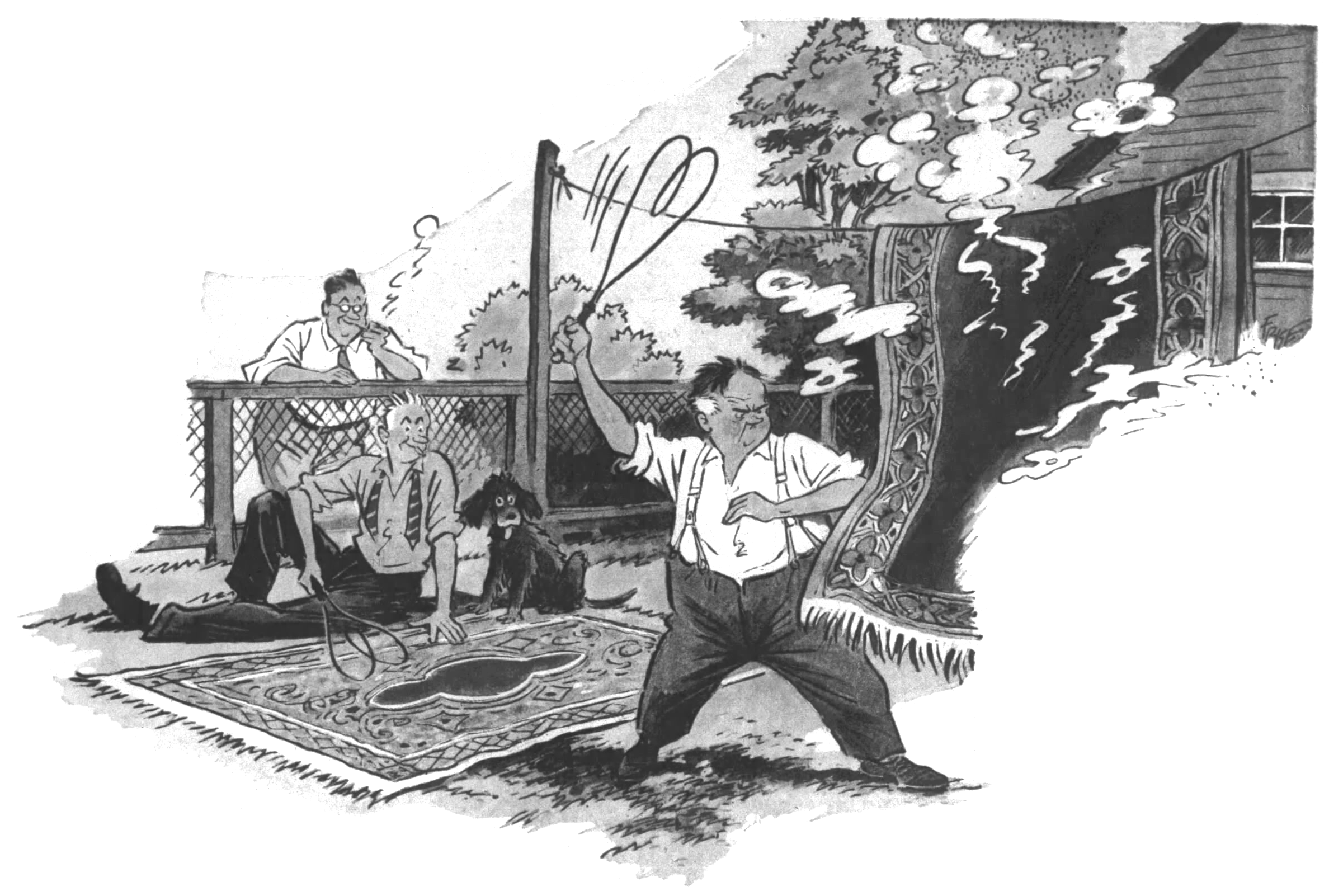
The carpets were on the line when we walked up Jimmie’s side drive. The two carpet beaters were hanging on the fence.
“A little exercise will do us good,” I said.
“I feel like a boy again,” said Jim, rolling up his sleeves.
We stepped up to the carpet.
“Do it systematically,” said Jim. “Stand at the top and beat down.”
No wonder the vacuum cleaner was invented. The brain of man must have been working a thousand years on vacuum cleaners without knowing exactly what it sought. Stevenson invented the steam engine for what end? What did Watt have in mind? What was Edison fumbling for when he ran across the talking machine, the electric light bulb and all those trinkets? I bet every one of them started out to think up some way of beating carpets other than with a stick.
You step up to the rug with the beater. You take a good stance. You swing. The beater smacks the rug with a satisfying thud. The dust flies. You swing again.
About the fifth swing, you know, without any exhaustion yet inspiring your thoughts, that this is an unnatural and monstrous act. The human frame was not designed for horizontal swinging of sticks. All our other stick swinging is vertical. In war, we strike down or up. In golf, in mowing, in reaping, we swing down and up. There is no natural action the human frame performs that is a horizontal swing like carpet beating.
The sixth swipe cramps your tenderloin. The eighth throws your shoulders out. By the tenth, your hips and thighs are already as exhausted as if you had climbed a mountain. Your lungs are cramped by the cross-swing.
Your head swims.
“Exchange beaters,” said Jim breathlessly. So we changed beaters and went to it for a second spasm. It went eight beats.
“Let’s rest,” I suggested. “We aren’t even getting any dust out of them.”
Which we did.
“Let’s take turn about,” said Jim. “Ten beats each.”
Which also we did.
We beat for half a minute and rested five minutes.
“Jim,” I said, “when I stated my principles regarding renting our vacuum cleaner, I overlooked one little thing.”
But before I could explain the little thing, one of the girls put her head out an upstairs window and called down:
“Hey, dad, what are you trying to do?”
“You wouldn’t recognize it,” said Jim. “We’re beating the carpet.”
“The vacuum cleaner was fixed this afternoon,” she called down. “The postman fixed it.”
So Jim led me into the kitchen, where he got the stone jug of buttermilk out of the refrig.
Leave a Reply