When the porter conducted me down to my reservation, seat 5 in the chair car, I glanced covertly around at the chairs adjacent. It was an eight-hour journey ahead of me, the whole long day. I looked forward to spending the trip snoozing, gazing out the window at the coming of spring, reading a little bit, snoozing some more. And everything could be spoiled if, in one of the seats beside me or across from me, some chatterbox of a casual acquaintance were to be my neighbor, who would gas and blather away, mile after mile, hour after hour.
What might be worse, of course, would be two middle-aged women with brand new hairdos, on their way to some convention, who, in strident society voices, would ruin the whole journey by tirelessly interrupting each other, debating their plans. It was with pleasure I noted, with my first cautious glance, that my immediate neighbors were complete strangers, already deeply immersed in their newspapers, and not at all the chatty type. The seat directly across from me, chair 6, was not yet occupied. I hoped for the best.
I got a couple of magazines and a good fishing book out of my bag and disposed the bag and my coat up in the rack. I shook out the morning paper, swung my chair firmly around to face out the window, and snuggled down for a pleasant and restful eight hours.
Just as the train started, I noticed out of the corner of my eye, the porter approaching with a bag. Behind him came an elderly man. I was lucky. It was a stranger. With a little shrug of content, I snuggled deeper in my seat. He was in chair 6.
I heard him thank the porter quietly. His voice was deep and kindly. A beautiful voice.
After watching out the window at the passing suburbs in the bright morning, I decided to swing my chair around casually and have a look at chair 6. He was just lighting a cigarette and had one of those 35-cent paper back novels laid ready on his knee.
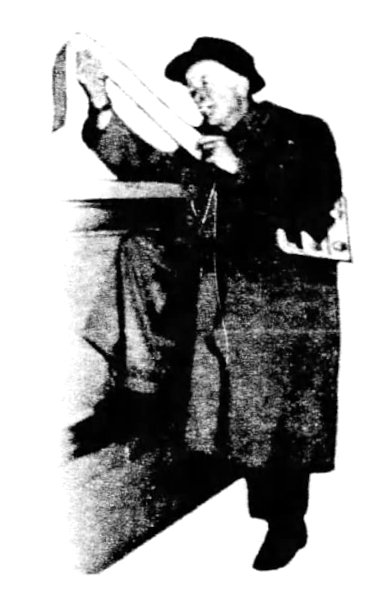
His head was shaggy, gray and noble. His profile was intensely interesting, a strong curved nose, splendid rugged forehead, humorous mouth. His eyes glanced out from under bristly brows. And he was tanned, even at this time of year, a deep, grained brown. Not a Florida tan, I thought to myself. This is a man from the North. Perhaps he is some famous mining geologist from Yellowknife.
His tweed suit was rough and costly. My glance ran down to his boots: they were those soft, walnutty ankle boots, obviously handmade. By Lob, of London, I bet myself, or at least by Tricker, also of London1.
He picked up the cheap paper novel and opened it with a sigh of pleasant relaxation. The more I looked at this magnificent old man, the more excited I became. Across his chest he wore an old-fashioned watch chain from which dangled some curious charm. On his left hand, I saw the iron finger ring of the Engineers. There could be no doubt about it; across from me sat one of the great Canadians. I cleared my throat and rattled my newspaper. He was already lost in page one of his tawdry novel.
After a while, I swung around and tried to enjoy the passing fields and woods. But I felt easier when turned slightly, so as to be able to seize an opportunity, if it presented itself, of opening a conversation. He swung his chair to face out his window.
An hour went by, two hours. He never took his eyes off his book. And he read dreadfully slowly. What a way, I thought, for a man of his stamp to waste his time, reading trash. I dipped into my fishing book. I glanced through magazines. I coughed, sighed. When he goes to lunch in the dining car, I figured. I will follow, in the hope of getting to the same table. But he fell asleep at lunch time; and after a long wait, I went in without him. He came in, to another table, just as I was preparing to leave.
The miles, the hours clicked by. I never remember a more restless journey. Not once did the distinguished old man meet my glance or indicate the slightest awareness of me, He was literally sunk in his book.
We neared the journey’s end. I thought perhaps he would finish the book in time for five minutes, 10 minutes, so that I could at least discover who and what he was. But it was a race between him and the book and the train. It was a dead heat. We lumbered into the station. People were all putting on their coats, as was I.
He finished the book and tossed it aside, stood up with a bright, kindly gaze around. He smiled at me, I at him, as he put on his hat.
“Do you know,” he said, “I believe I have read that damned book before!”
And I never did find out who and what he was.
Editor’s Notes: This story appeared in Greg’s Choice (1961).
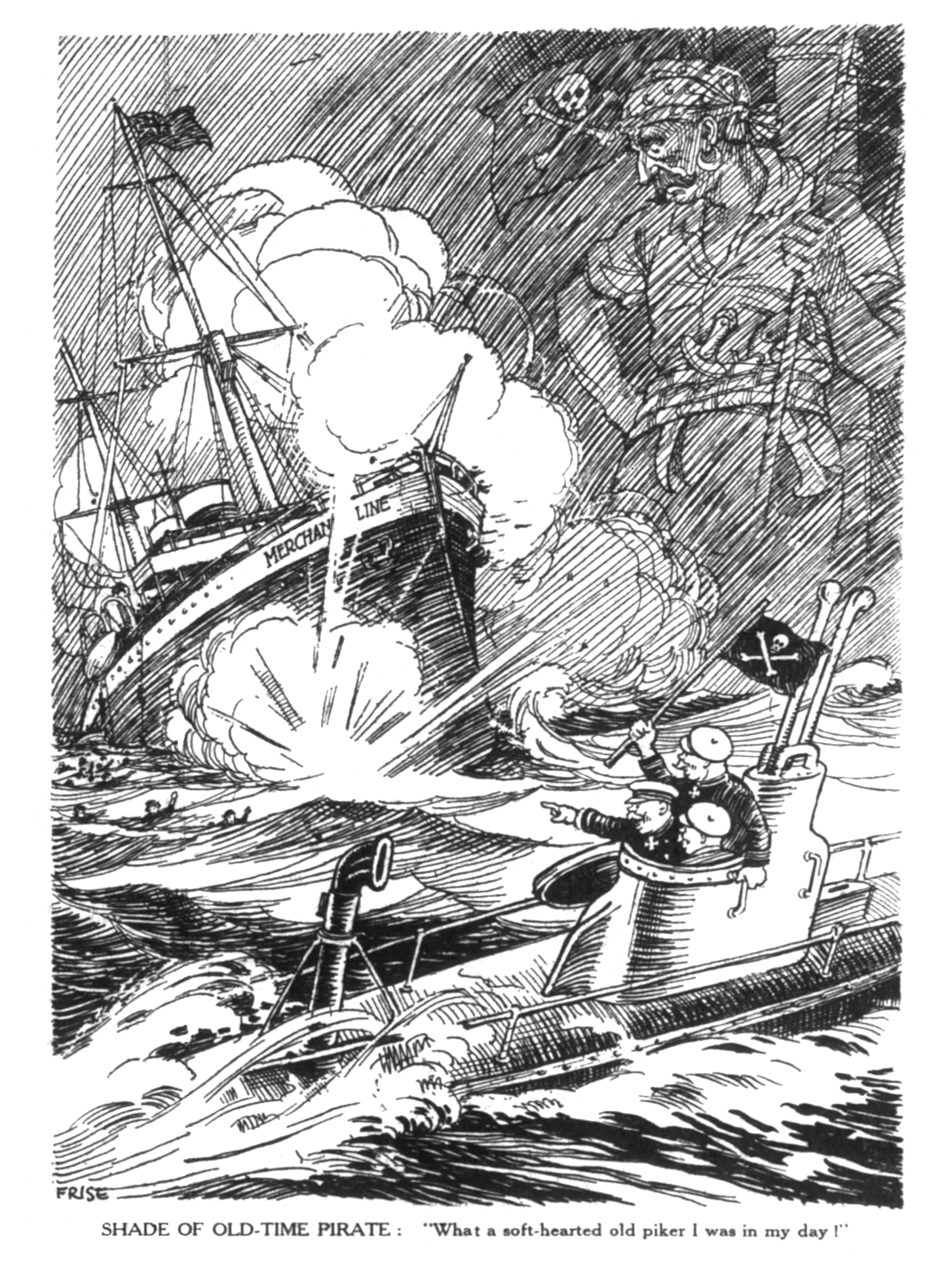
“Sail has the right of way over steam,” said Jim with a confident smile.
By Gregory Clark, Illustrated by James Frise, April 18, 1942.
“Air,” said Jimmie Frise, “is about the only thing they can’t ration.”
“And water,” I suggested.
“Even water is rationed, indirectly,” asserted Jim, “through the rationing of the things you put in water, like sugar, tea, coffee, soap. But air is free. It is the one thing they can never control.”
“How about poisoning it with poison gas?” I inquired.
“Purely incidental, and purely temporary,” said Jim lightly. “They have rationed what we eat, what we drink, what we wear. They have controlled our roof and shelter. How we live, what we can buy, where we can go – all these things are under control. The only thing we can count upon in unlimited quantity is air.”
“Let us breathe deep,” I said devoutly.
“Sometimes,” mused Jimmie thoughtfully, “when I look upon the civilized world of Europe and America in their present condition, I have to smile even in the face of all the tragedy. For in this vast, storm-tossed scene, the only person who is free or happy is the person who has nothing.”
“Nothing?” I questioned.
“Those who are suffering the most, right now,” stated Jim, “are those who possess the most. The rich. The prosperous. It goes for countries as well as for individuals. Compare the freedom today of a hobo and a great industrialist.”
“Most great industrialists are in the war up to their necks,” I asserted. “It is only the would-be industrialists, the ones who couldn’t quite make the grade, who are yelping.”
“I am speaking,” said Jimmie, “of freedom and happiness. If the rich man is a good man, he is working as never before in his career; a prisoner of his great possessions, all of which must now bear fruit as never before. If he is a bad man, think how he must be agonized by the taxes, the restrictions, the controls.”
“A hobo is a happy man,” I agreed.
“The nations that are suffering the most,” went on Jim, “are those that have been accustomed to the most. And is true not only of possessions like money or property. It is true of men with sons. The man with the most sons today, whether they are in the war or not, is the unhappiest. And it is true of education and other spiritual possessions. The man with the most brains, the man with the greatest intelligence, is today the least happy and the least free. He is a prisoner of his thoughts, the way the wealthy man is prisoner of his possessions.”
“A hobo,” I agreed, “sitting on the side of the road, not even thinking, is the happiest man in the world today.”
“And the freest,” pointed out Jim.
Small Farm Best
“What makes you smile, then,” I inquired “when you look upon a world in such a mess?”
“Just the thought,” explained Jim, “that all over the western world of Europe and America we have been so desperate to gain the very things that would steal our freedom. The more you own and the more you know, the less free you are. And in the golden age of the past century, we have, like maniacs, been fighting to get into prison. We have invented and manufactured and amassed every conceivable thing. We have pursued knowledge and education like madmen. And having got it all, we now know that a small house, in the midst of a few acres of land, with a well and a rope to lower a bucket, and a plow and a horse and a haystack, are all that the human spirit can possess without going nuts.”
“Why, Jim,” I protested, “that’s worse than communism.”
“It’s the next thing after communism,” agreed Jimmie. “Communism is old stuff. It’s over and done with. It’s here. Now we’ve got to look beyond, to the next stage.”
“You’d have us all peasants,” I snorted.
“Several thousand years ago,” declared Jim, “the Chinese tried civilization, as we know it, and discarded it as silly. By painful experiment, they discovered that possessions are merely a burden. Only the fools submit to possessing things, beyond the merest essentials. A cup, plate, knife. That’s about all a man needs. And usually he can borrow them, from some fool who has two.”
“Have you gone Oriental?” I demanded.
“We’re all going Oriental,” said Jimmie. “We are all wishing we didn’t have half what we’ve got. Already, we are giving things away. And the first things we are giving away are our most cherished beliefs. The next thing will be our property. It’s too much trouble.”
“What started this?” I muttered unhappily.
“It started,” remembered Jimmie, “with me saying that the only thing they couldn’t control was air.”
“And a fine remark that was,” I submitted.
“What I had in mind,” said Jim, shifting his feet from the office window sill to his desk, “was a boat.”
“A boat?” I protested, since most of these casual ideas of Jim’s are tied up to a stump somewhere.
“A sail boat,” said Jim. “There’s nothing like a sail boat. A dinghy. Or a little sloop of some kind. With a sail boat and air, you are the nearest thing to being free there is in all the world.”
“Aha,” said I, seeing light.
“We thought when we invented engines for boats,” said Jim, “that we had made a great step forward towards freedom. But a boat sails the sea today at its peril. And you can’t get fuel to run even a little launch.”
“I can still paddle a canoe,” I asserted.
“If you are well and strong,” countered Jim. “But you can be as weak as a cat and still go places in a sail boat. The wind takes you. And they can’t control wind. Or ration it. That is why the Chinese still like sail boats. We call them junks. Were we ever wrong!”
“What could we do with a sail boat?” I inquired.
“We could go to work in a sail boat,” said Jim calmly. “We could keep it tied up to a wharf out at Sunnyside. And in the morning, we could come down the street, get in the boat and sail down to the foot of Yonge St. There, we could get permission to tie it up at one of the company piers. And at the end of the business day, we could walk down to the lakefront; get in the boat and sail home westward to Sunnyside again.”
“If the wind was right,” I interposed.
“We can always tack,” asserted Jim, the sailor.
“And take half the morning,” I scoffed.
“We could get up early,” retorted Jim. “And besides, business life isn’t going to be half as strenuous as it was. With gas rationing and crowded street cars and everything, business just isn’t going to be in a position to expect people to be at work on time. Anyway, it will be the bosses who will be latest.”
“I suppose we are going to take life a lot easier,” I admitted, “now that the means of speed are being taken from us.”
“Would you go shares in a sail boat with me?” demanded Jim.
“Are you serious?” I retorted.
“Perfectly serious,” declared Jim. “We can’t go touring in the country because of the gas rationing. So we will go sailing on the lake. We have no means of taking a load of anything from here to Hamilton. But if we have a sail boat, and a fair wind, we can get to Hamilton in five hours. A boat with sails is, in view of the circumstances in which we find ourselves, the most practical possession in the whole world.”
“We’d look ridiculous coming to work in a sail boat,” I scoffed. “In Toronto.””
“Let us hope we will never look more ridiculous,” said Jimmie. “In Toronto.”
So I said I would go halves on a small, cheap sail boat with him. Whereupon Jimmie picked up the telephone very business-like and called a man.
“Wait a minute, wait a minute,” I protested; because you don’t agree to a philosophical proposition like a sail boat as if it were an ordinary business deal.
But Jim had, it seems, already done quite a bit of snooping for a sail boat and had located just what we wanted from a man down near the foot of Cherry St., towards Ashbridge’s Bay.
A Home-Made Dinghy
“We’ll be out to get her,” said Jimmie over the phone, “at about 2 p.m. We’ll sail her to a boathouse I know up at Sunnyside.”
“It can’t be much of a boat at that price,” I submitted. “I’ll bet anything you like that boats are more in demand now than ever.”
“Thirty bucks,” said Jim. “Hull, sail, mast, boom, rudder and gear, all in first-class shape.”
“It doesn’t sound reasonable to me,” I muttered.
And when we arrived at the old tumble-down boathouse on Toronto Bay down beside the coal piles, and were led through a sort of Davy Jones’ junk shop of boats and the carcasses of old boats picked clean long ago, and were shown our dinghy, it was obvious I was right.
It was a home-made dinghy about 10 feet long. It was old. It was warped. Its mildewed sail, when we unrolled it, was patched and patched over the patches. The ropes looked rotten to me. But Jim was undismayed.
“What do you expect for $30?” he demanded haughtily when I attempted to point out some of the deficiencies.
“I’ll put a pail in,” said the tired old boy who closed the deal with us. “She’ll probably leak a little at first.”
“Naturally,” said Jim. “They always leak at first.”
The three of us hauled and lifted the dinghy out of the old boathouse and down to some decaying wooden piles in the water which used to be a dock in the great old days of sail. We lowered her, and the water spurted through all the seams.
“Let her fill up for a little while,” sighed the old boy wearily, “while we step the mast and rig the sail.”
The mast had a bend in it. Two of the rings that hold the sail to the mast had broken away from the sail, and the old man had to go and slowly find a cigar box with sail needle, thread and a sailor’s palm2. And he sewed the rings back on.
Then we stepped the mast, and wedged it into place with some wooden chips. The rope broke twice while hoisting the sail, but the old boy went slowly away again, into the staggering boat house, and brought some marlin twine with which to splice the rope.
“You can bail now,” he gusted heavily. “See if she leaks faster than you can bail.”
I got down and bailed. It took 17 full pails and 20 short dips to reach the floor boards. An invisible slow trickle was still coming in which you could see if you sat and watched one special spot on the floor boards.
“Aye, ye, Sir!”
“Let her soak overnight, Jim,” I suggested, “and we’ll come down tomorrow and take her away.”
“When I buy a boat,” said Jimmie, “I’ve got a boat. I’ll sail and you bail. It’s a swell southwest wind. We’ll be at Sunnyside in less than one hour.”
I dipped a few more part pailfuls out. I glanced across the bay. Toronto Bay is not exactly a noble body of water. But it is an expansive, dirty and cold one from over the deck of a small, wet, leaky dinghy.
“Okay?” cried Jim.
“Aye, aye, sir,” I said with a feeble effort.
Jim in his young days, before the old war, used to be quite a sailor on Toronto Bay. Personally, I like prairies. Or, better, mountains.
The old man took hold of the mast and headed her into the breeze. Jim got set at the tiller and close hauled her. Then the old man gave us a shove and we were off.
“Bail,” said Jim, calmly; and the boat heeled slightly over in the breeze, causing the little water in her to slosh down to the low side, wetting my feet and legs clammily.
“Head straight for the Western Gap,” I warned, as Jim with a fixed grin only to be seen on the faces of amateur sailors, hauled hard and headed our craft for Hanlan’s Point.
“We’ll beat up, a little,” hailed Jimmie, “and then run down on the gap.”
I bailed. The dinghy’s heeling over had discovered new and larger cracks in the hull, and I suddenly found the water was coming in at least as fast as I could bail if I bailed all the time.
“Hey, Jim,” I warned. “Don’t waste any time. Don’t get too far from shore.”
“She’ll tighten up,” halloed Jim, “in no time.”
The mast creaked. The sail, which had more creases in it than any sail I had ever noticed, slatted; small things popped and rattled; something groaned; and the water slapping the hull seemed just outside. It seemed, I should say, almost in.
“Jim, steer closer to shore,” I commanded. “This water is getting ahead of me.”
“Bail,” ordered Jim cheerfully, hauling the sheet tighter.
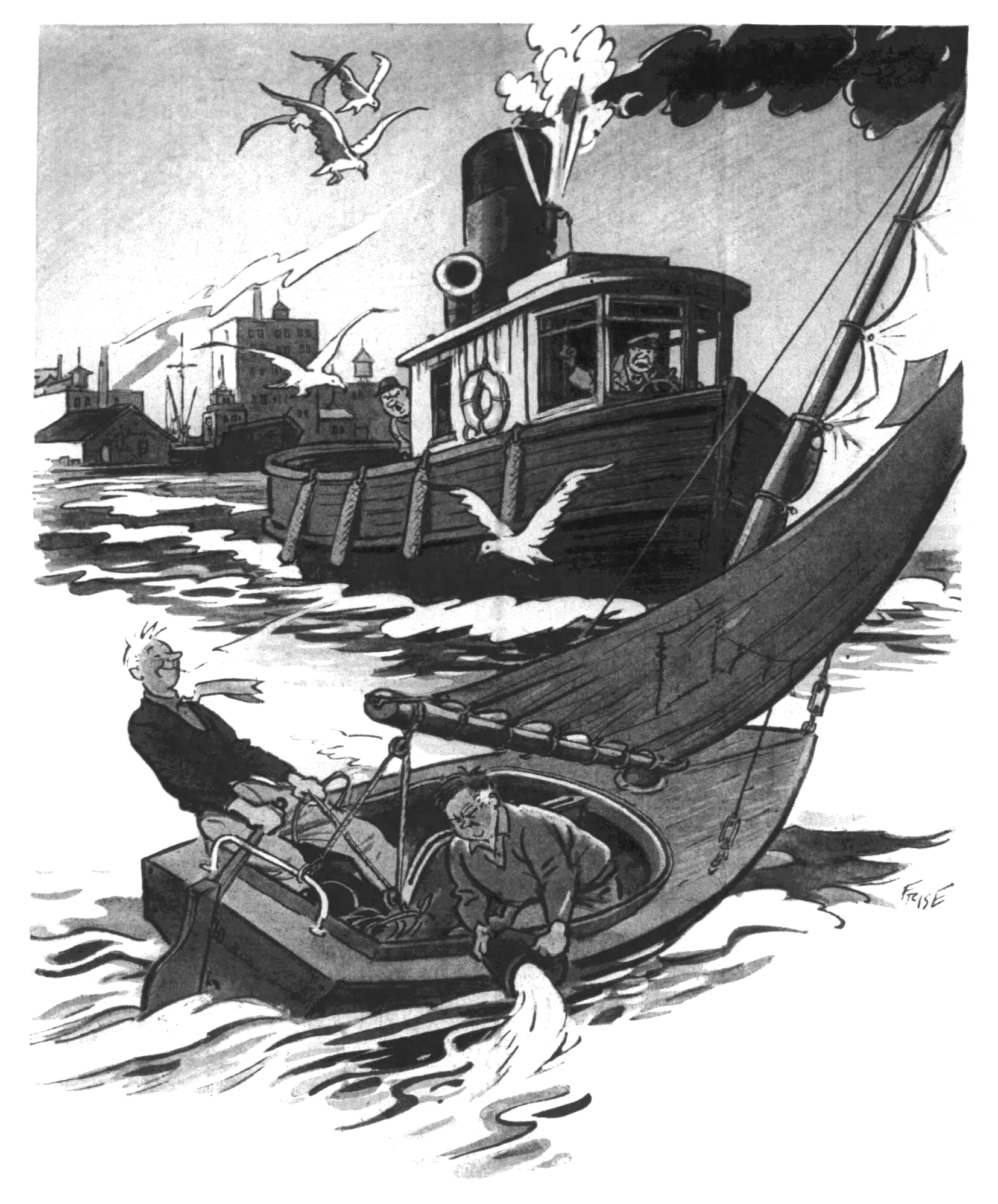
Suddenly a hoarse whistle roared almost in my ear, I straightened to behold a tug bearing square down on us.
“Jim!” I roared.
“Sail has the right of way over steam,” said Jim, with a confident and dreamy smile on his face. And he never even shifted muscle.
The tug, with another fierce toot, swerved slightly and passed behind us so close that the captain could have spit aboard us if he had had a spit ready. But he heaved a few big, loose cusses aboard us instead.
Shipwrecked
The swell from the tug came rushing high and crested straight for our stern.
“Jim, look out,” I shouted.
But Jim just leaned farther out and took another haul on the sheet. The big wave lifted us the way a lady lifts a rug to shake it. It gave us a shake and a snap.
The mast cracked, right across, like a stick of macaroni. The sail, with a calm slow bulge, folded quietly down on the heaving water. The dinghy, with Jim crouched beside me, remained flat.
Slowly the tug made a large circle and came back to us at quarter speed.
“What’s the big idea,” said the master hoarsely, “sailing an old hencoop like that around at this time of year? Don’t you know the frost ain’t out of spars yet?”
“Can you tow us?” demanded Jim coldly, a man of sail to a man of steam.
“To Hanlan’s Point, and no further,” said the master. “I’m tyin’ up there for the night.”
“Very good,” said Jim.
So they took us aboard and we hand-reefed the sail back aboard the dinghy and laid it, mast and all, inboard and Jim lashed her down.
“If she fills,” warned the tug master, “I don’t stop.”
“Go ahead,” said Jimmie.
And the tug, which was full of rumble and roar and power, leaped to life and surged and plunged across the bay to Hanlan’s Point, dragging the dinghy close behind, nose uplifted, in the churn and wake.
At Hanlan’s we paid the skipper $2 for his consideration and then found a local man who said we could haul our dinghy up on his lawn until we could make arrangements to sail her on the next leg of her journey westward. Then we took the last ferry home.
But there was a high gale of wind last night.
And I have hopes that when we go back tomorrow, the dinghy will have washed away.
A sailmaker’s palm is a specialized leather tool worn over the hand, featuring a metal thimble plate with divots to safely push thick sewing needles through canvas, leather, or heavy fabrics. ↩︎
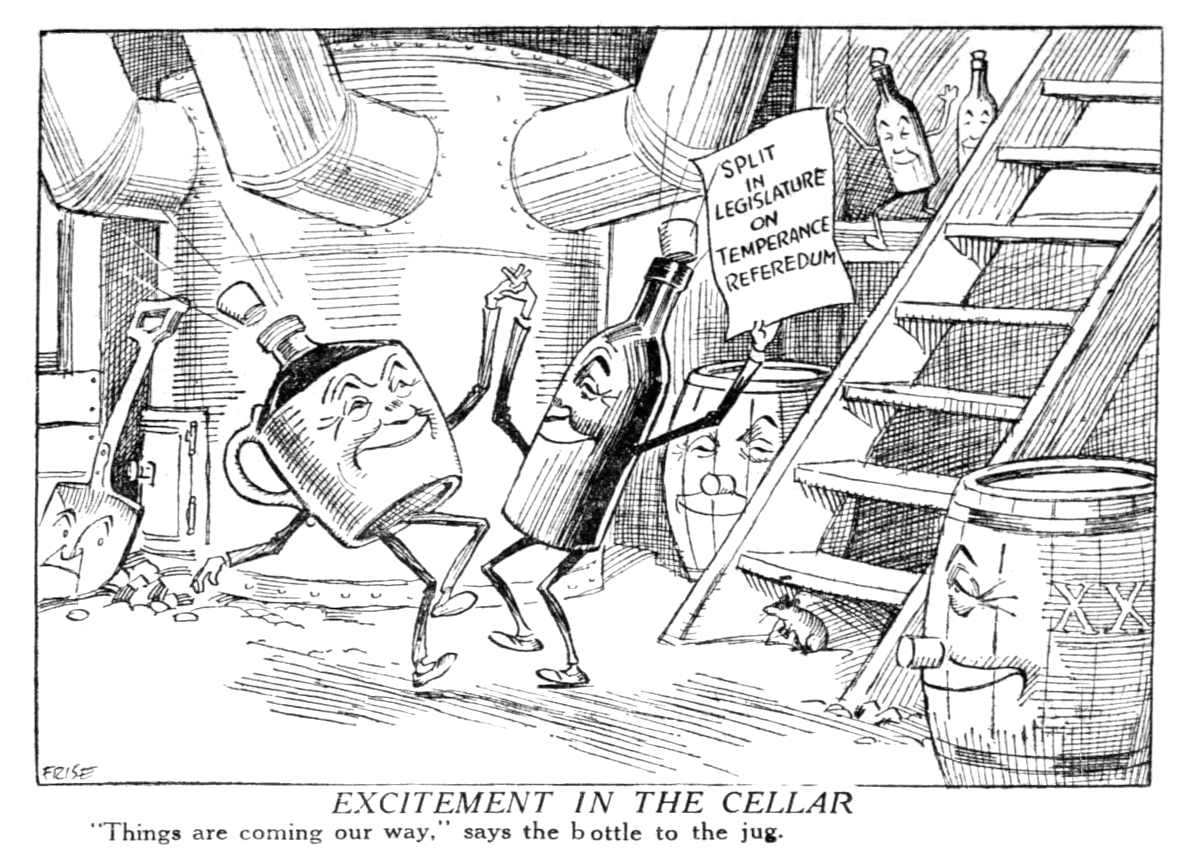
This political cartoon is about the Temperance referendum concerning a ban on the importation of alcoholic beverages into the province. It was supposed to be held in 1920, but was delayed until 1921 because of concerns about the voter list. This followed the 1919 Ontario prohibition referendum. Prohibition was a very contentious issue at the time, and the Toronto Star, where Jim worked, was editorially in favour of it. The stereotype was that men would keep their illegal booze in the cellar so as not to be seen drinking in public.
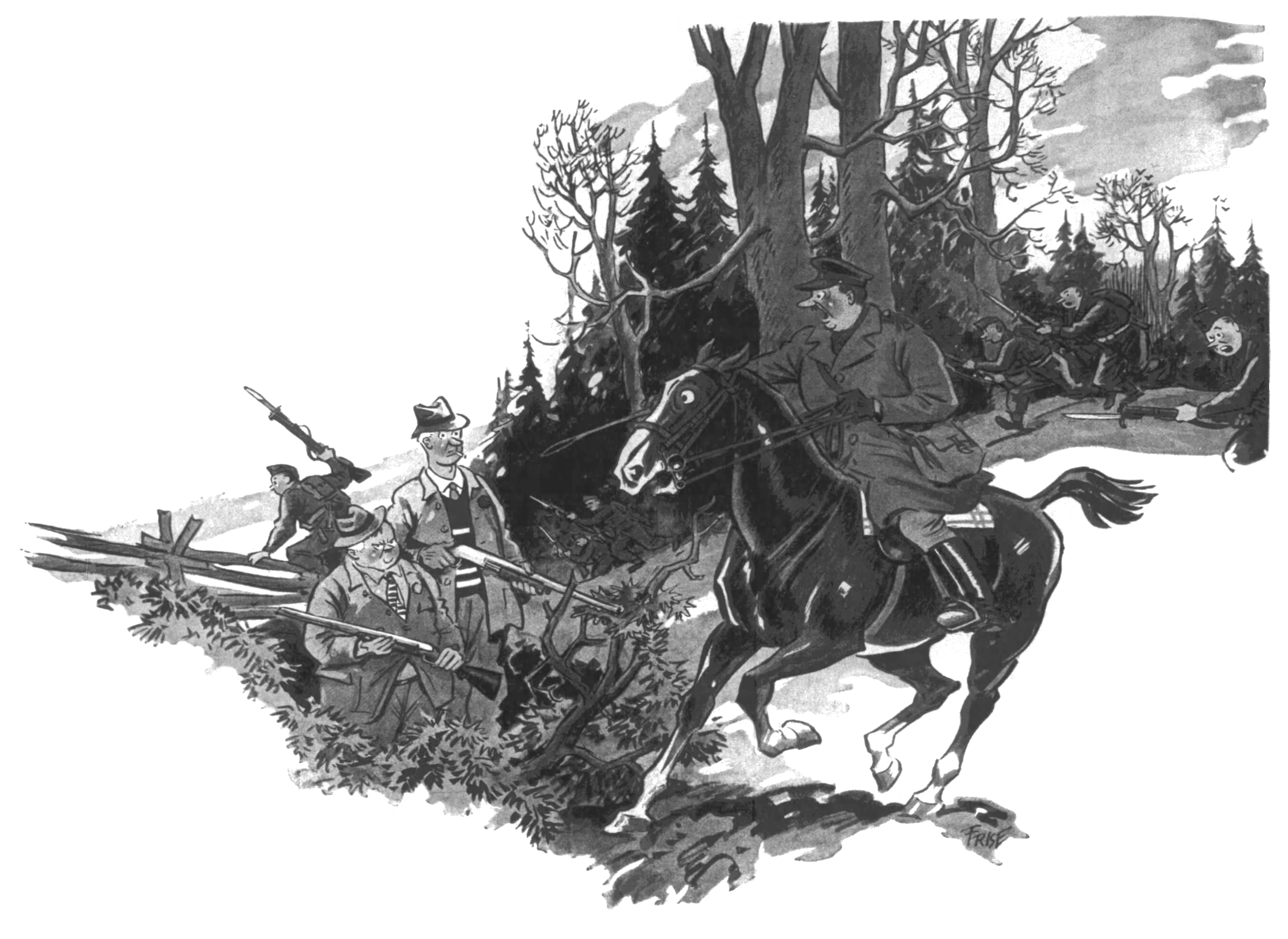
The major pointed his stick at us. “You!” he said. “You! You did it! It was you!”
By Gregory Clark, Illustrated by James Frise, April 13, 1940.
“The crows,” stated Jimmie Frise, “are nesting.”
“What of it?” I retorted dismally.
“I know a bush,” declared Jim, “where there will be seven or eight nests right now. That means 14 excited and noisy crows. Those 14, if disturbed, will set up a hue and cry that will attract 200 crows from the surrounding township.”
“So what?” I insisted.
“Let’s take an afternoon off,” said Jimmie, “and blast a few crows off the face of the map.”
“It isn’t crows we should be interested in blowing off the map,” I pointed out. “Jimmie, you should have better taste than to suggest crow shooting at a time like this.”
“It would cheer us up,” submitted Jim. “Here you sit, all day, all week, full of mental depression.”
“I am not depressed,” I informed him. “I am merely conforming to the nation-wide sense of the gravity of the times.”
“If everybody gets gloomy,” said Jim, “there is no telling what may happen to us. Gloomy people are always easily defeated. It’s the high heart that can’t be beat.”
“Do you think crow shooting would give me the high heart?” I scorned.
“I don’t care what you do,” informed Jim, “so long as you do something. Something usual, something normal. It is this sitting about glooming that is bad for all of us. The whole country.”
“The only war work I have done so far,” I said bitterly, “is hold wool while my wife winds it into balls.”
“The women are lucky,” sighed Jim. “In wartime the young ones can join organizations to work and drive cars and collect stuff and make stuff. And when they get old, they can still knit socks. There is no war age limit on women. A woman can sit quietly knitting, in her own home, putting patriotism and love and devotion into every stitch. She can sit there, in peace and quiet, making a pair of socks that she knows some day will be faring far over the bloody earth. She can feel she is in touch with the great reality. Who knows what man, what hero, will wear these very socks? Who can say what historic battle, what Waterloo or Thermopylae these very socks growing in her hands will one day share in? Even a very old lady, with knitting is needles in her hands, can feel in tunes with the ages.”
“Old soldiers never die,” I commented. “They just grouse away. We’re too old to enlist. Our collars are too white for us to make shells. And if we join any of these clubs for the entertainment of the troops and other patriotic purposes, we end up in a fight with the committee inside of a week.”
“Come crow shooting,” pleaded Jimmie. “Don’t you see? If there is nothing you can do, by way of helping, then at least take steps to keep cheerful. The worst thing those of us can do, who are unable to find any real war work, is to grow crabby and gloomy and sour. In the old war, don’t you remember, there was a slogan – ‘Business as usual’? There was another one – ‘Keep the home fires burning.” In that old war we all understood the importance of keeping cheerful and busy. The best way to give aid and comfort to the enemy is by being depressed and gloomy.”
“We should all go around shouting hurraw,” I sneered.
“Much better,” declared Jim, “than if we all went around groaning.”
“That is Sheer Hypocrisy”
“Who’s groaning?” I demanded.
“You don’t realize you’re groaning,” said Jim. “That’s the heck of it. The worst thing about people suffering from depression is that they don’t even hear their own groans.”
“Do you mean to say…” I gritted.
“Look,” said Jim. “This bush I speak of is only 15 miles from where we sit in this office. In it are, I bet you, seven or maybe 10 crows’ nests. Each nest has four or five eggs in it. That means, next summer, probably 60 or 70 crows set loose upon the harmless wild world. That means hundreds of baby songbirds killed in their nests by the parent crows to feed those black brats.”
“Blackshirts,” I hissed.
“Exactly,” said Jim, encouraged. “Crows are the cruel Nazis of the wild world. They go about the innocent world of the woods, silently, listening, peering, prying. They are killers. Nothing counts but them. They have no mercy, no heart. As far as they are concerned, the whole world could belong to the crows.”
“I once saw a crow struggling in a low bush,” I related. “When I got there and drove it off, I found it had pecked and killed the five nestlings of a beautiful rose-breasted grosbeak. One of the most colorful and one of the loveliest singing birds in the world.”
“Yet,” said Jim, “you decline to come crow shooting because you think it is unbecoming?”
“I wouldn’t want any of my sarcastic friends to find out I had been out amusing myself,” I assured, “while Rome burns.”
“Then,” cried Jimmie, “don’t go to amuse yourself. Go for some fine, honest purpose. Just sit down and think and think, for a little while. Convince yourself that some high, holy purpose is to be served by going crow shooting. You are going crow shooting in order to save the farmer’s crops. You are going crow shooting because, in time of war, all the young men who ordinarily keep the crows down are away, and somebody must do their job or else the country is going to be overrun and ruined by crows.”
“Jim,” I said, shocked, “that is sheer hypocrisy!”
“Hypocrisy?” retorted Jim. “Do you call it hypocrisy when a professional politician, whose real job is to keep in the limelight and get himself power, persuades himself that he should attack the government in wartime? My dear boy, it is human nature. Not hypocrisy. A man can persuade himself that the best course for him is the right course. All men do. All over the world, in every nation, in every village, in every lonely shack in prairie and forest, men are persuading themselves that the course they want to take or must take is the right course.”
“How horrible, Jim,” I protested.
“Please use your head,” pleaded Jim. “You know it is true as well as I do. Those men who happen to choose a course that is good are reputed to be good men. Those who happen to choose the bad course are said to be hypocrites. But no man knows, until it is too late, which is the good or the bad. Because if he did, the world would have been heaven 2,000 years ago.”
“We must struggle,” I cried, “against the evil course. That is the whole of morality.”
“Do you mean to say,” accused Jim, leaning forward, “that no good purpose would be served by shooting 20 crows?”
“Of course some good purpose would be served,” I agreed, “but would it be as good a purpose as refraining from idle amusements in a time of national peril?”
“Ah,” sighed Jim, “who are we to decide between the greater or the lesser good? When we see good to be done, however small, let us be up and doing.”
“You’ve got a queer kind of morality,” I declared.
“How’s yours?” retorted Jimmie.
When Sky Rains Crows
So of course we went crow shooting. There is a time of year, just about now, that belongs to the crows. If we were people of any imagination about our own much beloved land, we would long ago have adopted into everyday speech some phrase such as “crow time” or “crow fortnight” or something of the kind to indicate those few days in April when the woods and the moving skies are loud with crows. Crows pairing, nesting, mating, with all the tumult and the stealth that go with such activities. The road was very good out to this bush Jimmie had in mind. Even the sideroad was a good one, well beaten, as though much traffic had recently gone along it. We parked the car quietly at the corner of the bushlot.
“See,” said Jim in a low voice. “There’s two nests abuilding right within sight. And look at the country round about. A dozen large woodlots. All of them full of crows.”
We took our shotguns and boxes of No. 7½ shells and the crow-call and entered the bush very stealthily, so as not to advertise our purpose any more than necessary. Crows are wary beasts. Even as we walked, warning caws were sounding and suspicious birds were winging out over the dark fields, expressing their suspicions to the wide-flung world.
We hunted about until we found a little gully in the woods and there, amidst some bushes already standing, we built a hide with boughs and brush, cedar and pine to give it a thicketty and harmless air
Room for the two of us we built, so that back to back, Jim and I could scan the open space amidst the bare tree tops, where the crows would come crying and wheeling and darting madly in response to Jim’s crow-call.
Jim is an artist in two dimensions. He can cartoon mankind. But he can also cartoon a crow. He uses a little wooden tube with a horn-like vibrator in it. From this small instrument he can coax such sounds as drive a sentimental crow mad with excitement. He can imitate a young lady crow caught by the foot in barbwire. He can shout like a brave gentleman crow who has suddenly found a great horned owl in a cedar tree. He can emit the harsh wails and yelps of a baby crow. And even though all crows, both male and female, should know that no eggs are hatched yet, still the love-distracted creatures will respond to those anguished cries of a baby crow.
When you call crows, you do not shoot at the very first ones that come. The ones from your immediate surrounding woodlot are likely to arrive first. Jimmie always uses the loud excited “wolf, wolf” cry of the male crow to start with. This excited shouting sound means that a crow has found an owl. It brings the nearby crows in a few seconds. Silently they come, circling suspiciously but excitedly. They alight on tree tops unsteadily and, carried by their fears, soon join in the racket. This starts the crows in the adjoining woodlots to setting up the alarm, too. As they start for the scene of action, they let out the war-whoop. And that travels from woodlot to woodlot, far and wide across the township, until, if you are an artist with the call, you can have 100 or 200 crows all furiously heading for you. The sky will fairly rain crows. And then you start shooting.
The Bush Explodes
When we got our hide well and snugly built and our field of fire clearly defined, we set our shell boxes open and ready and crouched down and Jimmie started to call.
A sudden sharp caw. As though a startled crow had almost stepped on an owl hidden deep in a cedar tree.
Another sharp caw or two; and a startled, rattled cry, as though emitted by a crow leaping suddenly in flight. Then, a series of frenzied caws, as though the crow was perched on a nearby elm, almost falling off in his excitement.
Hardly had the first of these started before we heard the welcome sound of an answering caw at the far end of the woodlot we were in.
“Keep down,” hissed Jimmie.
From the distance we heard sudden series of caws, as other birds took up the alarm. Jim let go challenging barks on the crow-call and in the open space overhead a crow wheeled and landed all flustered on a tree top. It sat there only an instant before it began cawing madly, teetering on the bough.
Suddenly the whole woods and across the fields around became loud with crow-calls, as they shouted encouragement to the clever scout who had found the enemy. And presently, wheeling and diving excitedly all about us overhead, were a dozen, two dozen, crows.
Motionless in our blind, we crouched, while Jim continued his inciting tunes, more frantic every minute. And a regular din grew in the woods all about.
“Now,” hissed Jim.
We grasped our guns. We braced our backs against each other and rose. Bang. Bang. Bang. Bang. Our four shots, deliberate and aimed, smashed out in the noisy wood.
Silent as death, the startled crows vanished as though melted. All save two which fell to Jimmie’s gun. I am always too excited to get my first crows. I get a few later.
But hardly had the two toppled crows touched the earth before we heard an incredible sound. The whole woodlot was thrashing and crashing as though a herd of buffalo were loose. We stood petrified.
The bush exploded with a mortal smashing and banging. Shots rang out. Three, ten. Then 40, 70. And into our staggered view, in the little clearing in which we stood, 100 soldiers leaped, bayonets fixed, eyes glaring, faces flushed and triumphant, firing their rifles as they ran.
“You Bet You’ll Be Sorry”
Behind them another 100, all through the bush. The whole place seethed with soldiers, who charged in all directions, some passing us close by and not giving us even a sideways look. All leaping and chasing madly onward, as though the devil were after them or they were after the devil.
And while Jimmie and I stood dazed and unable even to speak to each other, there came at the tail end of this whirlwind of soldiers a major on a horse, plunging it furiously through the underbrush. He drove straight at us and reared his horse back and pointed his little stick speechlessly at us.
“You!” he strangled. “You! You did it! It was you!”
“Sir,” said Jimmie, “what is this…”
“You’ve ruined the manoeuvres,” roared the major. “Ruined them! The enemy has got us. We’re given away. They’ll surround us now. Oh, oh, oh.”
He whirled himself down out of the saddle and stood glaring speechlessly at us.
“But, sir,” I said. “We are a couple of innocent crow shooters…”
“Bah!” said the major, jerking his horse’s bridle in sheer rage.
“We’re extremely sorry,” said Jim.
“Sorry?” said the major. “You bet you’ll be sorry. My whole regiment wiped out. By a Western battalion at that. I’ll never hear the end of it.”
He stopped and stared at us shrewdly.
“Just a minute,” he said softly. “Maybe you’re members of that battalion, dressed up as civilians. How did you know four shots was the signal to advance?”
“We fired at crows,” I said.
“I’ll have my revenge,” said the major. “I’ll have you shot as spies. In civilian clothes. Firing the signal so my regiment would charge and give away our position to the enemy!”
Jim looked at me so bewildered I had to explain.
“It’s a sham battle, Jim,” I said. “Tactical manoeuvres. Two regiments out stalking each other. It’s quite all right. Don’t be alarmed.”
“You’ll hear about this,” gritted the major. “Stay right here, you two, until I come back. If I had any men left I’d put a guard on you. But don’t you leave here, at peril of your life. I want to get to the bottom of this.”
In the distance we could hear cheers.
“That’s the Westerners,” groaned the major. “They’ve surrounded the bush.”
He whirled up on his horse and dashed off into the thickets.
“Okay, let’s go, Jim,” I said, gathering my shell boxes.
“He said to wait,” protested Jim.
“We’ve got live ammunition, Jim,” I said pushing out of the blind. “They’ve only got blanks.”
So we crouched Indian fashion and got into our car and gave her the gas and went out the sideroad lickety split.
Suddenly something fluttered out from the planks. “A bat!” I shouted. “Where?” demanded Jim.
“If anything makes me sick,” declared Jimmie Frise, “it’s spring house-cleaning.”
“The law ought to be,” I agreed, “that spring house-cleaning had to be done on and not before May first. Then it would coincide with the opening of the trout season.”
“Perfect, perfect,” cried Jim. “Then the men could all go trout fishing for three or four days and leave the women to their frenzy.”
“Personally,” I submitted, “I can’t see the use of spring cleaning. It makes no difference. They’re always sweeping and dusting and using the vacuum anyway. They never rest. I think it is a kind of a spring disease in women, like trout fishing or gardening with men.”
“I wouldn’t doubt that at all,” said Jim. “They go kind of nuts, don’t they? They get all flushed and a wild look in their eyes?”
“It’s a form of spring fever,” I assured Jim. “Nature gives us all these deep instincts, like falling in love in June and feeling very industrious and saving in September, in order to keep us alive and going. This spring cleaning business probably dates away back to the cave man. I bet the caves were in a mess by the time spring came.”
“Old gnawed bones, and ashes and everything,” agreed Jim.
“So all the females of the cave man species,” I followed, “were suddenly filled with a furious fever of energy, and they got to work and held a kind of bone flinging and ash chucking orgy, to clean out the cave. It’s the same thing as in a wren, when she returns to the bird house in our gardens. She goes mad flinging out all the old sticks and debris of last year’s nests. If nature sends a lady wren nutty, there is no reason why it shouldn’t work with women.”
“Yet, the pity of it is,” said Jim, “that this fever isn’t necessary any more. Women keep homes clean all the year around, every day, sometimes twice a day. All this rumpus is sheer nuisance.”
“You can’t reason with them,” I warned.
“Naturally,” said Jim. “You can’t reason with a man in fever delirium. That’s what it is, spring delirium.”
“Do you think,” I asked, “we could talk it over with them and get them to put off until May first?”
“So we could go fishing until it’s over?” mused Jim.
“It’s a perfect arrangement,” I submitted.
“Yeah,” muttered Jim, “but there’s one little difficulty. My family has got me in a corner. They have it all arranged that I am to clean up the attic.”
“Do that in advance,” I cried. “Get it over with.”
“I might do that,” admitted Jim.
“It isn’t the work that upsets men,” I explained. “It’s the way the whole house is thrown into a wreck for nearly a week. That’s what gets a man’s goat. I don’t mind a little work.”
Antipathy To a Broom
“Would you help me with my attic?” inquired Jim.
“Why not?” I retorted. “What’s the trick about your attic?”
“Well, in a way,” said Jim, “the attic is mine, you see? All my stuff is up there. Guns, fishing tackle, decoys, work bench. I’ve got that old work bench up there. I’ve been tinkering at making decoys and things and there’s a lot of shavings and sawdust.”
“Aaaaah,” I said.
“That’s. why the women insist on me cleaning it up,” explained Jim. “I promised I’d clean it up last year. And the year before, I agreed to, and I did clean it up in a kind of a way. But they say it is my job and this year they’re kind of ganged up on me.”
“Of course, what you could do,” I offered, “is let it go to the bitter end and then one day you’ll come home and find they’ve done it in desperation.”
“They can’t,” said Jim. “I’ve got the key. I keep the attic locked ever since the days the kids were small. I didn’t want them going up and messing around my tackle and guns and stuff.”
“And you don’t want them messing around there now?” I added.
“Certainly not,” said Jim. “Even downstairs, where things are organized, I can never find anything I want after spring cleaning. It takes me about six weeks to get the house reorganized after spring cleaning. But if they ever got up into my attic, good heavens, I might never find anything again, ever,”
“I guess it’s up to you,” I sighed.
“I’m afraid it is,” said Jim. “The sawdust and shavings and things sometimes drift down through the cracks under the door. They are even saying that the sawdust is seeping through the ceilings. A man by rights ought to have a little cabin down at the foot of his yard, shouldn’t he?”
“After his kids start to grow up,” I agreed, “a man’s house is no longer his castle. It becomes only a sort of checker-board on which he plays a steadily losing game.”
“It was good of you offer to come and help me with the attic,” felt out Jim.
“Not at all,” I said, providing it’s not some night I can’t get away.”
“Oh, I’ll let you pick the night,” said Jim; which is a pretty low trick.
“I’m not particularly good at domestic work,” I submitted. “In fact, I have been told I am more a nuisance than a help.”
“Don’t you believe it,” cried Jim, heartily. “You’re a tidy little fellow. You can sweep while I shift the bigger stuff around.”
“Hm,” said I, neither positive nor negative; because there is some deep antipathy in my nature to a broom. Maybe some of my ancestors were stable boys.
To Clean Up the Attic
At any rate, Jim referred in a casual way to the cleaning of his attic from day to day, and finally, he tricked me.
“Did you hear about that short newsreel picture about bird dogs?” Jim inquired sweetly.
“No, where is it?” I asked.
“It’s at some theatre on Bloor St.,” said Jim. “I’ll look it up. It shows bird dogs pointing quail, and the gunners walking up to the point and flushing the birds and making lefts and rights. Boy, they say it is one of the most wonderful sport pictures ever produced.”
“Let’s go tonight,” I said promptly.
“Can you get off tonight?” asked Jim, pointedly.
“This is the first night I’ve got to myself in a week,” I assured him.
So Jim got up and pretended to hunt through the theatre ads for the picture and couldn’t find it. Then he telephoned one of the movie exchanges, and they said the picture wouldn’t be showing in the local theatres for another month.
“I must,” said Jim, innocently, “have seen the ad somewhere else. But say, look here, if you’re free tonight, how about coming over and giving me a hand with that attic of mine.”
“Er,” I said.
“Let’s get it over and done with. It’s only a month to the fishing season. You wouldn’t want me tied up with a lot of house-cleaning on May the first?” demanded Jim.
And since I couldn’t think of any graceful excuse, I was roped.
“It’s a perfect night for it,” continued Jim. “The family is all going to be out. We can have the house to ourselves. If we find any short cuts, we can use them, with nobody around.”
“Like chucking shavings, et cetera, out the attic window,” I instanced.
So waiting until around 8 o’clock to allow Jim’s family to leave the house and also to allow my supper to settle, I strolled around to Jim’s and he led me without delay upstairs and via the little stairway into the attic, which is just one big unfinished room, perfectly suited to a man’s needs.
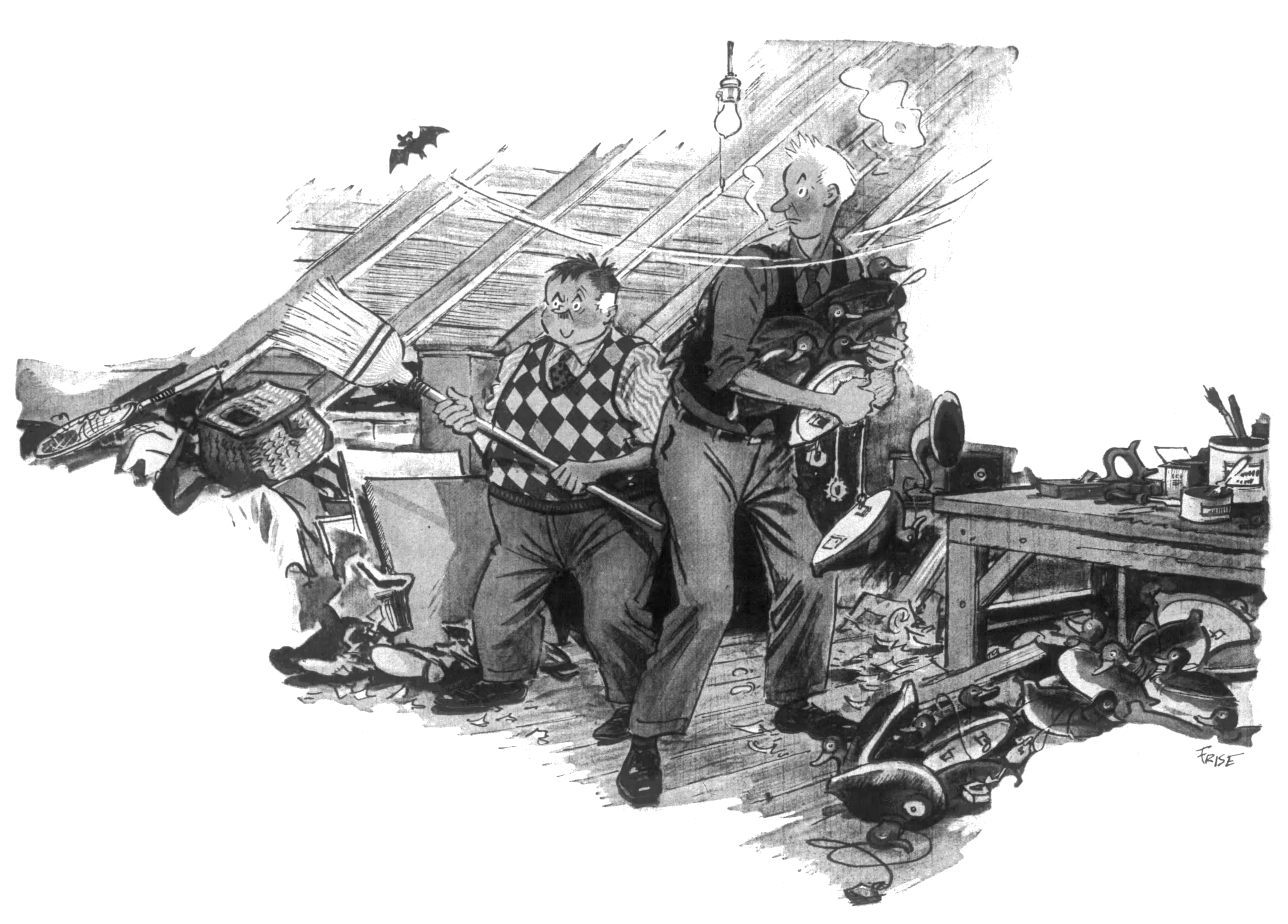
It was a mess. No wonder Jim kept the attic door locked and the key in his pocket. One corner was full of decoy ducks, like coal heaped in a coal bin. Another corner had an enormous heap of what appeared to be old magazines, hunting coats, rubber boots and fish baskets. In the midst stood a small carpenter’s work bench, and a foot deep all around it lay a drift of shavings, sawdust, hunks of wood, and all the ingredients of a fine life devoted to making things of no particular value or success.
“Well, Jimmie,” I said, “quite an evening’s work.”
“Now,” said Jim, very energetic. “I’ve got it figured out. I’ll start shifting everything to a new place, like, and you follow me with the broom.”
“If your wife,” I said, “ever saw this place.”
“I’ve been scared stiff this last few months,” admitted Jim. “Haunted, by day and by night.”
I peeled off my coat and hung it on a nail. Jim handed me the broom.
“I’ll start here, with these decoys,” suggested Jim. “I’ll shift them all over to that corner, and you sweep. Then when you catch up to me, I’ll shift the decoys and what will be under them to another corner, and so on. We’ll keep going around and around, see, until it is all cleaned up.”
“That’s the way the women do,” I admitted. “Shift everything around.”
So Jim started picking up big armfuls of decoys and carting them to the next corner, and to fill in the time, I started batting with the broom at the dusty rough, unfinished planking and rafters of the attic wall and ceiling.
Suddenly, in the garish light of the naked electric light bulb, something fluttered out from the planks.
“A bat,” I shouted.
Jim dropped an armful of ducks and peered into the already dusty glare of light.
“Where?” he demanded.
We stood perfectly still, and heard a small scratching sound.
“Here,” I said, swinging the broom.
The bat leaped heavily into space and wobbled sleepily around, narrowly missing our heads.
“Swing it,” roared Jim, snatching up a long piece of scantling that lay in the debris on the floor.
I swung. The bat ducked. I ducked; the bat swung.
“Look out,” shouted Jim, charging for the narrow stairway. “It’ll get downstairs.”
But he was too late. The bat, attracted perhaps by the warm current of air coming up the attic stairway, followed down, and we were just in time to see it wobble on half-wakened wings, into the glow of light at the foot of the attic stairs.
“After it,” commanded Jimmie, fiercely. “The women would go crazy if they saw that bat in the house.”
Riot and Confusion
Down the stairs we thundered, and commenced a cautious search, in room after room, listening, holding our breath, waiting to hear the faint scratching of the bat hiding behind some picture or mirror.
“Prod around,” said Jim.
So we prodded around, shoving at pictures on the wall, shifting dressers and keeping a wary eye.
“Turn on the bright lights,” I commanded, “blind the beast.”
Suddenly, soundlessly, the little bat came staggering and wobbling along the hallway ceiling and darted into the room.
Jim swung. The chandelier crashed terribly and splintered glass flew in all directions. The bat darted out.
“After it!” shouted Jim, colliding his hunk of scantling along walls and doors.
I heard another violent crash. Jim had swung at the bat in the front bedroom and swiped all the ornaments off the top of a chest of drawers.
“Downstairs,” cried Jim, leading the chase.
“Be careful,” I begged. “Don’t wreck the house.”
“Better wreck the house than have that bat, in it when the folks get home,” gasped Jimmie, crouched and searching like a gangster in a movie.
We found the bat after we had disarranged all the pictures in the living room and shifted all the furniture and upset everything on the buffet. It was up in the chandelier.
“Poke with your broom,” whispered Jim. “Poke it out towards me.”
Jim poised like a baseball player, gripping the scantling mightily.
I poked with the broom at the poor little beastie. fluttered out towards Jim.
Jim swung. The chandelier swayed madly, tinkled into a thousand splinters of glass and then, slowly losing its wiry grip of the ceiling, came down with about a square foot of plaster.
“I missed,” moaned Jim.
“Like heck you did,” I said, from my shelter under the dining-room table.
The house was full of dust, riot and confusion.
“Where did it go?” I begged.
“I saw it go upstairs again,” said Jim wearily.
So we followed. After 10 minutes, we found under the bathtub. It eluded us again, and to our joy, it turned up the attic stairs again.
“Good,” said Jim. “Now we’ve got it on our own territory.”
So we went after it, and got into Jim’s private attic just in time to see the bewildered little creature alight flat against the rough beams of the ceiling and tuck itself cleverly and quickly in behind some great two-inch stringers of the roof.
“Aaaaah,” sighed Jim. “Leave him there. Leave him right there, still in his winter sleep, the little devil, and some nice spring evening, I’ll open the window and let him fly out.”
“It’s best to leave a bat alone,” I agreed. “Just let him fly away.”
“He sure has wasted the evening,” said Jim.
“We’d better quit this job,” I offered, “and go down and straighten things up the best way we can before the folks get back.”
So we turned the light off, carefully locked the door, went down and telephoned the drug store for a couple of dozen new light bulbs, and straightened all the pictures and dusted everything, and did the best we could with the fallen chandelier.
“There’ll be the dickens to pay,” I said, after we had worked for an hour and still everything looked disturbed, somehow.
“It’ll give them a taste,” said Jim, “of what we men have to suffer when they’re spring cleaning.”